A kick scooter is listed as “36V,” while its charging specification says “42V.” A buyer may assume that one of those numbers is wrong and request a charger with exactly 36V output. That request can turn a normal battery designation into the wrong purchasing specification.
Direct answer: A kick scooter’s 36V designation normally refers to its battery’s nominal voltage, not the charger’s output setting. A 10-series Li-ion pack using cells specified at 3.6V nominal and 4.2V charge voltage gives a 36V nominal, 42V charging example. Confirm the actual pack specification: 42V is not a universal setting for every battery sold as 36V.
This guide is for vehicle brands, battery suppliers, importers and distributors specifying chargers for standing electric kick scooters. It explains how to read the voltage fields, resolve apparently conflicting labels and keep an approved charger configuration clear through purchasing and service supply.
Separate the battery designation from the charger output
The number in a scooter catalogue usually identifies a battery voltage class. The electrical output section of a charger specification describes a different part of the system. A charger sold “for 36V batteries” can therefore have a maximum output above 36V without a contradiction.
Start by identifying which document each number comes from. Is it the scooter’s sales page, the battery’s nominal-voltage field, the pack’s maximum charging voltage, or the charger’s DC output? Keep AC input in its own column: the mains supply voltage is not the voltage supplied to the scooter battery.
| Official example | Battery voltage | Charger information | Purchasing implication |
|---|---|---|---|
| Mi Electric Scooter 3 | 36V rated; 42V maximum charging voltage | 42V maximum output | “36V scooter” does not mean a charger limited to 36V output. |
| Ninebot KickScooter F2, model 051201U | 36V nominal; 42V maximum charging voltage | 41V, 1.7A rated output; 42V maximum output | Keep the rated and maximum fields separate when reviewing a proposal. |
These values come from Xiaomi’s Mi Electric Scooter 3 specifications and Segway’s F2 specifications. They illustrate terminology, not approval of an aftermarket replacement or evidence of a Linjia supply relationship.
For an OEM sourcing discussion, start with our 36V lithium battery charger options, then provide the pack’s actual charging requirements. A product category name alone cannot settle the output configuration.
Why a 10S Li-ion pack can be 36V nominal and charge to 42V
In battery notation, “10S” means ten cell groups connected in series. For a defined cell type, the series count links the cell-level voltage specification to the pack-level value. The nominal value and the charge-voltage limit are calculated from different cell fields.
Uses the cell’s nominal voltage.
Uses the specified cell charge voltage.
Condition: The calculation applies to a 10S design using cells with those voltage specifications. The Molicel INR-18650A datasheet, for example, lists 3.6V nominal and 4.2V charge voltage. This is a cell-level illustration; it does not identify the cells inside either scooter above or establish the approved target for another pack.
Do not reverse the calculation from “36V” alone and assume the pack must be 10S. Obtain its chemistry, series configuration and battery-maker-approved charging target. LiFePO4 and lead-acid systems require their own review, and the pack owner may specify a normal charge target below a cell’s listed charge limit. Our full-charge voltage guide covers the broader distinction across battery systems.
Why a charger document may show both 41V and 42V
The F2 example is useful because the same official specification lists 41V, 1.7A as rated output and 42V as maximum output. Copying only one field into a spreadsheet removes information that the original document preserves.
The published table does not explain every test condition behind that distinction. Do not invent a reason, treat 41V as a fault, or assume that the two fields are interchangeable. Ask the charger supplier for the voltage/current profile, output tolerance and the conditions under which each value applies. Match those answers to the approved battery charging specification.
Use the following reading order when labels appear to disagree:
- Identify the exact model and revision. Similar product names can cover different batteries or chargers.
- Copy the complete output section. Preserve rated output, maximum output and current, including units and qualifications.
- Compare with the battery charging document. A dealer description is not a substitute for the pack’s charging limits.
- Resolve the difference in writing. Obtain the supplier’s explanation and agreed acceptance values before approving the order.
A no-load meter reading is another measurement condition, not a replacement for those documents. Some charger designs need an enable or communication condition before delivering normal output. Electrical verification belongs with qualified personnel using the specified procedure; buyers do not need to probe live connectors to complete the initial specification review.
Does a “42V charger” deliver 42V throughout charging?
Not necessarily. In the conventional constant-current/constant-voltage charging method used for the cell example above, voltage rises during the current-controlled stage. At the voltage-controlled stage, charging current tapers. The charger’s voltage ceiling is therefore different from a claim that every point in the charging cycle has that same output voltage.
The battery system determines the permitted current, voltage target and completion conditions. Do not reuse a cell datasheet’s current or termination value as a complete scooter-pack specification. Parallel configuration, the BMS and the pack manufacturer’s requirements all remain relevant.
A supply capped at exactly 36V would not bring a pack specified for a 42V charge target to that target. Depending on the system, the result could be incomplete charging or failure to start normally. Replacing it with an arbitrary higher-voltage charger is also inappropriate: obtain the approved charger specification and resolve the mismatch first.
What a matching 42V number still cannot confirm
Once the voltage fields are understood, keep the remaining compatibility review specific. Two chargers marked 42V can differ in current, voltage tolerance, termination behaviour, polarity and control interface. A larger current rating is not automatic permission to charge a scooter faster.
For importers managing service stock, the connector needs an exact identity. Check the mating part, contact assignment, polarity and any identification, temperature or communication contacts. A plug that fits mechanically can still be wrong electrically. Use our connector pin-definition guide for the interface record and our battery capacity and BMS charging-current guide for the current review.

Keep the charger’s operating location and AC input in the specification as well. Cable reach, ventilation, charging-port clearance and the destination supply can differ between projects. A common output voltage does not settle these installation and use conditions.
Write a purchase specification that cannot be mistaken for 36V output
A request saying only “36V kick scooter charger” leaves the supplier to interpret whether 36V names the battery or the required output. Separate those fields in the RFQ, sample sheet and purchase order.
Illustrative wording: “For the identified 36V nominal Li-ion battery pack, confirmed as 10S. Required charging-voltage target: 42V DC, subject to the battery supplier’s written approval. Charger current, voltage tolerance, profile, termination, BMS interface and connector drawing: as specified in the attached approved documents.”
This wording illustrates field separation. It is not a specification for an unidentified scooter, and the unresolved fields must be completed before production approval.
Include these seven items in the buyer brief:
- Platform identity: scooter model, battery part number, supplier and revision.
- Battery definition: chemistry, series count, capacity and nominal voltage.
- Charging requirements: approved voltage target and tolerance, current and completion conditions.
- Control requirements: BMS limits and any enable or communication specification.
- Connection: mating sample or drawing, pin assignment, polarity, cable length and vehicle-port details.
- Market and use: AC input range, frequency, regional plug and permitted operating environment.
- Order controls: quantities, charger part number, label artwork, packaging and sample approval reference.
For a wider project brief, use the battery charger selection guide. Here, the essential purchasing control is simple: put “battery nominal voltage” and “charger output specification” in different fields.
Validate the approved version before releasing bulk and spare stock
For sample evaluation, provide the identified battery and the charging path that will be supplied with the scooter. Agree how the technical teams will verify charging start, voltage/current behaviour, completion and relevant controls. A test using a different pack or bypassing the vehicle harness does not establish the intended configuration.
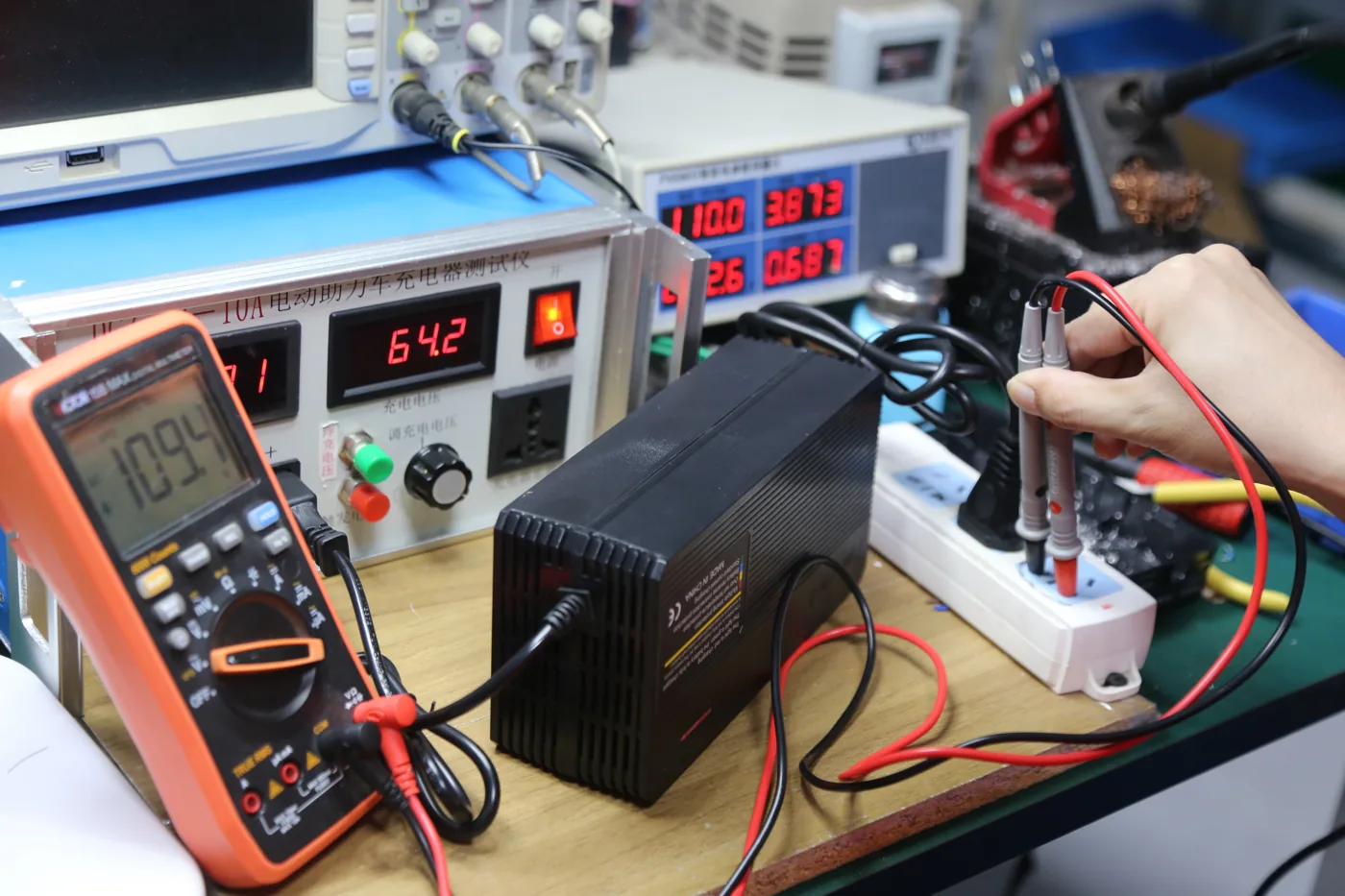
Linjia’s charger quality-control process includes electrical checks, dielectric withstand and insulation testing, and full-load burn-in. Those production checks verify an agreed charger specification; battery compatibility still needs the platform-specific approval described above.
After approval, keep the electrical specification, label artwork and charger part number tied to the same revision. A service bin labelled only “36V” loses the distinction this guide explains. Record which scooter and battery revisions each spare charger is approved to support, and review that record when the battery or interface changes.
Frequently asked questions
Is a 42V charger label automatically wrong for a 36V scooter?
No. It can be appropriate for a battery with an approved 42V charging target. The scooter’s nominal designation and the charger’s output describe different things. Verify the complete configuration before approving a replacement.
Can a 36V LiFePO4 or lead-acid battery use the same charger?
Do not assume so. The nominal label does not establish chemistry, charging profile or end-of-charge target. Obtain the charging specification for that particular battery system.
Can we approve a charger from a green indicator light?
No. An indicator reports the state defined by that charger’s design. It does not independently verify the battery’s state of charge, the correct voltage profile or platform compatibility.
Should a revised charger label say 36V or 42V?
Have the responsible team approve wording that clearly distinguishes the intended battery class from the actual electrical output fields. Preserve the model, current and any rated/maximum distinction, and check the requirements for the destination market.
Specify your kick scooter charger from the battery data
Send Linjia Power your battery and existing charger labels, battery datasheet, scooter model, interface photographs and expected quantities. Include the approved charge-voltage target and BMS requirements where available. For OEM or ODM supply, we can review those inputs and the proposed charger configuration before sample development.