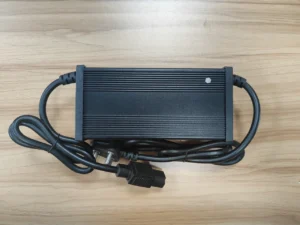
Full-load burn-in supports charger quality control by operating a charger under a defined load for a controlled period, giving the factory an opportunity to identify early operating abnormalities before release. It adds an operating-time dimension to electrical checks. Its value depends on the actual load, input, cooling conditions, monitoring and acceptance criteria. A charger that completes burn-in still needs the correct battery specification, applicable safety-related checks and final order verification.
What Does Full-Load Burn-in Mean for a Battery Charger?
Burn-in, sometimes called aging, is a controlled operating step in manufacturing. For a charger, “full load” must refer to the approved operating point and test procedure for that particular configuration. Switching on the AC supply or seeing an illuminated indicator does not establish how much output the charger is delivering.
A useful test description identifies the charger model and revision, the output load and how it is maintained, the AC input, the duration and the conditions around the unit. The battery’s nominal voltage alone cannot define that test. Charging voltage, current and charging-stage behaviour also matter.
For an OEM buyer, the practical question is whether the supplier can explain what each charger was required to do during the test and how an abnormal result would be recognized. See Linjia’s battery charger quality-control process for the wider sequence of production checks.
How Burn-in Complements Electrical and Insulation Checks
These checks answer different questions. Treating any one of them as a substitute for the others leaves part of the quality assessment unanswered.
| Check | Main question | Evidence a buyer should request |
|---|---|---|
| Electrical performance testing | Does the charger meet the specified electrical functions and limits at the tested conditions? | The applicable test items, settings and results for the approved model. |
| Dielectric withstand and applicable insulation checks | Does the product meet the defined insulation-related acceptance criteria? | The relevant procedure, test settings and recorded disposition. |
| Full-load burn-in | Does the unit continue operating acceptably during the defined loaded run? | Load conditions, operating period, observations and completion status. |
Linjia’s documented production flow includes electrical performance testing, dielectric withstand testing and full-load burn-in before final release. Burn-in is a supplementary step within that flow. The applicable settings and acceptance limits remain specific to the product and project.
What Can Loaded Operation Help Reveal?
Some abnormalities appear when a unit starts; others may emerge after it has operated under load. During a defined run, relevant observations can include an unexpected interruption, unstable output, abnormal heating or cooling behaviour, or a change in operating status. Whether a particular condition is detected depends on the procedure and monitoring used.
A short electrical check and a sustained loaded run therefore provide different views of the same charger. Neither observation, by itself, identifies the root cause of an abnormal result. A component, connection, assembly detail or test fixture may require investigation before the unit can be assessed again.
Buyers should ask what is monitored and what triggers a hold or failure. A statement such as “aging completed” is difficult to interpret without that context.
Which Conditions Make a Burn-in Record Useful?
Use this table when reviewing a sample plan or discussing a production order. It is a request checklist, rather than a statement that every factory uses the same settings or records.
| Confirm | Ask the supplier | Why it changes the interpretation |
|---|---|---|
| Product configuration | Which model, electrical rating and revision does the record cover? | A result for another version does not establish the status of your order. |
| Actual output load | What output operating point is required, and how is loading verified? | Connected power and indicator lights do not demonstrate full output load. |
| AC input | Which input condition is applied? | The stated input is part of the test scope. |
| Duration | What operating period is specified, and how is completion identified? | Elapsed time needs a defined start, finish and acceptance basis. |
| Cooling and surroundings | What housing, ventilation, spacing and ambient conditions apply? | The setup affects how an operating result should be understood. |
| Monitoring and abnormal results | What is observed, what is unacceptable, and how are affected units held? | Detection needs a clear route to investigation and disposition. |
| Release evidence | How does the completed run connect to the batch and final checks? | It should be possible to distinguish completed, pending and reworked units. |
Agree these points before using burn-in as a purchasing requirement. Do not copy an unverified duration, temperature or pass-rate claim from a general article into your product specification.
Where It Fits in Linjia’s Manufacturing Workflow
Linjia combines electronics production and assembly with electrical testing, insulation-related checks, full-load burn-in and final verification. The battery charger manufacturing process explains how those stages connect.
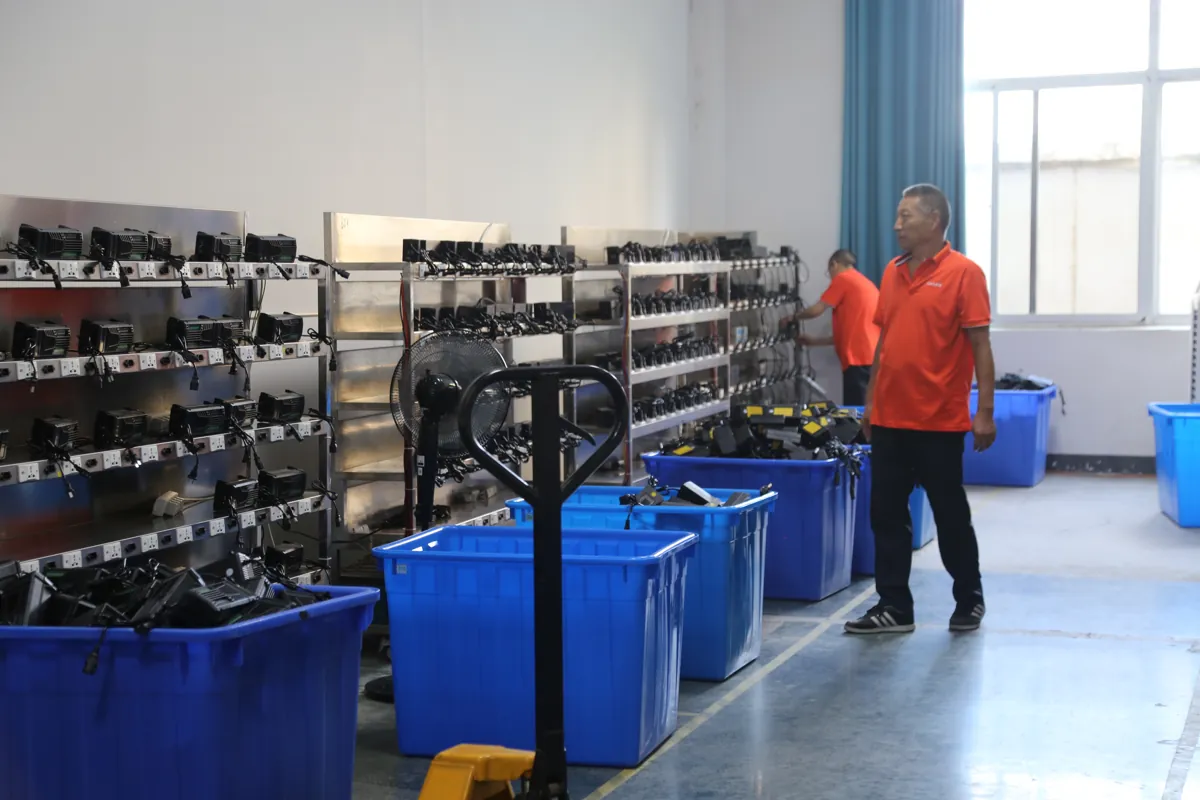
Our manufacturing view: the useful question is how the loaded run connects to the configuration being shipped. A well-run screening step cannot correct a wrong charging profile, connector or polarity. The test plan and final order checks must refer to the same approved product.
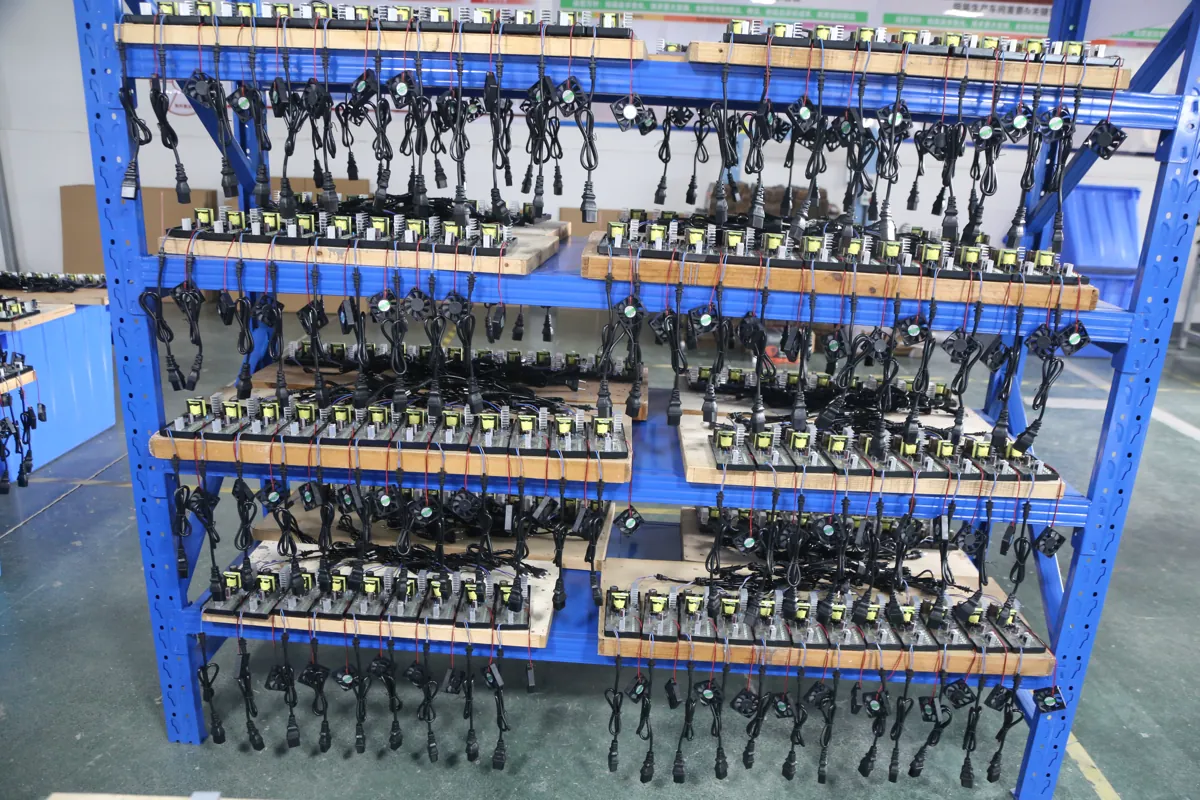
Product stage also matters when assessing factory evidence. A rack of exposed PCB assemblies and a rack of enclosed chargers show different stages of production. Ask which stage a photograph or record represents before treating it as evidence for the completed charger.
For the connection between an approved sample and repeat production, read why charger consistency matters from sample approval to mass production.
What Burn-in Cannot Establish on Its Own
Completing a defined burn-in run does not prove compatibility with every battery chemistry, full-charge voltage, BMS or connector. It also does not establish a fixed service life or guarantee that a unit will never fail in use.
Application-specific conditions still need their own review. Humidity, vibration, unusual ambient heat and local AC input requirements should be discussed during development. An ordinary rack photograph cannot demonstrate that those conditions were tested.
Keep production screening, product validation and market-specific compliance requirements distinct in the project plan. For a broader supplier review, use the battery charger factory audit checklist.
Buyer Checklist Before Approving the Test Plan
- Match the plan to the approved charger specification and sample revision.
- Confirm the load, input, operating period, cooling conditions and acceptance criteria.
- Ask how abnormalities, interrupted runs, repairs and required repeat checks are handled.
- Confirm how the run’s completion status connects to final electrical, configuration and packing checks.
Frequently Asked Questions
Is a longer burn-in always better?
Duration needs an engineering basis together with the selected load and conditions. Comparing hours alone is not a useful way to rank two suppliers. Request the reason for the chosen procedure and the evidence that it covers the intended production-screening task.
Can a load test replace testing with the actual battery system?
A controlled load can support the defined production test, but it does not by itself confirm the complete charging interaction with your battery and BMS. Battery matching and the applicable charging behaviour should be evaluated during sample approval.
What should happen if a unit is repaired after burn-in?
Ask the supplier to identify the repair, the required repeat checks and who authorizes release. Do not assume that an earlier pass remains sufficient after a change. The appropriate reinspection depends on the repair and the approved quality procedure.
Request a Charger Test Plan for Your Project
For an OEM or ODM order, share the battery chemistry, nominal and full-charge voltage, capacity, target current, BMS limits, connector and polarity, AC input, application environment and expected quantity. Linjia can review the configuration through its custom charger development process.
Review the testing scope before production. Ask for the relevant manufacturing flow, model-specific test plan and sample-approval process.
Further technical reading: TDK-Lambda, Why power supply evaluation reports are useful (June 9, 2015).