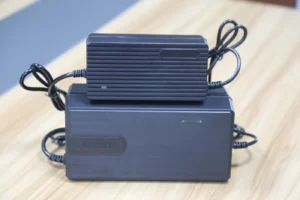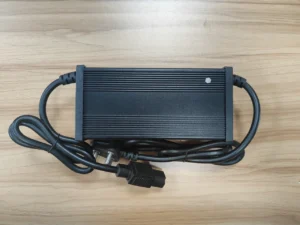
Before ordering a custom charger, confirm seven specification groups: battery chemistry and charging profile; output voltage; charging current and BMS limits; the output connector and cable; AC input and plug; installation and environment; and the final OEM configuration with acceptance requirements. Record the agreed values, supporting documents and open questions in one specification sheet. A request such as “same voltage, higher current, our logo” is useful for starting a conversation, but it does not yet define a charger that can be quoted, sampled and ordered without assumptions.
This guide is for vehicle manufacturers, battery brands, importers, distributors and equipment makers preparing a custom order. Its purpose is to turn an initial request into a specification both the buyer and manufacturer can check. The seven groups below organize the information needed for that handover; individual projects may require additional details.
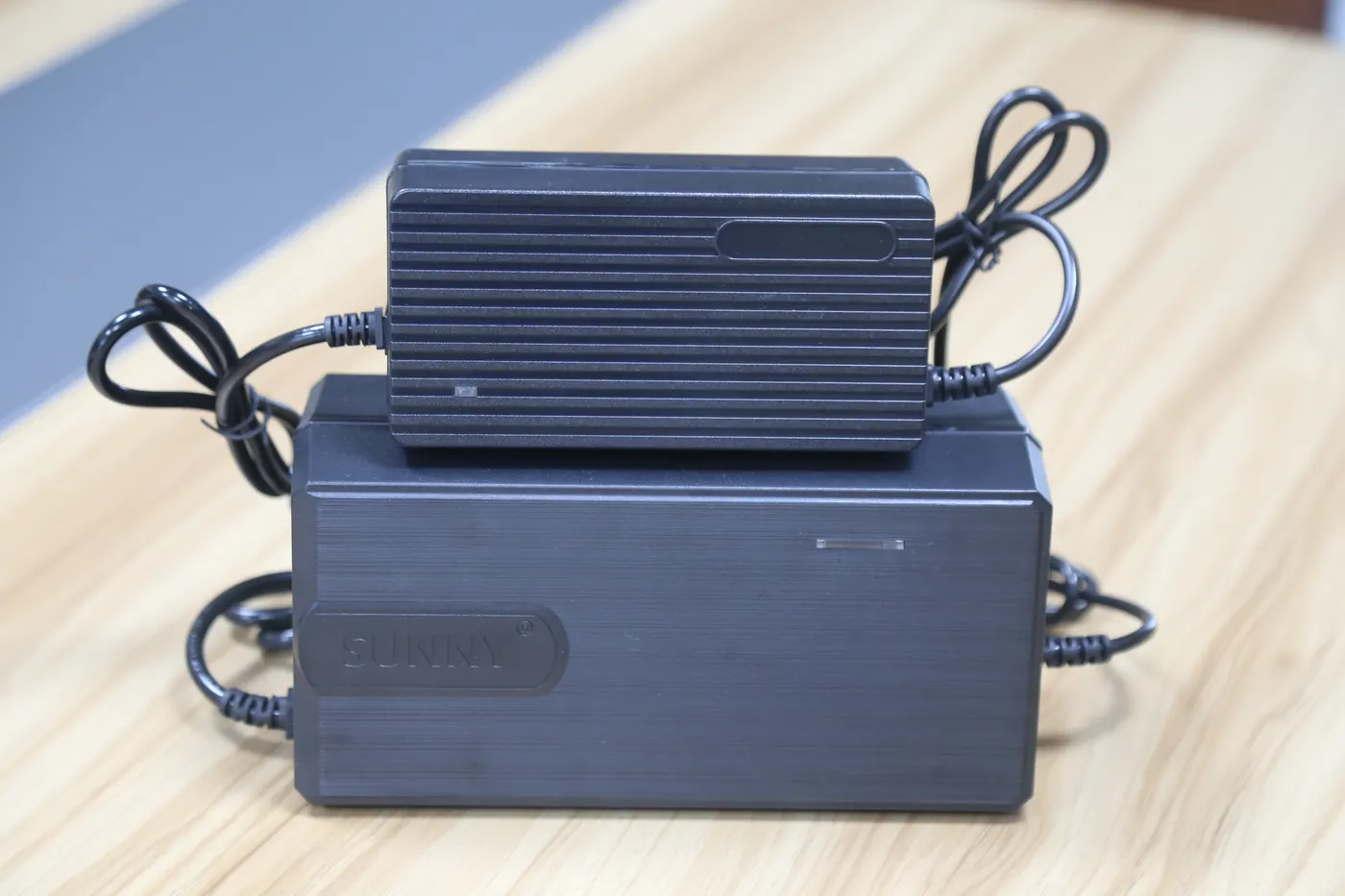
Custom charger specifications: who confirms what?
Use this table to assign responsibility before requesting a firm quotation. The battery supplier defines the battery’s permitted charging conditions. The charger manufacturer evaluates the proposed charger configuration. The buyer brings the battery, installation and destination-market requirements together.
| Specification group | Evidence to provide | Confirmation needed |
|---|---|---|
| 1. Battery and charging profile | Battery datasheet, chemistry, pack configuration and required charging sequence | Battery supplier confirms the charging requirements; charger manufacturer reviews the matching profile. |
| 2. Output voltage | Nominal voltage, exact charging targets and any stage-specific settings | Agree the setpoints, tolerances and measurement conditions. |
| 3. Current and BMS | Capacity, permitted continuous charge current, BMS charge limits and control requirements | Resolve current, temperature and communication constraints together. |
| 4. Connector and cable | Mating-part identification, pin drawing, polarity and cable requirements | Approve the complete cable assembly, including the drawing’s viewing direction. |
| 5. AC input and plug | Destination, operating input range, frequency and plug specification | Confirm the proposed input platform and mains lead, rather than the plug shape alone. |
| 6. Installation and environment | Mounting space, ventilation, ambient conditions, exposure and duty cycle | Define the conditions for evaluating output, cooling and enclosure suitability. |
| 7. OEM configuration and acceptance | Variant list, housing requirements, label artwork, packing details and acceptance scope | Identify exactly which configuration and documents the order will reference. |
1. Confirm the battery chemistry and approved charging profile
Write down the actual battery type, not only a general description such as “lithium” or “lead-acid.” Where relevant, identify the lead-acid construction, such as GEL or AGM, or the lithium chemistry and series configuration. Attach the battery supplier’s current charging specification and identify its revision.
The document should describe the required charging sequence: voltage stages, current control, stage transitions, termination, maintenance charging and restart behavior, wherever applicable. Temperature-related conditions also belong in this discussion. Do not assume that a maintenance or float stage used for one battery should be copied to another.
What to confirm in writing: the battery model and document revision, together with the charging profile the proposed charger must follow. If the battery maker has not supplied a required setting, mark it as open rather than borrowing a value from a similar-looking charger.
Texas Instruments’ battery charger design resources identify chemistry-dependent charging profiles, status communication and protection functions as separate design considerations. These are design inputs, not evidence that a particular Linjia model includes every function.
2. Specify the output voltage and its acceptance conditions
Separate the battery’s nominal voltage from the charger’s actual charging targets. If the charging program has several voltage stages, identify the applicable setting for each stage rather than putting one unexplained number on the order.
Also agree how the proposed output will be checked. The specification should state the relevant load or battery condition, the point of measurement, the fitted output cable and the permitted tolerance. A reading taken without knowing the charger’s operating state is a weak basis for accepting or rejecting a unit.
What to confirm in writing: a voltage-setting table tied to the battery requirements and an agreed evaluation method. Our full-charge voltage guide explains the underlying voltage terms; this order sheet should contain the actual project values.
3. Agree charging current, BMS limits and control behavior
Collect the battery capacity, the battery supplier’s recommended and maximum continuous charging current, and the BMS charging limits. Check that a figure copied from a BMS document is a charge-current rating rather than a discharge-current rating. Record the temperature conditions attached to those limits.
If faster turnaround is the objective, describe the charging window and how it will be evaluated. Starting state of charge, ending condition, battery temperature and any equipment load during charging can affect the result. A desired charging time is a requirement to review, not an automatic performance promise.
Where the battery needs communication, an enable signal, an interlock or a wake-up sequence, provide the relevant interface document. State what should happen at connection, during a protection event and after the condition clears. A connector with extra pins does not establish which signals are present.
What to confirm in writing: the proposed continuous charging current, applicable limits and any required control sequence. Communication functions remain subject to project evaluation; they should not be inferred from a housing or connector photograph.
4. Approve the complete output connector and cable assembly
A photograph helps identify an interface, but a production order needs a more precise definition. Provide the connector manufacturer and part number where available, the mating part, contact arrangement, pin assignments, polarity, cable length and routing constraints.
Make the drawing’s viewing direction explicit. A mating-face view and a wire-entry view can appear reversed. Numbered pins, a stated viewing direction and identification of both mating parts reduce ambiguity when the cable assembly is checked. See why connector pin definition matters in OEM charger projects for the contact-by-contact approval record.
Discuss conductor requirements, strain relief, locking and any auxiliary conductors as part of the same assembly. Do not leave a cable-length change until packing approval: it can affect installation and the conditions under which the electrical output is assessed.
What to confirm in writing: a cable-assembly drawing or equivalent controlled specification, supported by a mating sample when identification remains uncertain. The responsible technical teams should verify polarity; wire color alone is not the approval record.

Specify fault behavior separately from the connection assignment. Our guide to reversed polarity in charger projects explains protection boundaries, incident response and the evidence to request before releasing a charger configuration.
5. Define the AC input envelope and destination-market plug
List the destination country, required AC operating range, frequency, plug type and input-cable requirements. Distinguish a nominal local mains value from the range the charger is expected to accept. If field voltage variation is part of the requirement, describe it using reliable site information.
A different plug does not by itself turn an existing input design into a wide-input charger. In his interview on wide-voltage charger development, Linjia founder Sunny explains that a broader input range involves circuit and component decisions, with cost consequences. Buyers should therefore disclose this requirement while the platform is being evaluated.
What to confirm in writing: the input range the quoted configuration is designed for, the mains lead and plug, and the input conditions included in sample evaluation. Do not substitute “export version” for an actual input specification.
6. Describe installation, cooling and the operating environment
Tell the manufacturer where the charger will sit and how it will be used. A portable charger in a ventilated room, a unit carried on a vehicle and a charger installed inside equipment can impose different mechanical and thermal requirements.
Provide mounting orientation, available space, ventilation clearance, ambient-temperature expectations, daily charging schedule and exposure to dust, moisture, vibration or handling. Distinguish operation from storage and transport conditions when those requirements differ.
Ask whether the proposed output is available throughout the requested operating conditions or whether a defined reduction in output is needed. If potting, fan cooling or an enclosure change is proposed, assess it against the actual application. Potting alone does not establish a waterproof rating for a finished charger.
What to confirm in writing: an installation and environmental brief, plus the agreed conditions for checking the proposed mechanical and thermal solution. Keep unsupported protection or ingress-rating claims out of the label artwork.
7. Freeze the OEM configuration and acceptance requirements
The technical discussion must end with an identifiable order configuration. List the housing version, dimensions and mounting details, indicator behavior, cable assemblies, label artwork, accessories and packaging. Give each market or battery variant a clear identifier instead of describing several different units as one “custom model.”
Record the destination-market documentation required for that configuration. Ask which reports or certificates apply to the exact product and what remains to be evaluated. A company credential or a report for another model does not establish compliance for the ordered variant. Linjia’s certification and compliance support page explains this project-specific review.
Agree the acceptance scope as well: which characteristics will be checked, under what conditions, against which limits, and what evidence the buyer needs. Do not insert generic test durations, temperatures or inspection percentages without an agreed basis.
What to confirm in writing: a specification revision and variant list that the quotation, sample request and purchase order can all reference, with deviations clearly recorded.
How Linjia turns a request into a reviewable charger proposal
Linjia’s custom charger development and prototyping process begins with the battery and application requirements, then connects the proposed solution to design work, samples and evaluation. Plug, connector, cable, polarity, housing, label and packaging requirements form part of that project discussion.
The practical manufacturing judgment is that customization items interact. A current request affects more than the number on the label; an input-range change affects more than the AC plug; and a cable change affects more than appearance. Reviewing these items together makes a quotation more useful and exposes assumptions while they can still be resolved.
Keep the commercial and technical status clear. A preliminary price can carry stated assumptions. A sample should have a defined evaluation scope. A purchase order should identify the accepted configuration and any remaining conditions. For the subsequent handover, see how sample approval connects to mass-production consistency.
Buyer checklist before placing the order
- Attach the battery datasheet and identify the agreed chemistry, profile, voltage and charging-current requirements.
- Resolve BMS limits and any communication or enable requirements with the responsible suppliers.
- Approve the output-cable drawing, connector identification, pin assignments and polarity.
- State AC input, plug, installation, environment and the conditions used for sample evaluation.
- Identify the final housing, artwork, accessories, packing and destination-market documentation.
- Reference one specification revision across the quotation, sample record and purchase order; list every accepted deviation.
Frequently asked questions
Can I request a quotation while some specifications are still missing?
Yes, but identify the missing information. Ask the supplier to separate confirmed requirements from quotation assumptions and optional items. A budget quotation should not silently become the final technical specification.
When should I provide a physical mating connector?
Provide one when photographs, part numbers or drawings do not establish the mating arrangement confidently, or when fit needs to be evaluated. Identify the sample so both sides know which connector it represents.
What if the manufacturer proposes a different specification?
Request an itemized deviation list showing the requested condition, the proposed alternative and its implications for evaluation, price or delivery. Review each difference before incorporating it into the agreed specification.
Should different market versions share one approval sheet?
They can share a base document, provided each variant clearly identifies its differences. Separate plug, cable, label, input or battery-profile requirements so approval of one version is not mistaken for approval of all versions.
Request a custom charger specification review
Send Linjia Power your battery datasheet, chemistry, nominal and full-charge voltage, capacity, target current, BMS requirements, connector photos and pin definition, polarity, AC input and plug, application, environment, quantity, and OEM artwork or packaging requirements.
Include your current specification revision and mark anything that is still undecided. This gives our team a clear starting point for evaluating a suitable configuration and preparing the next technical discussion.