
Full-charge voltage is the battery-pack voltage specified at the end of an approved charging process. It is not the same as nominal voltage. A charger must match the battery chemistry, series count, required end-of-charge voltage, charging profile and BMS limits. If the target is too low, the battery may not charge fully. If it is too high, the BMS may interrupt charging or the battery may be exposed to unnecessary electrical and thermal stress.
For an OEM buyer, “48V,” “60V” or “72V” is only the starting point. The correct charger output must come from the battery specification—not from the nominal label alone.
Nominal Voltage and Full-Charge Voltage Are Not the Same
These voltage terms describe different things. Mixing them up is one of the easiest ways to approve the wrong charger.
| Term | What it means | How buyers should use it |
|---|---|---|
| Nominal voltage | A reference value used to classify or market the battery system. | Use it to identify the general battery family, not the final charger setting. |
| Full-charge voltage | The approved pack voltage at the end of charging under defined conditions. | Use it as a key input when specifying charger output and the charging curve. |
| Charger output voltage | The voltage delivered according to the charger’s approved charging profile. | Confirm that it agrees with the battery supplier’s required end-of-charge target. |
| BMS charge limit or cut-off | A battery-management boundary that may limit or interrupt charging. | Confirm it before charger approval; do not treat BMS protection as a substitute for correct matching. |
A battery’s voltage after charging and resting may also differ from the charger’s end-of-charge setting. That is why a single voltage reading, without the battery specification and charging conditions, is not enough to approve a charger.
What Determines a Battery’s Full-Charge Voltage?
The required value is determined by the battery design and its approved charging specification. Five inputs matter most.
1. Battery chemistry
Lead-acid, Li-ion and LiFePO4 batteries do not use the same charging profile. Even when two packs share the same nominal voltage, their end-of-charge requirements can differ.
2. Cell specification
For a lithium pack, the cell supplier defines the applicable charging limit and conditions. The selected pack target should follow the approved cell and battery documentation, not a generic value copied from another project.
3. Series count
For a lithium pack, the series configuration links the cell-level charge target to the pack-level target:
Pack end-of-charge voltage = number of cells in series × approved cell end-of-charge voltage
This relationship is useful only when the chemistry, exact cell specification and series count are confirmed.
4. Battery supplier and BMS limits
The battery supplier may specify a normal charging target below a cell’s absolute limit. The BMS may also impose voltage, current, temperature or communication limits. All of these conditions must be checked together.
5. Charging profile
Voltage alone does not define compatibility. The charger must also use the correct charging stages, current control and termination behaviour for the battery system.
Why Two “48V” Batteries May Need Different Chargers
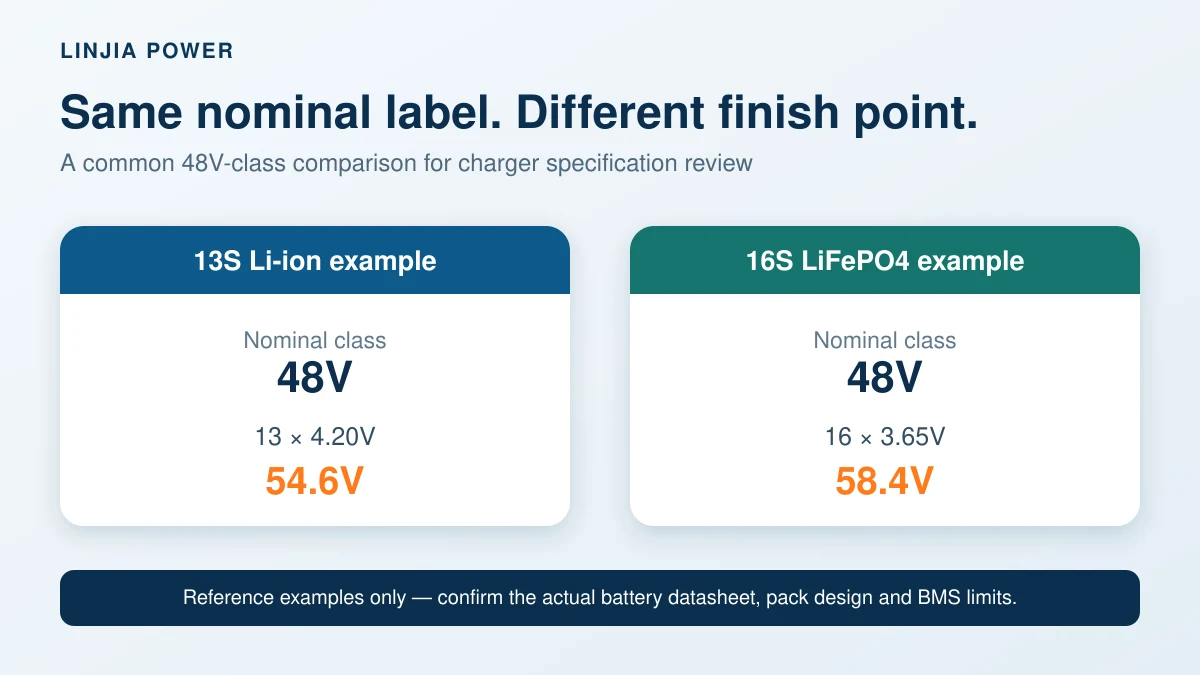
Consider two common lithium examples:
| Battery example | Series configuration | Common reference calculation | Result |
|---|---|---|---|
| 48V-class Li-ion pack | 13S | 13 × 4.20V | 54.6V |
| 48V-class LiFePO4 pack | 16S | 16 × 3.65V | 58.4V |
These are common reference examples, not universal charger prescriptions. The actual battery datasheet, pack design and BMS requirements remain authoritative.
Both packs may be sold as “48V,” but a charger configured for 54.6V should not automatically be approved for a battery requiring 58.4V—and the reverse is also true. A lead-acid battery introduces another difference because its multi-stage charging requirements cannot be inferred from a lithium example.
This is why our 48V battery chemistry compatibility guide treats nominal voltage as only one part of the decision.
What Happens When Full-Charge Voltage Does Not Match?
If the charger target is too low
- The battery may stop below its expected state of charge.
- Vehicle or equipment runtime may be shorter than expected.
- Cell balancing conditions may not be reached when the battery design requires them.
- The buyer may mistake a specification mismatch for a battery-capacity or charger-quality problem.
If the charger target is too high
- The BMS may cut off charging before the charger completes its normal cycle.
- The charger may repeatedly stop and restart, depending on the system design.
- The battery can be exposed to unnecessary electrical or thermal stress.
- In a serious mismatch, battery damage or a safety risk is possible.
If the voltage matches but the charging profile does not
The system can still be unsuitable. Chemistry-specific charging stages, current limits, termination logic and BMS communication may differ. Matching one number is not the same as approving the complete charger-and-battery system.
A BMS cut-off is a protection event, not proof that the charger is correctly matched. Repeated BMS interruption should trigger a specification review rather than be accepted as normal charging.
How Linjia Reviews Full-Charge Voltage Before Production
When a buyer sends only a nominal voltage, Linjia cannot confirm the charger from that number alone. We first review the battery label, chemistry, cell configuration or series count, battery-supplier data and BMS limits. Then we compare the required end-of-charge target with the charger output and charging curve.
For an OEM or ODM project, the approved electrical parameters and interface details should be locked before mass production. Finished electrical testing, dielectric withstand testing and full-load burn-in can then verify chargers against the approved product specification. These factory checks support production consistency, but they do not replace the original battery specification.

| Buyer input | What must be confirmed | Why it matters |
|---|---|---|
| Battery chemistry | Lead-acid, Li-ion, LiFePO4 or another system | Changes the charging profile and voltage requirements |
| Nominal and full-charge voltage | Both values from the approved battery data | Prevents nominal-label matching errors |
| Series count | Actual lithium pack configuration | Connects cell limits to pack voltage |
| Capacity and charging current | Ah, recommended current and maximum permitted current | Affects charging time, BMS limits and thermal design |
| BMS | Voltage, current, temperature and communication limits | Prevents interruption or control conflicts |
| Connector and polarity | Connector model, pin definition, polarity and cable | Confirms electrical and mechanical compatibility |
| Application and environment | Vehicle or equipment, AC input, plug, heat, dust and duty cycle | Affects input and thermal design decisions |
Full-Charge Voltage Checklist for Charger Buyers
Before approving a charger sample or requesting a quotation, prepare:
- Battery chemistry.
- Nominal voltage.
- Exact required full-charge voltage.
- Lithium series count, if applicable.
- Battery capacity in Ah.
- Recommended and maximum charging current.
- BMS charge-voltage and charge-current limits.
- Communication requirements, if any.
- Connector photo, pin definition and polarity.
- AC input, plug, application, operating environment and expected quantity.
If the full-charge voltage is not printed on the battery label, request the battery datasheet or written confirmation from the battery supplier. Do not calculate it from nominal voltage alone.
Frequently Asked Questions
Can I determine full-charge voltage from nominal voltage?
No. Nominal voltage identifies the general battery class, but chemistry, cell specification, series count, pack design and BMS limits determine the approved end-of-charge target.
Does a BMS make any charger with the same nominal voltage safe to use?
No. The BMS is not a replacement for a correctly specified charger. It may interrupt a mismatch, but repeated cut-off can indicate an incorrect voltage, current, profile or communication setting.
Can two chargers with the same connector be interchangeable?
Not necessarily. Connector appearance does not confirm voltage, current, charging curve, polarity or pin definition.
Is a higher full-charge voltage better?
No. The correct target is the value approved for the battery system. Higher is not better; lower is not automatically safer. Either direction can create performance or compatibility problems.
Why is the voltage on the charger label higher than the battery’s nominal voltage?
Because nominal voltage is a classification value, while the charger must raise the battery to its approved end-of-charge target. The exact difference depends on the battery system.
Need a Charger Specification Review?
Send Linjia Power your battery chemistry, nominal and full-charge voltage, capacity, BMS charge limits, connector photo and pin definition, polarity, local AC input, application, environment and quantity. We can evaluate an appropriate custom battery charger configuration for sample approval and mass production.