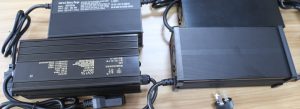
Choose an e-rickshaw battery charger by matching the battery system—not by matching the vehicle’s nominal voltage alone. Confirm the battery chemistry, nominal and full-charge voltage, capacity, permitted charging current, BMS limits, connector pin definition and polarity. Then check the destination-market AC input and plug, the vehicle’s operating environment, and the required duty cycle. The correct charger is the configuration approved for that complete set of conditions.
This order matters for vehicle manufacturers, battery brands, importers and distributors. Two e-rickshaws both described as “48V” can require different charger outputs, charging profiles, connectors or current limits.
Start With the Battery System, Not the E-rickshaw Label
“E-rickshaw” usually describes a passenger electric three-wheeler, but the name does not define one universal battery system. Vehicle platforms can differ by battery chemistry, pack configuration, capacity, BMS, connector, market and daily service pattern. A charger should therefore be selected from the approved battery and vehicle specifications.
| Confirm first | What the buyer should provide | Decision it controls |
|---|---|---|
| Battery chemistry | Lead-acid, Li-ion, LiFePO4 or another approved system | Charging profile and termination logic |
| Voltage data | Nominal voltage and exact required full-charge voltage | Charger output and curve |
| Battery capacity | Capacity in Ah and battery supplier’s recommended charge rate | Target charging current and expected charging time |
| BMS limits | Permitted charge voltage, current, temperature and communication requirements | Compatibility and protection coordination |
| Interface | Connector model, photo, pin definition, polarity and cable requirements | Electrical and mechanical fit |
| Market and use | AC range, local plug, ambient conditions and operating schedule | Input, thermal and mechanical design |
The e-rickshaw battery charger application page shows how these inputs are turned into an OEM configuration. The following steps explain how to choose an e-rickshaw battery charger for a defined vehicle and market.
1. Match the Charger to Battery Chemistry and Charging Profile
Lead-acid, Li-ion and LiFePO4 battery packs should not be treated as interchangeable just because they share a nominal-voltage label. They can require different charging stages, voltage targets and termination behaviour. A connector that fits does not make one charger suitable for all three chemistries.
Ask the battery supplier for the approved charging specification. For a lithium project, also confirm the cell type, series count and BMS requirements. For a lead-acid project, confirm the battery type, pack configuration and the battery maker’s required multi-stage charging profile. Do not copy an output setting from a previous vehicle unless the complete battery specification is the same and has been reapproved.
2. Confirm Nominal Voltage and Full-Charge Voltage Separately
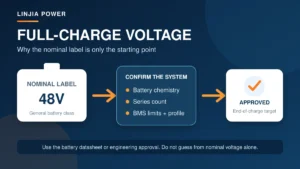
Nominal voltage classifies the battery system; it does not by itself specify the charger’s final output. A “48V,” “60V” or “72V” e-rickshaw battery can have a different full-charge requirement depending on chemistry and pack design.
For lithium batteries, the pack’s series configuration and approved cell-level target help determine the pack-level value. The battery supplier may specify a normal charging target below an absolute cell limit, and the BMS can add its own voltage conditions. For lead-acid batteries, the approved charging stages and temperature assumptions also matter. Our full-charge voltage guide explains why nominal voltage is only the starting point.
Manufacturer’s view: When a buyer sends only “48V charger,” the specification is not ready for sample approval. The battery chemistry, full-charge target, capacity, BMS, current and interface must be reviewed together.
3. Select Charging Current From Capacity, BMS Limits and Duty Cycle
A higher current can reduce charging time, but it is not automatically the better choice. The battery supplier’s recommended and maximum charge current, the BMS limit, charger thermal design, ambient temperature and the vehicle’s operating schedule all affect the decision.
For example, a fleet that charges overnight may value lower thermal stress and predictable turnaround more than the shortest possible charging time. A passenger vehicle that returns to service between shifts may need a different balance. The buyer should define the required charging window first, then verify that the proposed current remains within the battery and BMS limits under the intended environment.
Use the 48V charging-current selection guide for the underlying current, capacity and charging-time logic. Its examples are reference methods, not a substitute for the actual battery specification.
4. Verify the Connector, Pin Definition and Polarity
Connector appearance is not enough. Two visually identical connectors can use different pin assignments or polarity. The cable length, conductor specification, strain relief and locking method may also affect installation and field reliability.
Before a sample is built, send:
- Clear photos of the vehicle and battery-side connector.
- The connector manufacturer and part number, if available.
- A pin-by-pin definition.
- Confirmed positive and negative polarity.
- Required cable length and any routing constraints.
- Communication pins or interlock requirements, if used.
Polarity should be measured and documented, not inferred from wire colour or a previous order. Final-order verification should compare the connector and polarity with the approved sample and order specification.
5. Match AC Input and Plug to the Destination Market
The e-rickshaw battery charger must accept the actual mains conditions where the vehicle will operate. Confirm the required AC input range, frequency and local plug. Also identify whether charging occurs in a controlled depot, a roadside location, a workshop or another environment where supply variation, dust, heat, moisture or mechanical handling may be relevant.
Do not approve a market plug as a cosmetic change at the end of the project. Plug type, input cable, insulation, labelling and applicable compliance documentation should be part of the approved configuration.
6. Evaluate Environment, Cooling and Daily Use
An e-rickshaw charger that operates reliably in a mild indoor setting may need a different enclosure or thermal approach for a hot, dusty or poorly ventilated location. Buyers should specify:
- Expected ambient-temperature range.
- Indoor, sheltered or exposed charging location.
- Dust, moisture and splash conditions.
- Available ventilation and mounting clearance.
- Number of charging cycles or operating hours per day.
- Whether the charger is carried on the vehicle or stays at a depot.
These inputs help determine whether the proposed housing, cooling method, cable arrangement and power level are appropriate. They also define the conditions that should be reproduced during sample evaluation.
E-rickshaw Battery Charger Buyer Decision Table
| Project condition | Recommended buyer action | Do not assume |
|---|---|---|
| Battery chemistry is not confirmed | Pause charger selection and obtain the battery specification | Nominal voltage identifies the charging profile |
| Full-charge voltage is missing | Request the approved end-of-charge target from the battery supplier | It can be derived from “48V,” “60V” or “72V” alone |
| Faster charging is requested | Check capacity, recommended charge rate, BMS limit and thermal conditions | The highest available current is suitable |
| Connector looks familiar | Verify part number, pins and polarity with a mating sample | Shape confirms electrical compatibility |
| Vehicle will be sold in a new country | Review AC input, plug, labels and required compliance evidence | The existing domestic configuration can ship unchanged |
| Sample passes a bench charge | Evaluate a complete cycle under intended battery, load and environment conditions | One successful connection proves production readiness |
Common E-rickshaw Battery Charger Selection Mistakes
Choosing by nominal voltage only
This can produce an incorrect end-of-charge voltage or charging profile. It is the most important mismatch to prevent.
Treating the BMS as a substitute for correct matching
A BMS protection event is not normal charge termination. Repeated cut-off should trigger a review of voltage, current, profile, temperature and communication settings.
Increasing current without reviewing the complete system
The battery, BMS, wiring, connector and charger all need to support the proposed current under the intended environment.
Approving a connector from a photo alone
A photo helps identify the housing, but a physical mating sample and documented pin definition provide stronger approval evidence.
Changing the battery after charger sample approval
A new cell, series count, capacity, BMS or supplier can change the required charger specification. Treat the change as an engineering review, not a routine purchasing substitution.
How Linjia Reviews an OEM E-rickshaw Charger Project
Linjia’s approved product scope covers 6V–72V chargers for lead-acid, Li-ion and LiFePO4 systems. For an e-rickshaw battery charger project, the engineering review starts with the battery, BMS, connector, input and operating conditions. Plug, cable, connector, polarity, housing, label and packaging options can then be evaluated within the approved electrical solution.
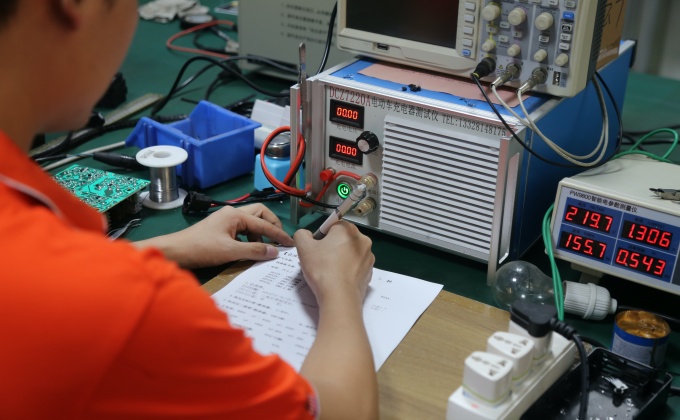
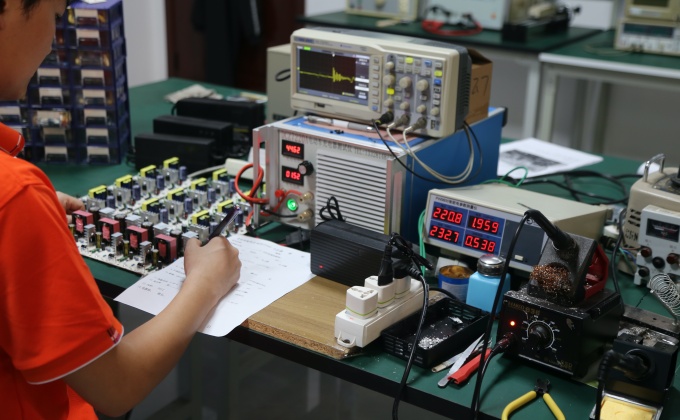
After the specification is agreed, sample evaluation should confirm charging behaviour and physical compatibility. Production controls then compare incoming materials, PCBA, assembled units, electrical performance, dielectric withstand, full-load burn-in and final order details with the approved configuration. These checks support consistency; they do not correct an incomplete battery specification.
For a new vehicle platform or a configuration with non-standard battery, BMS, cable or housing requirements, use the custom battery charger development process to lock the specification before mass production.
Information to Send Before Requesting a Sample
- E-rickshaw type and destination market.
- Battery chemistry and supplier.
- Nominal voltage and exact full-charge voltage.
- Battery capacity in Ah.
- Recommended and maximum charging current.
- BMS voltage, current, temperature and communication limits.
- Connector photos, part number, pin definition and polarity.
- Required AC input range, frequency and plug.
- Cable, housing, cooling, label and packaging requirements.
- Operating environment, charging window and expected quantity.
A complete specification package makes sample evaluation faster and reduces the risk of approving a charger that cannot be reproduced for the final order.
Frequently Asked Questions
Can one 48V e-rickshaw battery charger work with every 48V battery?
No. The chemistry, full-charge voltage, charging profile, current limit, BMS, connector and polarity must all match. “48V” alone is not enough.
How do I choose between a 5A and 10A charger?
Use the battery supplier’s recommended charge rate, battery capacity, BMS limit, required charging time and thermal conditions. A 10A charger should not be selected simply because it is faster.
Can the same charger be used for lead-acid and lithium e-rickshaws?
Not unless the charger is specifically designed and approved for both complete battery systems. Their voltage targets and charging profiles can differ even when the nominal voltage is similar.
What should be tested on an e-rickshaw battery charger sample?
Verify the complete charging cycle with the intended battery and BMS, output behaviour, connector fit, pin definition, polarity, temperature, local input conditions, indicators and mechanical installation.
What changes require charger reapproval?
Changes to the battery chemistry, cells, series count, capacity, BMS, current, connector, polarity, cable, input, housing or environment should trigger a documented compatibility review.
Request an E-rickshaw Battery Charger Evaluation
Share the application, battery specification, destination market, connector and polarity details, operating environment and expected quantity. Linjia Power can review the requirements and propose an appropriate sample configuration for OEM production. For 48V lithium projects, you can also review the available 48V lithium charger platform before requesting customization.