
The right 48V battery charging current is the highest current that stays within the battery maker’s continuous charge limit, the BMS limit, and the thermal and connector limits of the complete system. Battery capacity provides a useful starting point, but it is not enough by itself. Chemistry, series-cell count, full-charge voltage, charge profile, temperature, expected charging time, connector rating, and application duty cycle all have to agree before an OEM buyer approves a charger.
This guide turns those requirements into a practical selection process. It also explains why “faster” is not automatically “better,” how to estimate charging time without making unrealistic promises, and what to put on an RFQ so a charger supplier can quote the correct platform.
Start with the battery specification, not the charger label
“48V” is a nominal system class. It does not define the charger’s final voltage or safe current. A 48V battery may be a lead-acid pack, a 13-series-cell lithium-ion pack, a 16-series-cell LiFePO4 pack, or another configuration designed around a specific vehicle or energy-storage system. Those packs can require very different voltage targets and charging logic.
Before choosing amperage, obtain the battery datasheet and confirm these six items:
- Chemistry and series-cell count: for example, 13S Li-ion or 16S LiFePO4.
- Nominal capacity in amp-hours: use the production battery specification, not a marketing estimate.
- Maximum continuous charge current: this is normally stated by the cell, battery, or BMS supplier.
- Required full-charge voltage and profile: voltage tolerance and termination behavior matter as much as current.
- Connector, polarity, and pinout: include any interlock, temperature, or communication pins.
- Operating conditions: ambient temperature, enclosure airflow, charge frequency, and target charge window.
If any of these items is missing, treat the current selection as provisional. Linjia’s battery charger selection guide provides a broader checklist for matching voltage, chemistry, connectors, and usage conditions.
Use C-rate as a screening tool
Charging current is often expressed as a C-rate. The basic relationship is:
Charge current (A) = battery capacity (Ah) × selected charge rate (C)
For a 50Ah battery, 0.1C equals 5A and 0.2C equals 10A. That calculation is useful for comparison, but it is not permission to charge at either value. The selected rate still must be at or below every applicable limit.
| 50Ah example | Calculated current | What the buyer must still verify |
|---|---|---|
| 0.05C | 2.5A | Whether the charging window is acceptable |
| 0.10C | 5A | Battery recommendation, temperature, and target time |
| 0.20C | 10A | BMS, cells, wiring, connector, and charger thermal margin |
| 0.30C | 15A | Explicit battery approval and system-level validation |
Do not use a generic C-rate across chemistries. Lead-acid charging may spend substantial time in absorption, while lithium charging normally transitions from constant current to constant voltage and then tapers. The battery manufacturer’s recommended and maximum rates always take priority over a rule of thumb.
Apply the lowest-limit rule
A safe current is determined by the weakest approved element in the charging path. In practical terms:
Selected current ≤ battery limit, BMS limit, connector limit, cable limit, charger continuous rating, and application thermal limit.
For example, a cell supplier may allow 15A, while the BMS permits only 10A and the existing connector is rated for 8A under the product’s real temperature conditions. The correct starting point is not 15A or 10A; it is 8A or a redesign of the limiting hardware. A charger cannot make an underspecified cable or connector safe.
Battery and BMS limits
Lithium batteries may have separate limits for normal charge current, short-duration charge current, and low-temperature charging. The BMS can also reduce or block current according to cell temperature, imbalance, or state of charge. Confirm whether the charger must respond to a simple enable signal, CAN communication, or another control method. For lead-acid packs, confirm whether the battery is flooded, AGM, or gel and obtain the approved voltage and compensation requirements.
Connector and cable limits
Connector ratings depend on contact design, wire gauge, crimp quality, mating cycles, enclosure temperature, and derating practice. A connector that appears adequate on paper can still run hot in a sealed vehicle compartment. Pinout and polarity must be documented, especially when similar connectors are used across different charger models.
Thermal limits
Higher current means more stress in the charger, wiring, connector, and battery. The charger should deliver its rated output continuously under the agreed input voltage and ambient range without excessive temperature rise or unstable derating. Fanless and fan-cooled designs may need different enclosures, component margins, and maintenance expectations.
Use catalog ranges as references, not universal rules
For Linjia 48V lithium charger platforms using a 54.6V profile, typical selection references include 2A for approximately 10–17Ah, 3A for 14–28Ah, 5A for 24–45Ah, 7A for 35–60Ah, 8A for 40–70Ah, and 10A for 50–80Ah. Higher-current platforms are available for larger packs. These ranges help identify a starting platform; the battery and BMS specifications determine final approval.
For 48V lead-acid applications, Linjia’s portfolio includes current classes from about 1.9A through 7A for selected 10–70Ah applications, with 10A, 15A, and 30A platforms for larger capacity ranges. The correct output voltage can vary by flooded, AGM, or gel battery requirements, so chemistry and battery type must be stated on the RFQ.
See the 48V lithium battery charger manufacturing page for platform context. Use the range to start a technical discussion, not to override the pack supplier’s instructions.
Estimate charging time realistically
A first-pass estimate is:
Ideal charging time (hours) = amp-hours to be returned ÷ charger current
If a 50Ah battery needs 40Ah returned, the arithmetic gives eight hours at 5A or four hours at 10A. Real charging takes longer. Lithium current tapers during the constant-voltage stage; lead-acid batteries spend time in absorption; charger efficiency, BMS behavior, temperature, aging, imbalance, and auxiliary loads also affect the result.
For OEM planning, define a charge target such as “from 20% to 90% at 25°C” and validate it using the production battery. Avoid promising a time based only on capacity divided by current.
When a lower current is the better engineering choice
A lower-current charger is often appropriate when the vehicle charges overnight, the battery maker recommends a conservative rate, passive cooling is preferred, the enclosure has limited airflow, or the connector and wiring are already qualified at the lower value. It may also reduce cost, size, acoustic noise, and stress on an aging field battery.
Lower current is not automatically safer if the voltage profile is wrong. A 5A charger with an incorrect full-charge voltage or termination method can be a worse match than a properly engineered 10A unit. Current is only one part of the specification.
When a higher current is justified
A higher-current design can be justified when the available charging window is short and the battery, BMS, connector, cable, AC input, and thermal system are all rated for it. Fleet operations may value faster vehicle turnaround, while large battery packs may need more current simply to achieve a practical overnight charge.
The cost decision should include charger size, fan requirements, thermal design, connector upgrades, AC-circuit capacity, validation workload, and warranty risk. The correct comparison is system cost per reliable charging cycle, not only charger purchase price.
What an OEM RFQ should specify
| RFQ field | Required information | Why it matters |
|---|---|---|
| Battery | Chemistry, series count, nominal voltage, Ah, datasheet | Defines voltage, profile, and current limits |
| BMS | Continuous charge limit, temperature rules, communications | Prevents nuisance trips and unsafe assumptions |
| Performance | Starting SOC, target SOC, target time, ambient range | Turns “fast charging” into a testable requirement |
| Interface | Connector drawing, polarity, pinout, cable length and gauge | Controls fit, voltage drop, and heating |
| AC side | Input range, frequency, plug, market and power limits | Ensures deployment compatibility |
| Commercial | Forecast, order quantity, branding and certifications | Selects a realistic OEM platform |
If the application requires a new housing, connector, charging curve, label, or communication behavior, review Linjia’s custom battery charger development process.
Validate the selected current before mass production
A production decision should be based on representative batteries and the intended charger configuration. Record charge current and voltage over the full cycle, BMS events, battery and connector temperatures, charger case temperature, charge time, restart behavior, and behavior at the ends of the AC input range. Include aged or low-state-of-charge batteries if they are part of the real use case.
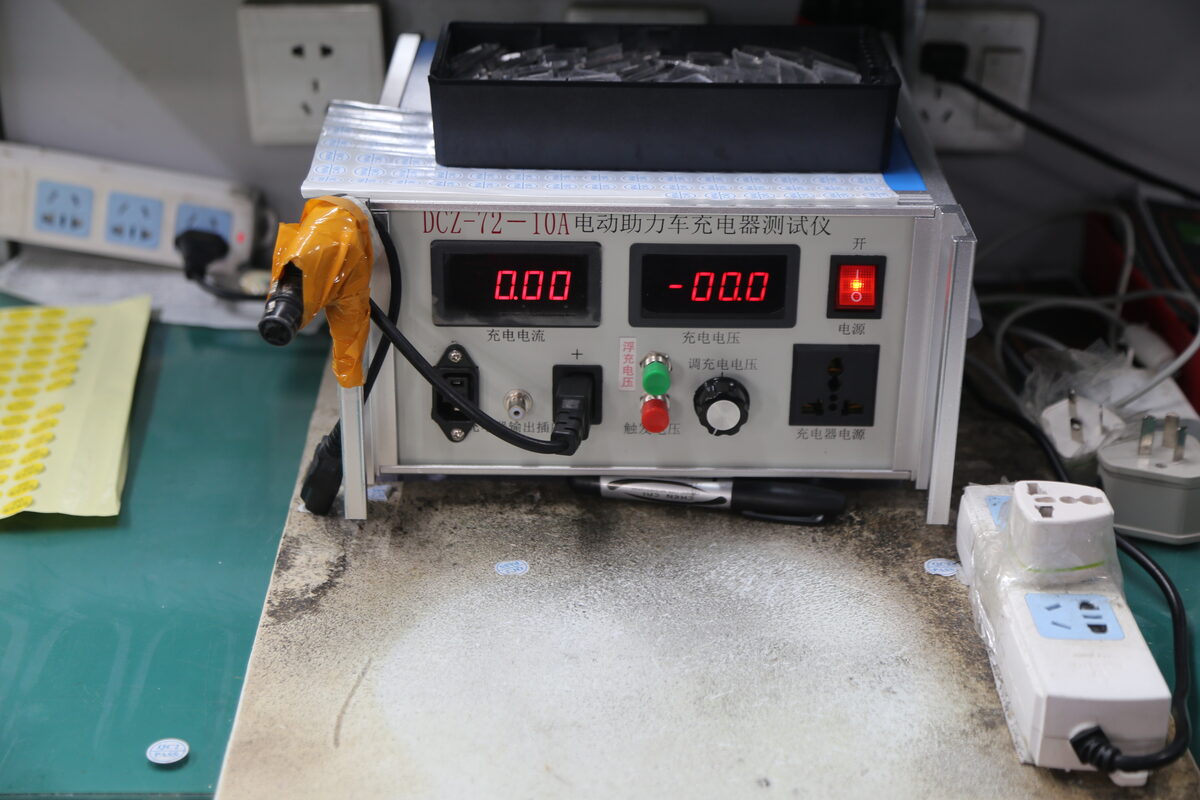
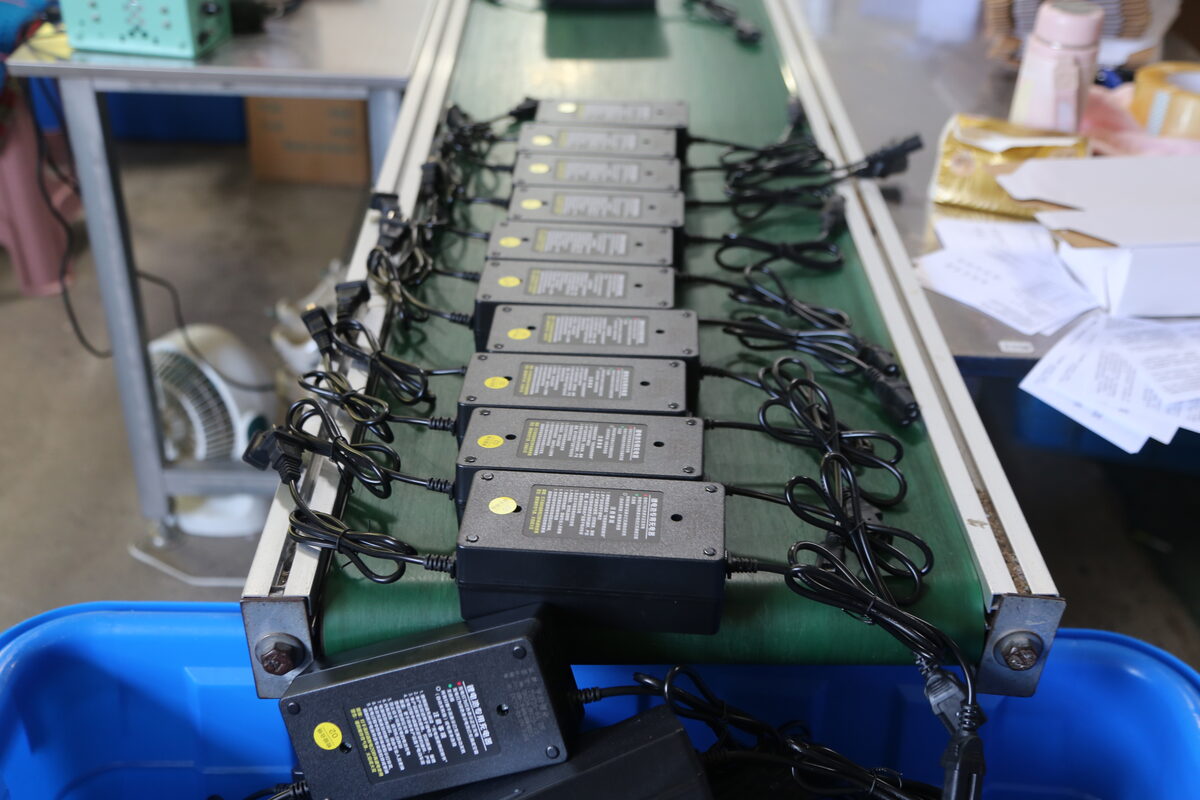
Manufacturing controls should then preserve the approved combination. Linjia’s process can include incoming inspection, PCBA and semi-finished testing, electrical checks, high-voltage insulation tests, connector and polarity verification, full-load burn-in, and final packing inspection. Learn more about battery charger quality control and the manufacturing process.

Frequently asked questions
Is 10A too much for a 48V battery?
Not necessarily, but it must be approved for the exact pack. A 10A current equals 0.2C for a 50Ah battery and 0.1C for a 100Ah battery. Check the cell or battery limit, BMS limit, connector, wiring, temperature, and charge profile before approval.
Can I replace a 5A 48V charger with a 10A model?
Only after verifying that the battery and complete charging path support 10A and that voltage, profile, connector, polarity, and communications remain correct. Matching nominal voltage and plug shape is not enough.
Does a lower charging current extend battery life?
A conservative rate can reduce heat and stress in some applications, but battery life also depends on chemistry, voltage limits, temperature, depth of discharge, storage state, and cell quality. Follow the battery maker’s recommendation and validate the actual duty cycle.
What information should I send to the charger supplier first?
Send the battery datasheet, chemistry and series count, capacity, maximum charge current, full-charge voltage, BMS requirements, connector drawing and polarity, AC market, target charging time, and expected quantity.
Choose the current as part of a complete charging system
The correct 48V battery charging current is a coordinated engineering decision. Start with the battery and BMS limits, screen the options by C-rate, confirm the connector and thermal margins, define a realistic charge window, and validate the final combination before production. For a model recommendation or OEM sample plan, contact Linjia Power with your battery specification and application details.