
Choose a 48V 5A charger when the battery, charging window, connector, and thermal conditions favor a moderate current; choose 10A only when the complete battery system is approved for the higher rate and faster turnaround has real operational value. The 10A option can be roughly twice as fast during the constant-current portion of a cycle, but it is not automatically the better OEM choice.
This 48V 5A vs 48V 10A battery charger guide compares charging time, battery capacity, BMS limits, thermal design, connector requirements, cost, and validation. It is written for OEM buyers who must turn a vehicle or equipment requirement into a repeatable production specification.
Quick comparison: 48V 5A vs 48V 10A
| Decision factor | 48V 5A charger | 48V 10A charger |
|---|---|---|
| Current | Moderate | 2× the current of 5A |
| Ideal time to return 50Ah | About 10 hours | About 5 hours |
| Heat and hardware demand | Generally lower | Higher; requires stronger validation |
| Typical use case | Overnight charging, moderate packs | Larger packs or shorter turnaround |
| Connector and cable | Must be rated above 5A with margin | Must be rated above 10A with margin |
| Battery approval | Required | Required; never assumed from nominal voltage |
The charging-time values are arithmetic baselines, not promises. Real cycles take longer because current tapers, efficiency is below 100%, and battery temperature, condition, balancing, and auxiliary loads change the result.
First confirm that both chargers are electrically comparable
A fair comparison requires more than a “48V” label. Both candidates must have the correct full-charge voltage, chemistry-specific profile, voltage tolerance, termination behavior, connector, polarity, pinout, communications, and AC input. If any of these differ, current is no longer the only variable.
For example, a common 13S lithium-ion pack may require 54.6V, while a common 16S LiFePO4 pack may require 58.4V. A 48V lead-acid pack may use a different multi-stage profile and a voltage in a different range specified by the battery maker. Use the full-charge voltage guide before comparing amperage.
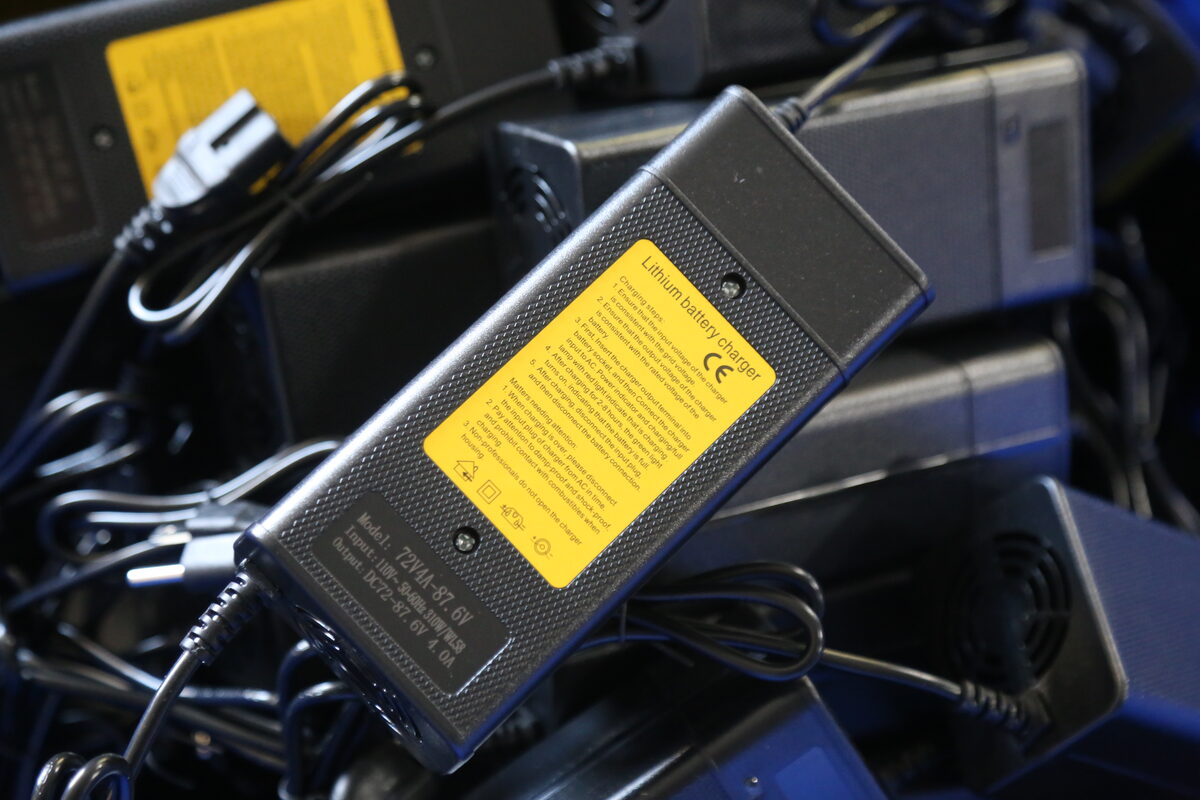
Compare current with battery capacity and C-rate
For a battery capacity in amp-hours, the approximate charge rate is:
C-rate = charger current ÷ battery capacity
| Battery capacity | 5A charge rate | 10A charge rate | Ideal time for full Ah return |
|---|---|---|---|
| 25Ah | 0.20C | 0.40C | 5 hours vs 2.5 hours |
| 40Ah | 0.125C | 0.25C | 8 hours vs 4 hours |
| 50Ah | 0.10C | 0.20C | 10 hours vs 5 hours |
| 80Ah | 0.0625C | 0.125C | 16 hours vs 8 hours |
| 100Ah | 0.05C | 0.10C | 20 hours vs 10 hours |
These calculations help procurement compare options, but the battery supplier’s current limit decides what is allowed. A 25Ah pack that permits only 0.2C should not receive 10A merely because the charging time looks attractive. Conversely, a properly designed 100Ah system may gain little operational value from a 5A charger if it must recharge overnight.
How Linjia’s platform ranges can guide an initial choice
Within Linjia’s 54.6V lithium charger range, a 5A platform is commonly referenced for approximately 24–45Ah batteries, while a 10A platform is commonly referenced for approximately 50–80Ah batteries. These are product-selection ranges, not universal battery rules. The exact pack datasheet and BMS settings take priority.
For 48V lead-acid systems, the portfolio includes several intermediate currents, plus a 10A platform referenced for selected 70–100Ah applications. This matters because an OEM does not always need to jump directly from 5A to 10A. A current near 6A, 7A, or 8A may better balance time, heat, size, and battery requirements. Review available options on the 48V lithium battery charger page, then confirm the production specification with the battery supplier.
Where 5A usually makes more sense
A 5A charger is often the better OEM choice when:
- The battery capacity is moderate and the approved rate is near 5A.
- The product charges overnight and faster turnaround has little value.
- A smaller, quieter, or fanless enclosure is preferred.
- The existing connector, cable, or AC power budget is limited.
- The equipment operates in a warm or poorly ventilated enclosure.
- The project prioritizes lower system stress and simpler thermal management.
Five amps may also be easier to standardize across a family of moderate-capacity batteries, but only if every variant shares compatible voltage, profile, connector, and charge-current limits.
Where 10A can justify the extra design work
A 10A charger becomes attractive when the battery is large enough, the BMS explicitly accepts the current, and shorter charge time improves fleet availability or customer experience. Examples include delivery vehicles with limited downtime, equipment that must complete multiple shifts, and larger packs that would take too long at 5A.
The higher current must be treated as a system change. Confirm wire gauge, contact resistance, connector temperature rise, fuse strategy, charger cooling, case temperature, AC input power, and behavior at low and high line. If the battery uses communication to authorize current, confirm the charger’s control logic and failure behavior.
Charging time: define the interval that matters
OEM teams often ask, “How long does it take to charge?” without defining the starting point. A defensible requirement includes initial state of charge, target state of charge, temperature, battery age, auxiliary load, and acceptable completion criteria.
Consider a 50Ah battery that needs 35Ah returned. The ideal constant-current calculation gives seven hours at 5A and 3.5 hours at 10A. The actual time will be longer because the charger will eventually reduce current and the BMS may balance cells. If the product only needs to recover from 30% to 80% during a work break, test that interval rather than advertising an unsupported zero-to-full number.
Thermal design often decides the winner
Doubling output current does not simply double every loss; component losses and temperature rise depend on topology, component resistance, switching behavior, airflow, enclosure, and ambient temperature. A well-designed 10A charger can be reliable, but it usually needs a different power stage and thermal strategy than a 5A model.
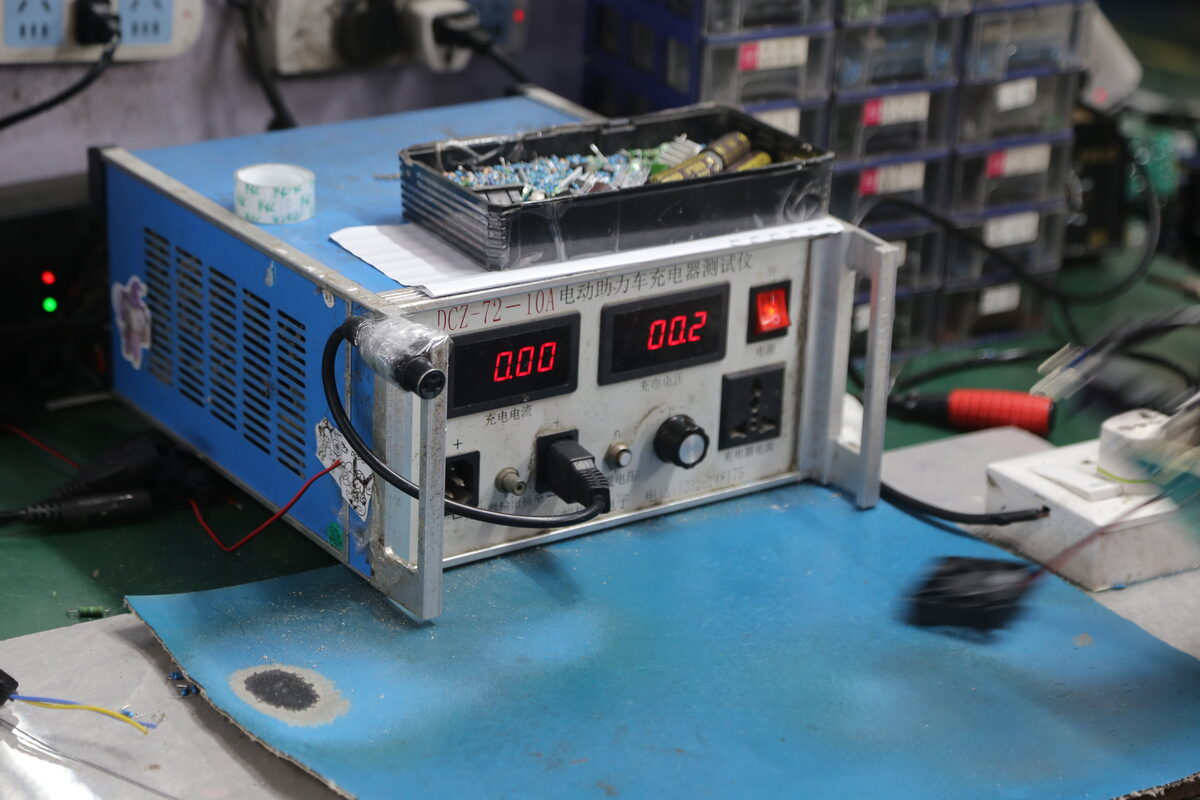
Ask the supplier for continuous full-load capability at the agreed ambient temperature. The validation plan should measure internal hot spots, case temperature, connector temperature, cable temperature, fan behavior, derating, and recovery. A short bench run at room temperature is not a substitute for a full cycle in the intended enclosure.
Connector, cable, and polarity requirements
A connector that works at 5A should not be assumed safe at 10A. Obtain the connector manufacturer’s rating, apply the OEM’s derating rule, and validate the assembled cable. Contact quality, crimp tooling, cable length, wire gauge, mating cycles, and contamination all affect heating and voltage drop.
Document the exact connector series, housing, contact, polarity, and pinout on the drawing. If 5A and 10A chargers look similar but must not be interchanged, use labels, keyed connectors, model controls, or other error-proofing. Linjia can support connector and cable customization through its custom charger development process.
Compare total OEM cost, not only unit price
| Cost area | Questions for 5A | Questions for 10A |
|---|---|---|
| Charger hardware | Can a smaller platform meet the requirement? | Does it require a larger case, fan, or higher-rated parts? |
| Vehicle hardware | Are current cable and connector ratings adequate? | Must wiring, connector, fuse, or inlet be upgraded? |
| Operations | Is overnight time sufficient? | How much is faster turnaround worth? |
| Validation | Is the current model already qualified? | What new thermal, battery, and EMC work is required? |
| Warranty | Could long charging time cause user misuse? | Could extra heat or unapproved current increase risk? |
The lowest-priced charger can become expensive if it causes downtime, field replacement, connector damage, or battery claims. The right procurement decision aligns charger performance with real operating economics.
A practical OEM decision sequence
- Confirm chemistry, series count, full-charge voltage, and charge profile.
- Record battery capacity and maximum continuous charge current.
- Check the BMS limit and communication or enable behavior.
- Calculate 5A and 10A C-rates and ideal time baselines.
- Define the real SOC interval and target time.
- Verify connector, cable, fuse, and AC input margins.
- Compare thermal design, enclosure, fan, and ambient requirements.
- Build samples and validate the complete charge cycle.
- Freeze the approved BOM, label, connector, and test limits.
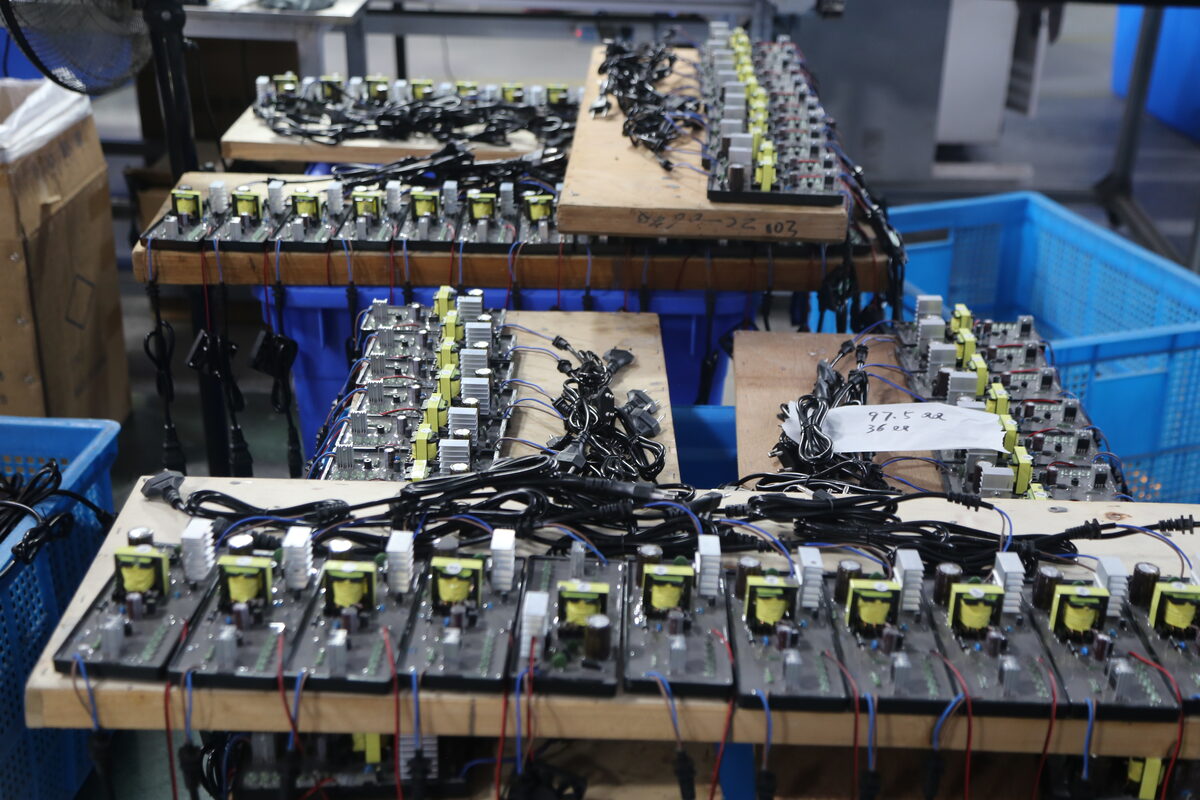
For an overview of factory checks that support that freeze, see Linjia’s battery charger factory and quality control process.
Frequently asked questions
Will a 10A charger always charge twice as fast as a 5A charger?
No. It may be close to twice as fast during the constant-current portion, but tapering, BMS limits, temperature, balancing, efficiency, and battery condition reduce the difference over a complete cycle.
Can a 10A charger damage a battery that came with a 5A charger?
It can if the battery, BMS, connector, cable, or thermal design is not approved for 10A. Do not upgrade based only on nominal voltage or plug fit.
Is 5A enough for a 48V 100Ah battery?
It may be electrically acceptable if approved by the battery maker, but the ideal full-capacity time is about 20 hours before taper and losses. If the available window is shorter, a higher approved current may be needed.
Can the same 10A charger be limited to 5A?
A programmable platform may support controlled current settings, but the specific charger, firmware, labeling, and configuration process must be designed and validated for this use. Do not assume that any 10A charger can be safely adjusted in the field.
Choose from the system requirement
For OEM buyers, the 48V 5A vs 48V 10A battery charger decision should begin with the battery and duty cycle. Five amps is often a strong fit for moderate packs and overnight charging; 10A is valuable when the pack and hardware support it and faster turnaround matters. Send Linjia the battery datasheet, BMS limit, connector drawing, input market, target charge window, quantity, and branding requirements through the contact page for a matched recommendation and sample-validation plan.