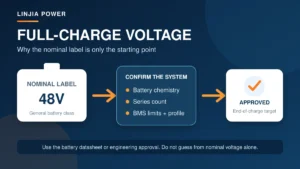
The same 48V charger should not normally be used for lead-acid, lithium-ion, and LiFePO4 batteries. “48V” is only a nominal system label. These battery types can require different full-charge voltages, charging stages, termination rules, temperature behavior, and safety controls. A plug that fits does not prove compatibility.
A purpose-designed programmable or multi-profile charger can support more than one chemistry only when its voltage range, control logic, current, interface, configuration safeguards, and validation cover every approved battery. For OEM projects, separate keyed charger variants are often easier to control than an unrestricted “universal” charger.
Why nominal 48V does not define compatibility
Nominal voltage describes the operating class of a battery, not the voltage required to finish charging it. Internal series-cell count and cell chemistry determine the final target. Three batteries sold as 48V can therefore need materially different outputs.
| Common 48V-class example | Typical full-charge reference | Charging behavior |
|---|---|---|
| 13S lithium-ion | 54.6V | Constant current / constant voltage with current taper and BMS protection |
| 16S LiFePO4 | 58.4V | Constant current / constant voltage with chemistry-specific limits and BMS protection |
| 48V lead-acid | Often about 57.6–59.2V | Multi-stage charging; exact value depends on flooded, AGM, gel, temperature and manufacturer |
These figures are common references, not permission to charge a particular pack. Always use the battery maker’s specified voltage tolerance and profile. Linjia’s full-charge voltage guide explains why a few volts of difference is critical in a battery charger specification.
The charging profile must match the chemistry
Lead-acid charging
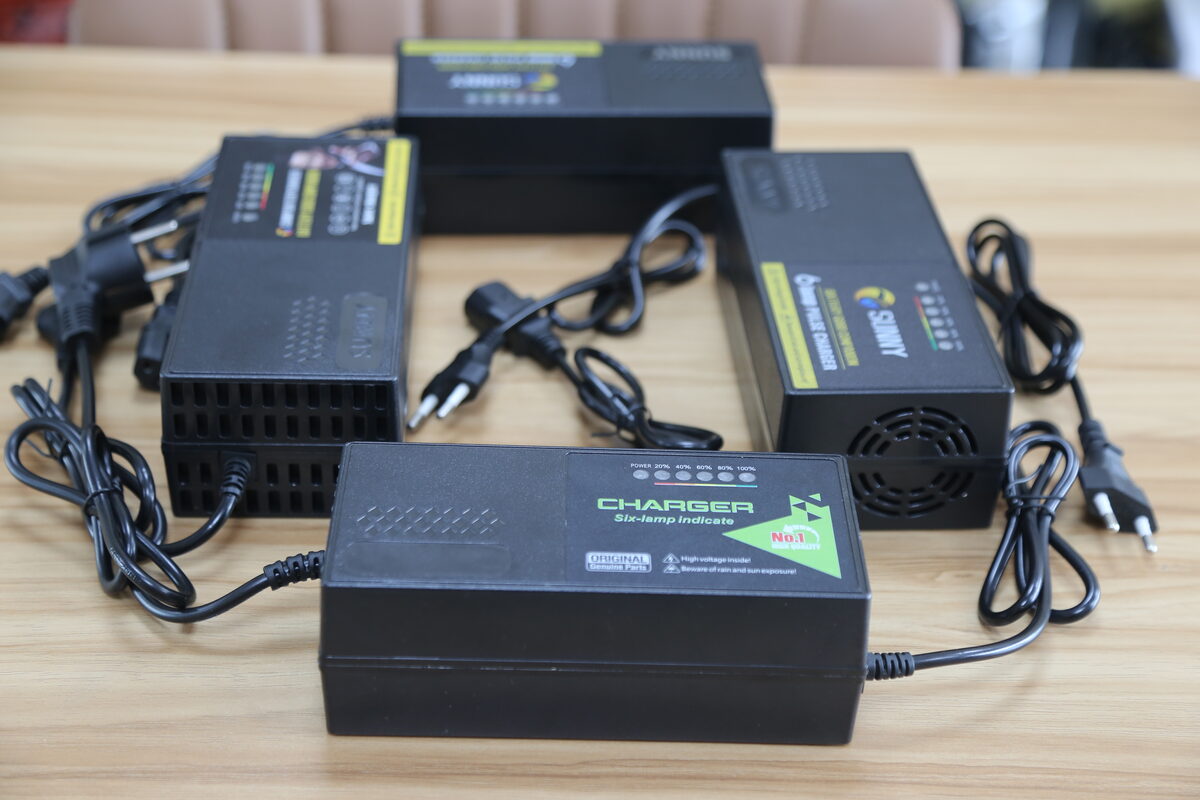
A 48V lead-acid charger normally uses multiple stages such as bulk, absorption, and float. The approved absorption and float voltages can vary by flooded, AGM, or gel construction. Temperature compensation may also be required. A lithium charger that stops after a constant-current/constant-voltage cycle may not maintain a lead-acid battery as intended, while an inappropriate float stage can be unsuitable for many lithium systems.
Lithium-ion charging
A common 13S lithium-ion pack uses a 54.6V full-charge target, but the exact pack specification controls the limit. The charger typically supplies constant current, holds the final voltage, and terminates after current tapers to the defined threshold. The BMS monitors cell voltage, current, and temperature and may interrupt charging if a limit is exceeded.
LiFePO4 charging
A common 16S LiFePO4 pack uses a 58.4V reference. LiFePO4 has a different voltage curve and safety behavior from conventional lithium-ion chemistry. It still requires a compatible BMS and charger, and many packs restrict or block charging below a defined temperature.
The battery datasheet may intentionally specify a target below the chemistry’s theoretical maximum to support a particular service-life or balancing strategy. The charger must follow the approved pack specification rather than a generic internet value.
What can go wrong with the wrong 48V charger?
- Overvoltage: the charger may exceed the pack or cell limit, causing BMS trips, damage, or a safety hazard.
- Undercharge: a lower-voltage charger may stop early, reducing usable capacity and preventing proper balancing.
- Wrong termination: the charger may float, taper, or restart in a way the battery was not designed to accept.
- Excess current: cells, BMS, connector, cable, or fuse may not support the charger’s output.
- Low-temperature risk: lithium charging may need to be blocked or reduced when the pack is cold.
- Interface mismatch: polarity, pinout, enable lines, CAN messages, or interlocks may be wrong even when the connector fits.
Do not use connector shape as a compatibility test. Some industries reuse the same physical connector across different voltages and chemistries. Check the label, drawing, and electrical specification every time.
Why the BMS does not make any charger safe
A BMS is an essential protection layer, but it is not a substitute for a matched charger. Repeatedly relying on overvoltage or overcurrent protection to stop an incompatible charger can cause nuisance shutdowns, contactor or MOSFET stress, incomplete charging, cell imbalance, and unpredictable restart cycles.
The charger should operate inside the battery’s normal limits. The BMS should remain a protection and supervisory system. For communicating packs, document message definitions, timeout behavior, default current, fault recovery, and what happens if communication is lost.
Can one programmable charger support all three chemistries?
Technically, a platform can be engineered with multiple approved profiles. Commercially, that should be treated as a controlled product system, not as a universal charger. The following conditions should all be met:
- The power hardware safely covers the full voltage and current range.
- Each profile has the correct stages, limits, taper, termination, restart, and temperature behavior.
- The selected profile cannot be changed accidentally by the end user.
- Connector keying, battery identification, or communication prevents a wrong-profile connection.
- The label and user instructions clearly identify every approved battery.
- Each charger-and-battery combination is validated over input, load, and temperature extremes.
- Production programming and final testing verify the intended profile.
Possible control methods include separate keyed connectors, factory-locked firmware variants, a service-only configuration tool, resistor or pin identification, or digital communication with the battery. A user-facing selector switch is usually a weak safeguard unless the application’s risk assessment specifically accepts it.
A compatibility checklist for OEM buyers
| Item | Lead-acid | Li-ion | LiFePO4 |
|---|---|---|---|
| Battery detail | Flooded, AGM, or gel; Ah | Series count; cell and pack data | Series count; cell and pack data |
| Voltage | Bulk/absorption/float and compensation | Full-charge voltage and tolerance | Full-charge voltage and tolerance |
| Current | Recommended and maximum rate | Cell, pack, and BMS limits | Cell, pack, and BMS limits |
| Termination | Stage transitions and maintenance mode | Taper threshold and restart logic | Taper threshold and restart logic |
| Temperature | Compensation requirement | Charge range and cold-charge rule | Charge range and cold-charge rule |
| Interface | Connector, polarity, interlock | Connector, polarity, BMS communication | Connector, polarity, BMS communication |
The battery charger selection guide can help procurement collect these inputs before requesting a quotation.
Three safer product strategies
1. Dedicated charger for each battery
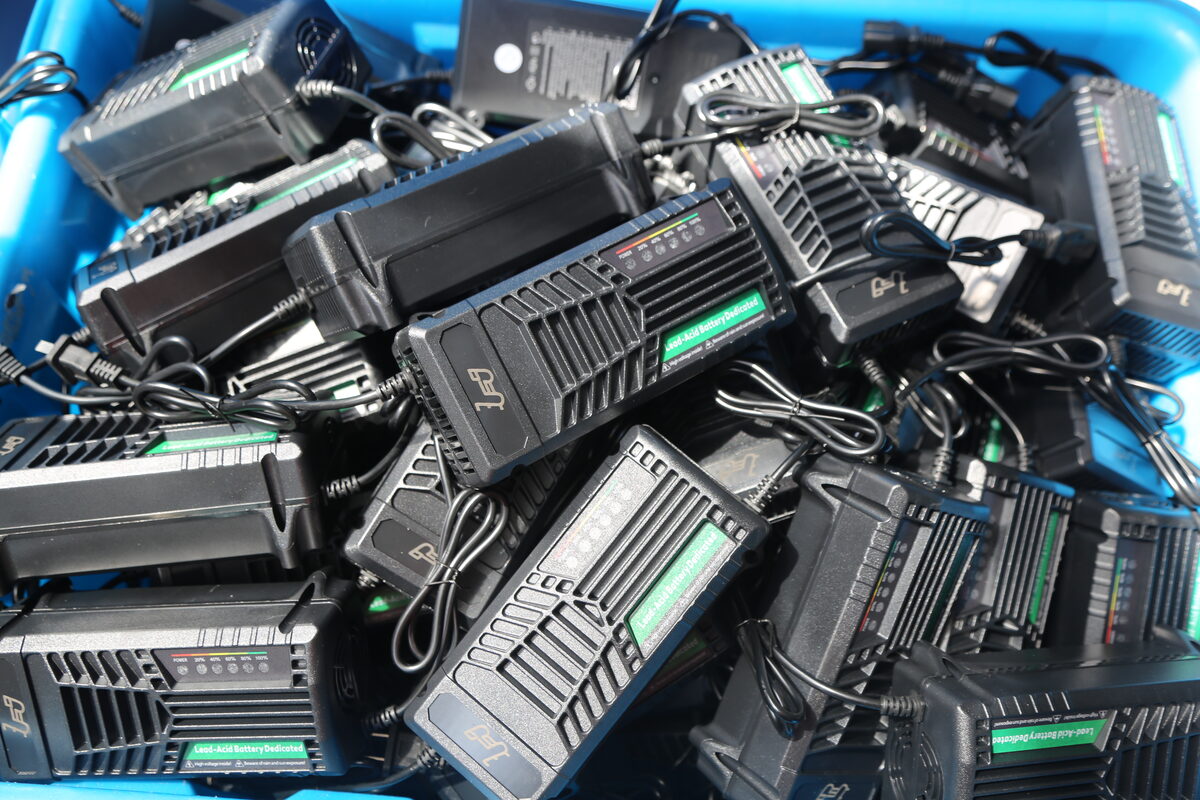
This is the clearest approach: one fixed profile, one battery specification, and one unmistakable label. It simplifies validation, field service, and operator training. Keyed connectors or visibly different housings can further reduce interchange risk.
2. One hardware platform with factory-locked variants
The supplier may use a common power platform while shipping separate firmware, labels, cables, and model numbers. This can reduce engineering and purchasing complexity without letting users select the wrong chemistry.
3. Automatically identified multi-profile system
For sophisticated equipment, the charger can identify or communicate with the battery and load only the approved profile. This requires a defined handshake, safe default state, error handling, cybersecurity consideration where applicable, and much more system validation.
Linjia supports housing, cable, connector, charging-curve, label, and communication customization through its OEM battery charger development service.
How to validate a multi-chemistry program
Build a test matrix that includes every approved charger profile, battery variant, connector, input range, and temperature condition. Record voltage and current across the cycle, stage transitions, termination, restart, BMS events, communication faults, connector temperature, charger temperature, and battery temperature. Also test foreseeable errors, such as connecting the wrong battery or losing communication.
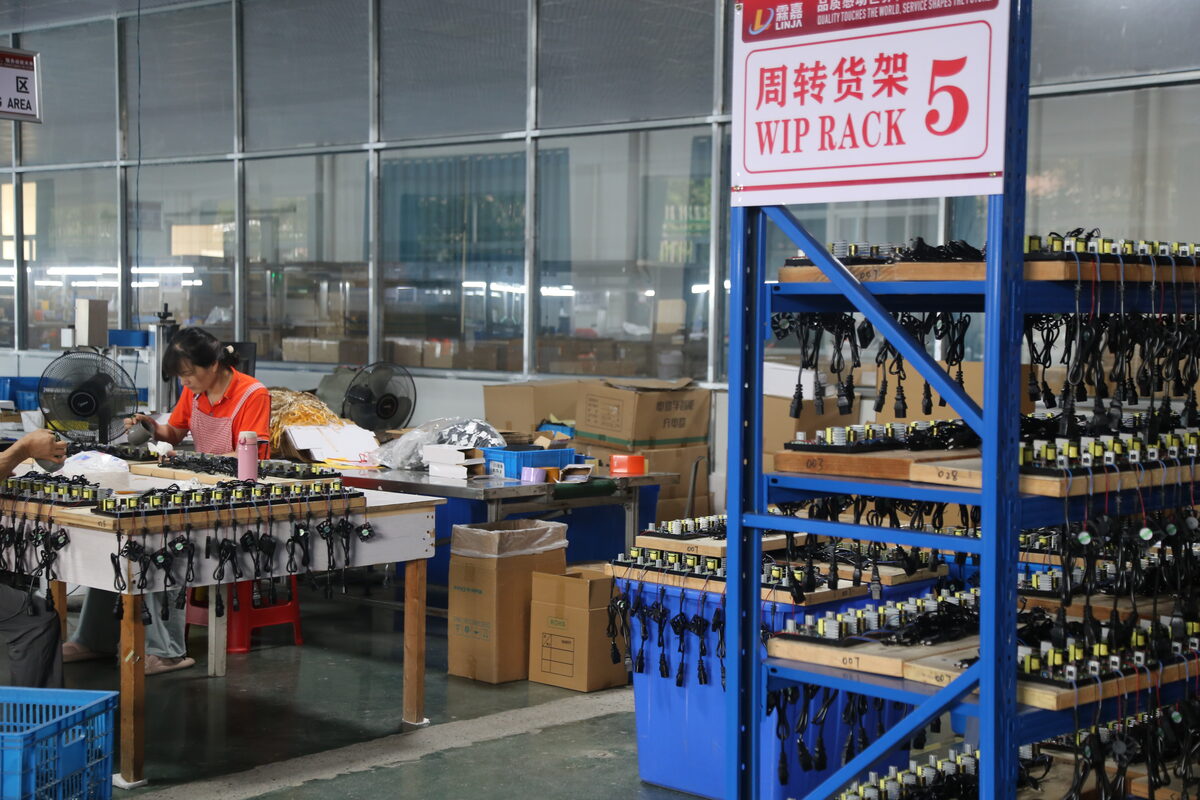
Production controls must prevent the correct hardware from receiving the wrong firmware or label. Recommended controls include unique part numbers, controlled programming files, barcode or serial-number linkage, model-separated work-in-process, connector and polarity checks, automated electrical limits, full-load burn-in, and final label verification. Linjia’s manufacturing process and quality controls describe the supporting factory steps.
Frequently asked questions
Can a 54.6V Li-ion charger charge a 48V LiFePO4 battery?
It is generally not a correct match for a common 16S LiFePO4 pack that requires a higher full-charge voltage such as 58.4V. It may stop early and fail to deliver the expected capacity or balancing behavior. Use the exact battery specification.
Can a 58.4V LiFePO4 charger charge a 13S Li-ion battery?
No, not unless the battery and charger are specifically engineered as part of an approved controlled system. A 58.4V fixed output is above the common 54.6V target for 13S Li-ion and can trigger protection or create a serious overvoltage risk.
Can a lead-acid charger be used on a lithium battery?
Do not assume so. Lead-acid stage logic, float behavior, temperature compensation, current, and voltage may be unsuitable. Use a charger with a profile explicitly approved for the exact lithium battery and BMS.
What if the connector and polarity are the same?
That proves only a physical and polarity match. You still must verify full-charge voltage, profile, current, BMS behavior, pinout, communication, temperature limits, and termination.
Is a multi-profile charger a good OEM solution?
It can be when variants share a properly rated hardware platform and profile selection is locked or automatically controlled. If users can easily select the wrong profile, dedicated keyed variants are often safer and easier to support.
Match the charger to the exact battery
The safest answer is simple: treat each 48V battery specification as unique until compatibility is proven. Match chemistry, series count, full-charge voltage, charge profile, current, BMS, connector, polarity, temperature range, and operating logic. To review a lead-acid, Li-ion, LiFePO4, or controlled multi-profile project, send Linjia Power the battery datasheet, BMS requirements, connector drawing, target charging time, input market, expected quantity, and branding needs.