Voltage fluctuation changes what a charger must tolerate at its AC input—not the battery’s approved charging voltage. A falling supply can increase input current and losses, reduce available output or trigger an orderly shutdown. A brief interruption may cause the charger to restart, while a high-voltage event needs a different protection strategy. For an OEM project, specify the actual voltage profile, charging load, ambient temperature and required recovery behavior, then approve the complete charger configuration against those conditions.
For vehicle manufacturers, battery brands and charger importers, “220V input” is not enough to judge real-world supply reliability. The practical question is how the finished charger behaves when the electricity at the charging socket is no longer steady.
Not every voltage fluctuation is the same fault
A voltage printed on the wall outlet, local supply specification or product label is a nominal reference. It does not describe every second of operation at a busy charging location. Buyers should distinguish the following events before asking an engineer for “wide-voltage protection.”
- Extended low voltage (brownout): the AC supply remains below its intended operating level for a meaningful period. This can challenge full-output operation and thermal design.
- Short voltage dip: the voltage falls briefly and returns. The charger may maintain operation, reduce output, reset or stop depending on its specific design and the event duration.
- Interruption or repeated on/off supply: energy from the wall disappears or repeatedly returns. Starting behavior, inrush current and the control sequence become relevant.
- High input or transient surge: voltage exceeds the expected operating level or changes very quickly. Continuous overvoltage and short surges are different events requiring different assessments.
A measured AC operating range, an under-voltage shutdown point, a surge withstand specification and a required hold-up time are therefore separate requirements. One marketing phrase does not establish all four. The related 110V, 220V and wide-range input selection guide explains which nominal input configuration to choose; this article focuses on what happens when that supply varies after installation.
Why low AC voltage changes the input design
Input current and heat cannot be ignored
For a similar delivered output power and similar efficiency, the approximate input power relationship is input power ≈ RMS input voltage × RMS input current × power factor. If voltage decreases while input power and power factor remain comparable, input current generally needs to rise. The real behavior depends on the input topology, control method and power limits. Higher current can increase stress and loss in the input path, including connections, switching devices and other current-carrying components.
That is why a charger should not be approved simply because it turns on at the lowest requested voltage. Engineering must determine whether it can provide the agreed output continuously, whether it must derate, and whether component temperatures stay within their approved limits. Texas Instruments describes brownout-related thermal stress and control behavior in its UCC28065 PFC controller documentation. Those device specifications are examples of electrical design principles, not specifications for a Linjia charger.
Input protection is a sequence, not a checkbox
An AC-to-DC charger may include rectification, filtering, power conversion, control and protective functions, but the implemented architecture depends on the model. A protective threshold should be chosen with adequate margins, measurement tolerance, load and operating conditions in mind. Engineering may need to define when charging begins, when it reduces or stops, and the voltage and timing needed for a restart.
Input undervoltage lockout is not a cure for an overloaded supply. It is one way a designed circuit can avoid unsuitable switching or operating conditions. If the actual supply remains below an approved threshold, the appropriate result may be reduced output or no charging rather than forced full power. Examples of brown-in, brownout and soft-start behavior appear in TI’s AC-to-DC controller information; features must be verified on the exact proposed charger model.
Low voltage, high voltage and surges need different evidence
A broad steady-state input range does not automatically prove tolerance of repeated dropouts, sudden voltage restoration or fast surges. Surge protection also should not be described as protection against every long-duration overvoltage. The selected components, insulation design and applicable safety or EMC requirements must be reviewed for the target configuration and market. Never test mains-powered equipment by improvising wiring or bypassing protective devices; qualified technicians should use suitable controlled instrumentation.
The battery should not receive an uncontrolled response
AC input performance and battery-side charging approval are two different parts of the specification. At a lower AC input, a capable converter may still regulate the required DC output within its operating envelope. Outside that envelope, it may reduce available current, shut down or restart. A buyer should not assume that a “48V charger” will maintain a particular current under every supply condition—or that restarting will resume the correct charge stage automatically.
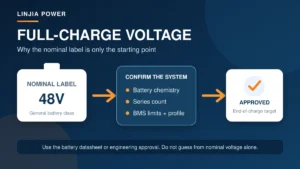
For lead-acid batteries, confirm the selected charging profile, voltage limits, current and any restart state. For lithium systems, confirm the battery manufacturer’s full-charge setting, current limits, BMS behavior and the response to an interrupted charging session. Do not change an approved battery charging voltage to compensate for poor AC supply. Refer separately to Linjia’s full-charge voltage guide when specifying the battery-side requirements.
Recovery behavior is a purchasing issue as much as a circuit issue. If mains voltage repeatedly crosses a threshold, a charger may cycle between starting and stopping unless its control strategy prevents undesirable rapid repetition. Buyers should ask whether the proposed model has appropriate restart conditions, fault indication and any required delay or hysteresis. They must not infer these features from the phrase “automatic charger.”
Buyer decision table: match the supply problem to the design evidence
| Observed condition | What could change | Buyer should request |
|---|---|---|
| Sustained low input | Input current, component temperature, available output | Confirmed minimum operating input and output or derating at that condition |
| Short dips | Charging continuity or control reset | Defined dip depth/duration and observed output/recovery response |
| Repeated supply loss | Startup sequence, interruption of charge cycle | Restart behavior, permitted cycling and BMS/battery coordination |
| High steady-state input | Operating boundary and protection response | Maximum permitted input and stop/recovery conditions |
| Fast surges | Stress on protective and input components | Applicable qualification method and model-specific evidence |
| Low input plus high ambient | Combined electrical and thermal margin | Sustained output and temperatures under the combined worst relevant condition |
Do not copy test voltages, surge levels or pass thresholds from an unrelated product. These values must come from the target market requirements, agreed installation conditions and approved model specification.
Build an acceptance matrix before releasing a bulk order
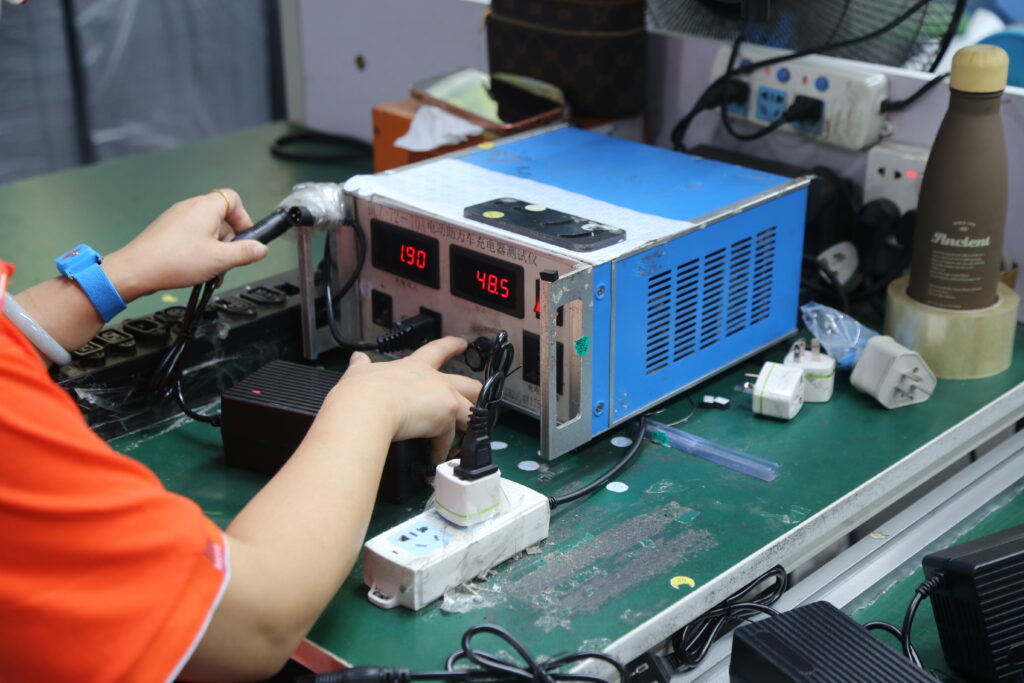
A sample that works during a five-minute office demonstration does not establish performance at a real charging site. Ask engineering and the supplier to agree the exact test conditions, measurement method, stabilization period, output load and pass criteria. The following is a proposed procurement test plan—not a claim that Linjia has completed every test for every charger model.
| Test case | Conditions to specify | Acceptance evidence |
|---|---|---|
| Normal input | Target nominal AC and agreed DC load | Input readings, regulated output and charging behavior |
| Lowest required continuous input | AC minimum, sustained load, cooling and ambient | Available output, efficiency or input draw as relevant, component thermal review |
| Input sag and restoration | Defined voltage profile and duration | Output state, fault indication and recovery sequence |
| AC interruption and return | Defined interruption and repeat count | Safe startup, charging-stage and battery/BMS coordination |
| High operating input | Approved upper AC condition | Normal operation or specified protective response |
| Combined site condition | Low input plus expected elevated ambient and duty | Sustained output, temperatures and operating margin |
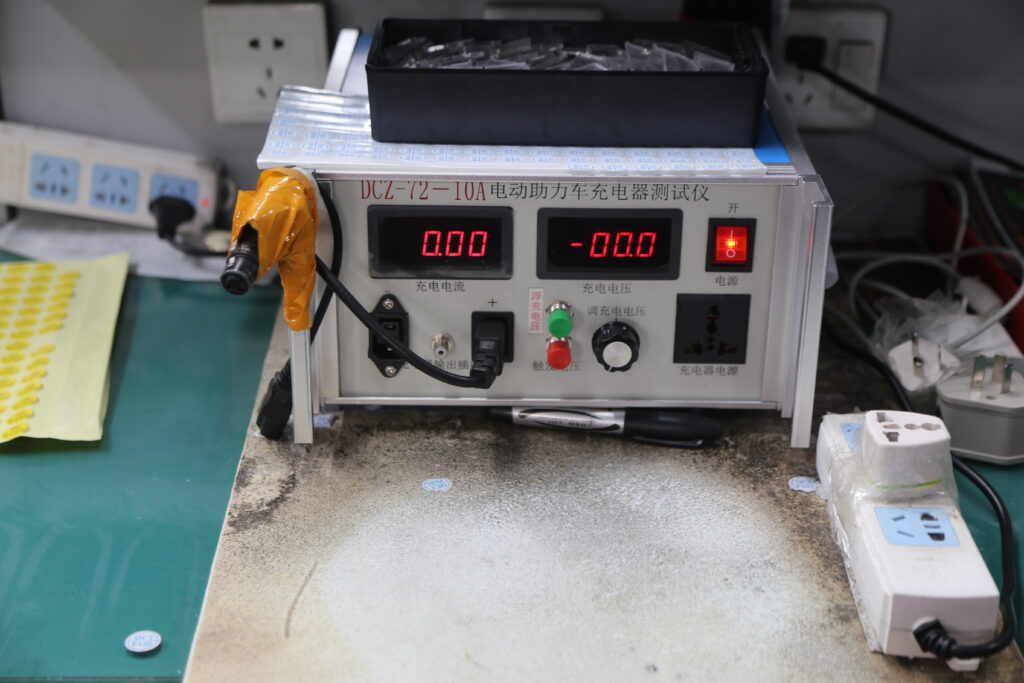
Record both the input at the charger’s terminals and the DC behavior. Measurements made only at a distant distribution board may miss wiring-related voltage drop at the socket. Where practical, include the customer’s real installation information and the proposed AC cord, plug, DC connector and mounting arrangement. A battery or representative load must be selected and controlled by qualified engineering personnel according to what is being evaluated.
How Linjia ties input requirements to production control
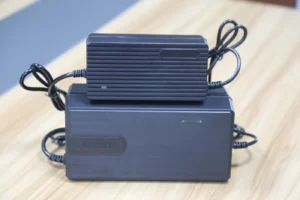
Linjia Power manufactures AC-to-DC chargers for lead-acid and lithium battery applications, with input and regional plug configurations reviewed in OEM/ODM projects. We treat the customer’s supply environment as an engineering input alongside battery specifications, connector polarity, installation and cooling—not merely a note on the packaging.
Our factory’s established workflow includes incoming inspection, PCBA manufacturing and checking, assembly inspection, electrical checks, insulation-related testing, full-load burn-in and final verification. These stages help control batch consistency. They do not, on their own, certify performance against an unspecified grid fluctuation or surge requirement. A special AC input condition should first be approved for the exact configuration; any necessary production control points must then reference that approved revision.
For a project that needs additional validation, the buyer and engineering team should determine which tests belong to type or sample qualification and which need routine production checks. This avoids making an unsupported promise that every shipped unit has undergone a laboratory simulation of every possible grid fault. Related reading: how full-load burn-in supports charger quality control and how hot climates change charger design decisions.
What information should a charger buyer send?
- Target market and installation: country, charging site, socket/plug type, wiring environment and intended ambient range.
- Grid data: nominal frequency and voltage, recorded minimum/maximum if available, dip or interruption observations and the duration/frequency of disturbances.
- Required behavior: acceptable derating, continuity, fault indication, stop and restart requirements.
- Battery: chemistry, nominal and full-charge voltage, capacity, approved charge current, BMS limitations and connector/polarity.
- Commercial project: expected quantity, required charging time, sample approval plan, documentation and configuration reference.
Is a wide-input charger automatically protected from unstable electricity?
No. The continuous AC rating addresses an operating interval. Dips, interruptions, overvoltage and surges have separate characteristics and must be assessed independently.
Can a charger keep delivering full output when AC voltage falls?
Only if that performance is within its verified operating envelope. Some designs can regulate output over a specified range; others need to reduce output or stop. Request evidence at the required load and temperature.
Does a low-voltage shutdown mean the charger is defective?
Not necessarily. A controlled shutdown outside the approved operating range can be the intended response. A failure to meet an agreed in-range requirement is a separate matter requiring investigation.
Should buyers test low input and high temperature together?
Yes, when those conditions can occur together in the intended service. Separate nominal-room-temperature checks cannot demonstrate performance under the combined condition.
Discuss your charger input requirements with Linjia Power
For an OEM/ODM charger project, send your AC supply observations and battery specifications together. Linjia can review the appropriate design and validation scope through our custom battery charger development process. Include estimated order volume and the sample acceptance requirements rather than relying on “220V” or “wide voltage” alone.
Send your AC input and battery specifications for engineering review