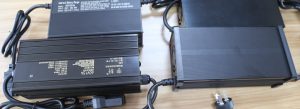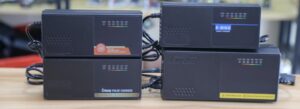
A 60V charger for an e-scooter or electric three-wheeler must match the actual battery pack, its charging voltage and its permitted current. A five-block lead-acid pack and a lithium pack sold in the same voltage class can require different charging profiles. Vehicle layout also matters: a removable scooter battery, an onboard charging port and a depot-charged three-wheeler can present different cable, cooling and approval requirements. Use this 60V charger guide to turn those differences into a controlled purchasing specification.

What Does 60V Mean on the Battery and Charger?
Keep three entries separate on the project specification: nominal pack voltage, charging-voltage target and charging current. The vehicle’s “60V” description normally refers to its battery voltage class. The charger’s output must follow the battery manufacturer’s charging specification, including the relevant stages, tolerances and termination conditions.
A five-block lead-acid pack: add voltage, not amp-hours
If a vehicle uses five identical 12V 20Ah lead-acid batteries connected in one series string, the nominal pack is 60V 20Ah. It is not 60V 100Ah. Series connection raises voltage while the string retains the individual battery’s rated Ah capacity, assuming matched batteries and the same rating conditions. Using the incorrectly added capacity could lead to an unsuitable current request.
This follows the series-connection principle illustrated in Victron Energy’s Wiring Unlimited battery-bank reference. The actual lead-acid charging stages still come from the battery supplier; multiplying five by 12V does not determine the end-of-charge setting.
A lithium pack: identify the series count and approved cell target
Where the battery specification explicitly calls for 17 cells in series charged to 4.2V per cell, the calculated pack target is 17 × 4.2V = 71.4V. This is a conditional example, not a rule for every battery marketed as 60V. A different series count, chemistry or approved cell target changes the result. LiFePO4 requires its own confirmed pack specification.
| 60V project reference | What it establishes | What still needs approval |
|---|---|---|
| Five 12V lead-acid blocks in series | 60V nominal pack voltage | Battery type, charging stages, voltage targets and temperature conditions |
| 17-series lithium-ion pack with an approved 4.2V cell target | 71.4V calculated pack target | Pack-level tolerance, BMS requirements, charge current and termination |
| Linjia’s listed 60V lithium series | Catalogued 71.4 ± 0.2V output | Whether that specific configuration is accepted by the battery and BMS |
| Linjia’s listed 60V MX/YF/MY lead-acid series | Catalogued 73.3–74.0V output | The exact model, charging behaviour and battery-maker requirements |
These catalogue entries show why two “60V” chargers should not be interchanged by their name. Review the 60V lead-acid charger range or the 60V lithium charger configurations according to the battery chemistry. For the underlying terminology, see our full-charge voltage guide.
Define the Vehicle Layout Before Selecting the Charger Structure
“E-scooter” can describe a seated scooter, an electric moped or a standing kick scooter. “Electric three-wheeler” can describe passenger, cargo or utility equipment. These names do not establish battery capacity or charger power. Confirm the actual vehicle and how the operator connects it for charging.
| Vehicle and charging arrangement | Check on the actual vehicle | Purchasing consequence |
|---|---|---|
| Seated scooter with a removable battery | Whether the charger mates directly with the battery or through a separate dock | Approve the battery-side interface and any required interlock or communication |
| Scooter charged through a vehicle port | Vehicle harness, port pinout, cable route and available parking clearance | Test through the complete charging path, not only on a loose battery |
| Passenger electric three-wheeler | Charging location, pack arrangement and required time before the next shift | Validate the selected current against the real charging window |
| Cargo or utility three-wheeler | Pack specification, charger mounting or storage, and cable handling during work | Review mechanical fit and thermal conditions alongside electrical compatibility |
| Standing kick scooter described as 60V | Exact pack designation and any proprietary charging interface | Assess it as a separate platform; do not copy a seated-scooter configuration |
A three-wheeler’s load rating or a scooter’s motor wattage does not directly determine charging current. Start with the battery and the approved charge path. Passenger-platform buyers can also review the e-rickshaw charger application requirements.
Choose Current From Capacity and the Available Charging Window
First record how much charge the vehicle normally needs to replace, then define the hours available before it returns to service. This is more useful than requesting “the fastest 60V charger” without a battery specification.
As a preliminary calculation, replacing 20Ah at a constant 5A takes 4 hours; at a constant 10A it takes 2 hours. These are ideal constant-current calculations only. They exclude current taper, lead-acid charge return losses, balancing, temperature restrictions, interruptions and other charging stages. They are not promised full-charge times.
The same current also represents a different charge rate for different capacities:
| Illustrative pack capacity | Illustrative charging current | Current divided by capacity |
|---|---|---|
| 20Ah | 5A | 0.25C |
| 60Ah | 5A | Approximately 0.083C |
| 60Ah | 10A | Approximately 0.167C |
This table explains the calculation; it does not recommend these currents. The selected value must remain within the battery manufacturer’s allowed charge rate, the BMS charge-current limit where fitted, and the ratings of the complete charging path. Do not substitute a BMS discharge-current rating for its charging-current rating.
For a scooter parked overnight, the available window may allow one current level. A three-wheeler required for another shift may present a shorter window. If the battery cannot accept the current needed for that schedule, the operating plan or battery system needs review; increasing the charger rating alone does not resolve the constraint.
Use Actual Charging Voltage When Comparing Power and Cooling
For a configuration operating at 71.4V and 3A simultaneously, DC output power is approximately 214W. At 71.4V and 10A it is approximately 714W. These figures come from voltage multiplied by current. They are neither AC input ratings nor measurements of charger efficiency, and output power changes over the charge cycle.
This explains why a compact charger and a higher-current unit should be assessed in their actual installation. Confirm ventilation clearance, the position of cooling openings, ambient conditions and the maker’s permitted mounting arrangement. A fan opening does not establish an ingress-protection rating, and a ventilated enclosure should not be assumed suitable for rain or splash exposure.

Also check the destination’s actual AC supply and the input range printed on the proposed unit. A local wall plug confirms mechanical fit with the socket; it does not prove wide-input capability. Keep input voltage, frequency and plug selection on the same approved specification as the DC output.
Keep Charging Ports and Service Spares Distinct Across 60V Platforms
A brand may sell a 60V lead-acid vehicle and a 60V lithium vehicle with similar styling. If the chargers look alike, a service team can select the wrong spare even when purchasing ordered the correct part.
Assign a separate approved charger part number to each battery configuration. Link that number to the full-charge target, current, profile revision and connector drawing. Keep a compatibility record for the vehicle or battery model rather than labelling every spare simply “60V charger.” Labels and packaging should help the dealer distinguish the approved variants.
For a removable pack, verify whether its direct charging socket uses the same electrical definition as the vehicle’s port. A physically matching plug does not prove this. Document power pins, polarity and any signal or interlock pins, then validate the intended connection with a mating sample. An adapter needs its own electrical and current-rating review.
Approve One Complete Configuration Before Repeating Orders
Linjia’s manufacturing view: “60V” is a product family label, not a complete production instruction. A useful approval record connects one battery specification to one charger configuration, including the electrical settings, connector drawing, input version and label reference. This is especially important when a vehicle brand buys several currents or both lead-acid and lithium variants.
Linjia’s manufacturing controls include electrical testing, dielectric withstand checks and full-load burn-in. These production checks support an agreed configuration; a successful factory test cannot establish compatibility with an unidentified battery. During sample evaluation, verify a complete charging cycle with the intended pack, BMS and vehicle harness, and record the conditions used.
When a battery supplier, cell series, BMS, port or charging current changes, review the linked charger approval. Our guide to sample approval and mass-production consistency explains how to preserve that reference across repeat orders.
Questions Buyers Ask About 60V Chargers
Can a 60V charger compensate for one weak lead-acid battery in a series string?
A correct total pack voltage does not prove that every block is in the same condition. A weak or unbalanced block needs battery-level diagnosis. Changing the pack charger’s voltage or current without the battery supplier’s guidance is not a substitute for that diagnosis.
Does a 1,000W motor require a 1,000W charger?
No. Motor power describes the traction system. Charger selection follows the battery’s approved charging limits and the required replenishment schedule, together with the charging-port and harness ratings.
Can a 60V lead-acid vehicle be converted to lithium while keeping the charger?
The conversion requires a new compatibility review. Compare the new pack’s chemistry, charging target, profile, BMS and interface with the existing charger. Reuse is possible only if the complete configuration is specifically supported and approved; the shared nominal-voltage class is insufficient.
Does “45Ah” in a charger model mean 45A charging current?
No. Ah is a capacity unit; A is a current unit. A model name may refer to an intended battery-capacity class, but the charger’s actual output current must be read from its approved specification. Do not turn a model code into a charging-current instruction.
Request a 60V Charger Configuration Review
Send the vehicle type and destination market; battery chemistry, series arrangement, nominal and full-charge voltage; capacity and permitted charge current; BMS charging requirements; port photos, pin definition and polarity; AC input and plug; installation conditions, charging window and expected order quantity. Include the existing charger label where available.
With those inputs, Linjia Power can assess a matched configuration for sample evaluation and OEM or ODM supply.
Technical reference: Victron Energy, Wiring Unlimited, battery-bank wiring. Linjia catalogue voltage examples checked on 21 October 2026. Calculations are illustrative; the current approved battery and charger specifications govern each project.