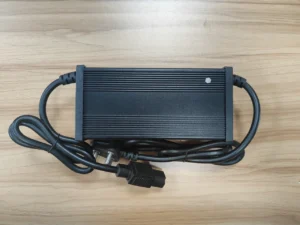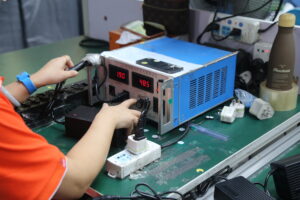
Natural cooling uses the charger’s thermal structure and surrounding air without a cooling fan. Fan cooling adds forced airflow and can support a higher continuous output within a particular design. Choose between them using the required charging power, ambient temperature, installation space, noise limits and maintenance conditions. Both need a model-specific operating specification and validation in the intended installation.
For vehicle manufacturers, battery brands and importers, this decision affects more than the enclosure price. A charger that performs on an open sample bench may face restricted airflow in a charging bay or vehicle compartment. This guide compares natural cooling vs fan cooling for battery chargers and explains what to put into an OEM sample-approval record.

Natural cooling and fan cooling at a glance
Compare the two arrangements at the same required DC output and under the same operating conditions. A fanless model and a fan-cooled model can have different dimensions, component selections and approved power limits.
| Decision factor | Natural cooling | Fan cooling |
|---|---|---|
| Heat removal | Heat passes through the designed thermal paths to the housing, heatsinks and surrounding air. | A fan moves air through or across the thermal structure; the airflow route remains important. |
| Continuous output | Must stay within the approved passive-cooling envelope. | Can allow greater continuous output in a given design when the specified airflow is available. |
| Acoustic requirement | Eliminates cooling-fan noise. Other electrical or mechanical sounds may still be present. | Fan sound depends on the fan, speed control, load and installation. |
| Dust and maintenance | Has no fan to wear or service; vents and heat-transfer surfaces can still become obstructed. | Adds a moving component and an airflow path that may collect contaminants. |
| Mounting space | Needs the specified orientation and clearance for passive heat removal. | Needs clear inlet and outlet paths and separation from recirculating hot exhaust. |
| Moisture protection | Fanless construction alone does not establish an ingress-protection rating. | A fan or grille alone does not establish the permitted moisture exposure. |
| Acceptance evidence | Output and temperature data in the intended mounting arrangement. | The same data, plus the specified fan operation and relevant protection behavior. |
Start with the battery and application requirements, then assess cooling. For a compact vehicle project, the e-bike battery charger options provide an application starting point. Use the battery charger selection guide to organize chemistry, charging voltage, current, interface and environment before selecting a structure.
When should an OEM buyer evaluate natural cooling?
Natural cooling is useful when the project places a high value on low noise and avoiding a fan as a service item. The design must move heat from internal components to surfaces that can release it. Depending on the charger, that can involve heatsinks, thermal interfaces and the housing, followed by natural air movement around the unit.
TDK-Lambda’s convection-cooling explanation describes why clearance and mounting direction matter. For a charger buyer, the practical question is whether the proposed position preserves the manufacturer’s intended heat-removal path. Request the selected charger’s own installation limits.
Evaluate a naturally cooled design when the required output can be maintained throughout the agreed charging duty, at the highest intended ambient temperature and within the available space. A room-temperature demonstration at reduced output leaves that decision unresolved. Include nearby equipment and the way chargers will be spaced in the real installation.
There is no universal charging-current boundary that divides fanless and fan-cooled chargers. The actual output voltage, efficiency, enclosure size and thermal design all influence the choice. A statement such as “every charger below a certain amperage is fanless” is insufficient for approving an OEM configuration.
When is fan cooling worth evaluating?
Evaluate forced airflow when the required heat removal is difficult to achieve passively within the available size and operating environment. A fan-cooled design may provide the required continuous output in a smaller structure, but the supplier must define the airflow conditions and permitted operating envelope.
As a power-electronics example, TDK-Lambda specifies different continuous output ratings for convection and forced-air operation in its CUS500M1 announcement. This illustrates why cooling conditions belong beside a power rating. Those ratings apply to that product and are not specifications for Linjia chargers.
Ask whether the fan runs continuously, follows load, or responds to temperature. MEAN WELL’s power-supply FAQ, questions 25 and 66, describes load- and temperature-based control and explains the tradeoff between airflow and noise. Confirm the actual control behavior of the proposed charger, including its expected behavior during the different charging stages.
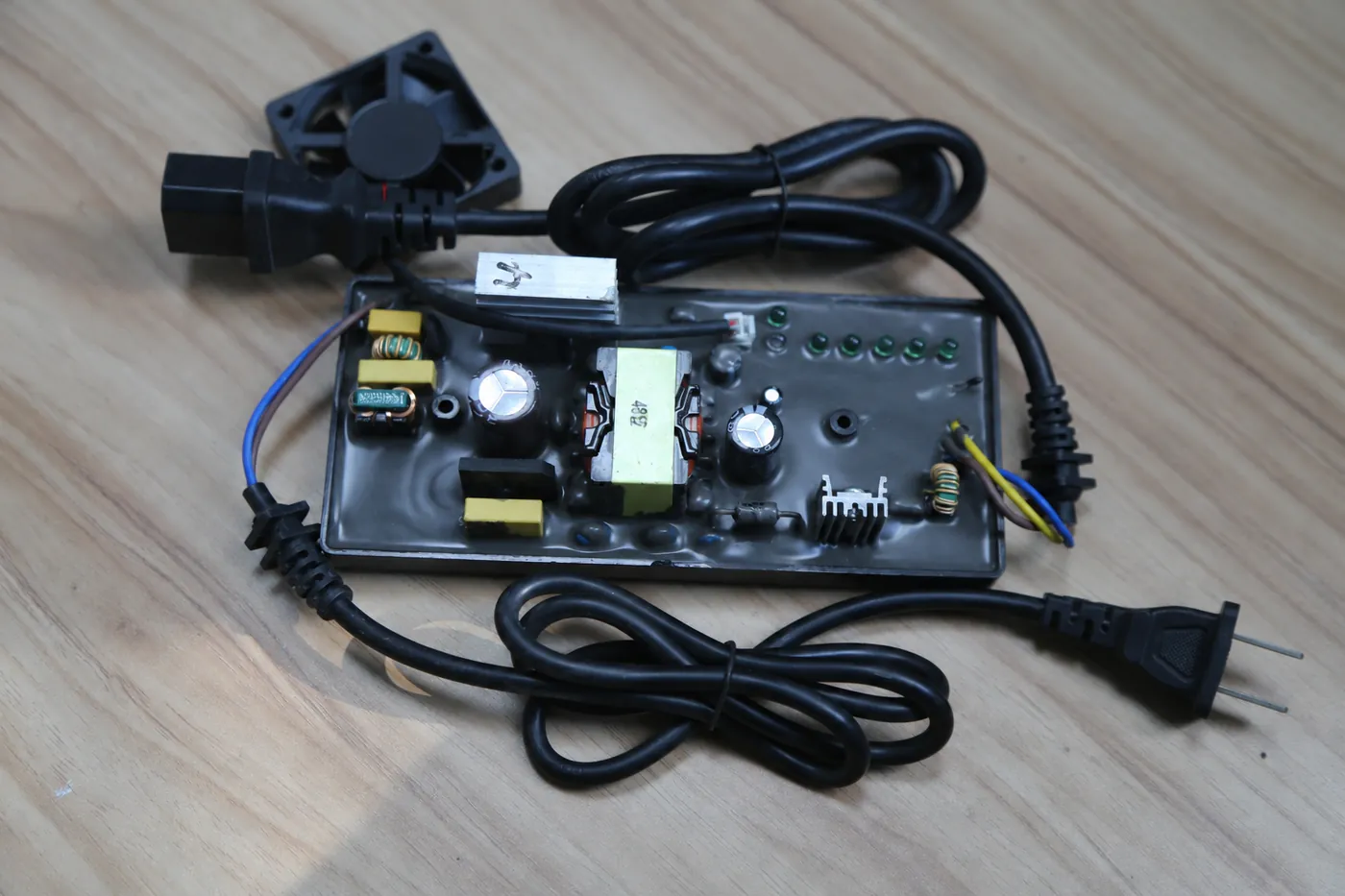
For procurement, record the approved fan specification and installation arrangement alongside the charger revision. A replacement fan with similar dimensions can have a different airflow, electrical requirement or control behavior. Changes need engineering review. Users should follow the manufacturer’s service instructions and should not remove or slow a fan to reduce noise.
Compare power and operating conditions before choosing a housing
Charging current alone does not describe the thermal demand
DC output power is approximately output voltage multiplied by output current at the operating point being assessed. Use the actual charging voltage rather than the battery’s nominal voltage label. Input power also includes conversion losses, so output watts and heat generated inside the charger are different quantities.
Arithmetic illustration: a charger delivering 300W at an assumed efficiency of 90% takes approximately 333W from the input; the difference is about 33W of conversion loss. These assumed values explain the calculation and do not describe a Linjia model. Actual losses vary with input, load and temperature, and their distribution inside the charger matters.
For current selection, keep the battery manufacturer’s charge limit, BMS limit, cables and connector ratings in the approval process. Adding a fan does not authorize a higher battery charge rate. Our 72V 5A vs 10A charger comparison addresses that separate current-selection decision.
Use the local air temperature and the real mounting space
Air reaching a charger in a crowded charging bay or equipment compartment can be warmer than air elsewhere in the building. Describe the intended placement, neighboring heat sources, charging schedule and clearance. For fan-cooled units, check that discharged hot air cannot readily return to the inlet or feed another unit.
TDK-Lambda’s mounting precautions explain how orientation can affect convection cooling and when output derating may be necessary. Obtain the charger’s own mounting and derating instructions. Do not transfer a clearance distance or temperature limit from another product.
Define low-input and high-temperature requirements together when both can occur in service. The charger input-voltage guide explains why input coverage and available charging output need separate confirmation.
Specify dust, moisture, noise and maintenance separately
Describe the actual exposure rather than requesting a general “outdoor” or “dustproof” charger. A fanless unit can still have openings. Potting can form part of an environmental design, but the potting material and complete enclosure also affect heat transfer and serviceability. An IP claim requires evidence for the exact finished configuration.
Our potted vs non-potted charger comparison covers fill boundaries, material documentation, environmental evidence and service considerations.
For a noise-sensitive project, agree how and where sound will be assessed, together with charging load, ambient conditions and the number of chargers operating. For a dusty application, ask about the manufacturer’s permitted cleaning and service procedure. Adding an unapproved filter or cover can change airflow and calls for reassessment.
If a charger already shows abnormal heating in service, use the charger overheating checks for buyers to document the symptom and operating conditions before requesting a cooling change.
What should be validated before approving a charger sample?
Use a written acceptance plan for the complete cooling configuration. The following is a proposed buyer framework; it is not a statement that every Linjia model has completed each listed assessment. Qualified personnel should agree the methods, instruments and acceptance limits before testing.
| Assessment | Conditions to record | Decision supported |
|---|---|---|
| Sustained charging output | Model revision, AC input, actual DC voltage/current, charging stage, duration and ambient conditions. | Whether the required output remains available during the agreed duty. |
| Temperature assessment | Defined measurement points and limits, mounting direction, clearance and enclosure arrangement. | Whether the thermal design is acceptable in the intended installation. |
| Fan operation, where fitted | Approved fan identity, direction, start/stop or speed-control behavior and relevant charging conditions. | Whether the delivered configuration matches the sample and operating description. |
| Protection and recovery | Engineering-defined abnormal-condition tests and documented stop, reduction and recovery behavior. | Whether the agreed protection response is supported by evidence. |
| Noise and environmental needs | Agreed acoustic method and any required dust/moisture evidence for the finished model. | Whether the proposed installation and service plan meet the project requirement. |
Keep sample thermal qualification distinct from routine production checks. Linjia’s quality-control process includes electrical inspection and full-load burn-in within its manufacturing workflow. Ask which records apply to your exact model and which conditions were used.
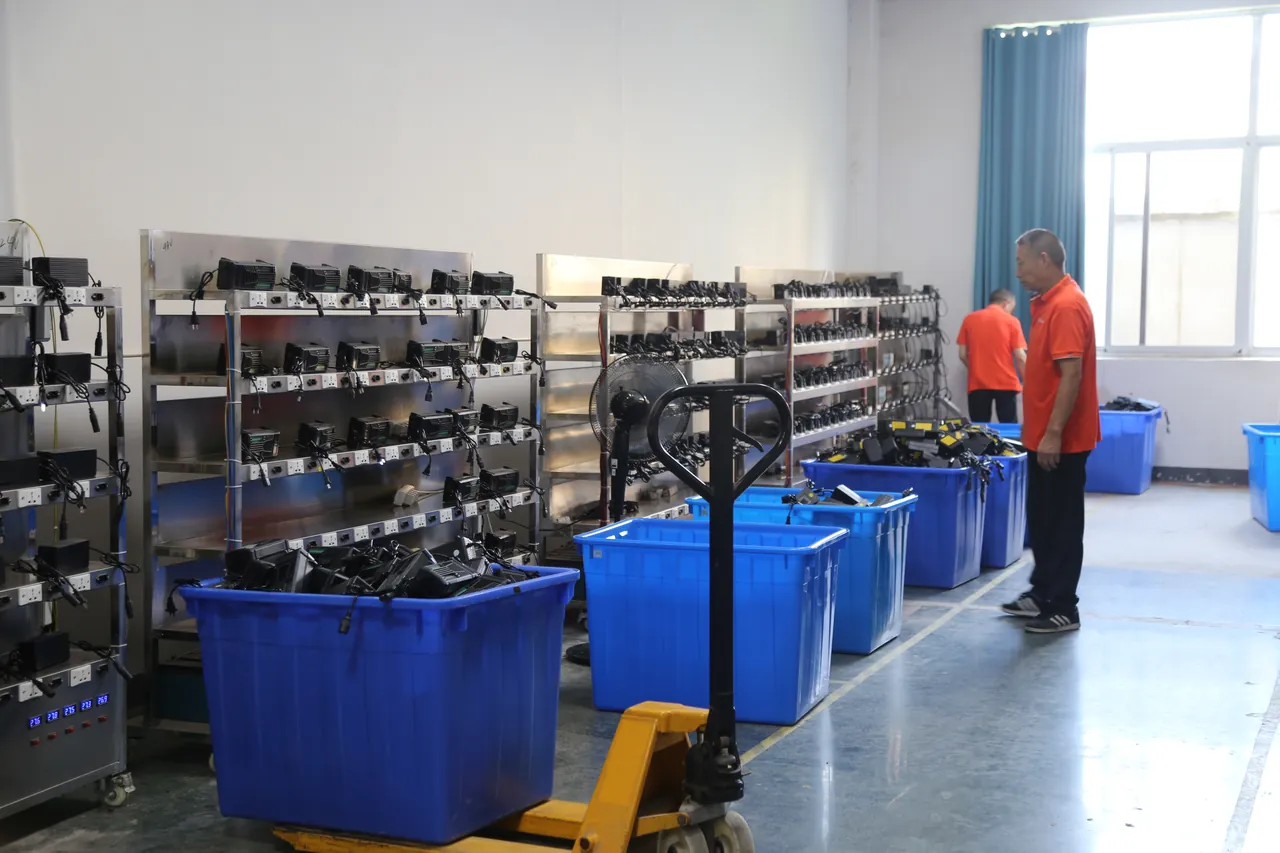
Our full-load burn-in guide explains the scope of that production step. A rack photograph documents a real setting; it does not establish a thermal limit, test duration or a pass result for a proposed product.
Linjia’s published charger FAQs identify naturally cooled, fan-cooled and potted structures as project options. Use the custom charger development process to agree the cooling arrangement, approve the sample and keep the relevant configuration under change control.
Buyer checklist for natural cooling vs fan cooling
Send these eight items with the RFQ so the supplier can evaluate a defined application:
- Battery: chemistry, nominal voltage, required charging voltage, capacity and battery/BMS charge limits.
- Charging requirement: intended current, charging profile, target turnaround and daily operating schedule.
- Input: AC operating interval, frequency, destination plug and any special supply conditions.
- Installation: available dimensions, mounting position, clearance and neighboring heat sources.
- Temperature: expected air temperature at the charger, including the hottest intended operating condition.
- Exposure: dust, humidity, water exposure and any required model-specific test documentation.
- Noise and service: acoustic requirements, permitted maintenance access and expected cleaning arrangements.
- Order control: connector/polarity, quantity, approved housing/cooling revision and sample acceptance requirements.
Does an aluminum housing mean the charger is naturally cooled?
No. Aluminum housings can be used with different cooling arrangements. Check the complete model specification, fan provision, thermal structure and operating limits. The case material alone cannot establish the cooling method.
Is a fan that stops during charging necessarily faulty?
Some designs control the fan by load or temperature. Compare the observed behavior with the exact model’s instructions and charging stage. Unexpected interruption, unusual heating, smell or noise should be referred to the supplier; do not open an energized charger or bypass protection.
Can the fan be removed to make a charger quieter?
Only a manufacturer-approved redesign and validation can establish fanless operation. Removing or slowing the fan changes the cooling conditions on which the original rating depends. Request a suitable low-noise configuration instead.
Does fan cooling make a charger charge faster?
A fan does not set the charging profile. It may help a particular design sustain its approved output, while the battery specification, BMS and charging current determine the permitted charging process. Compare complete approved configurations.
Request a cooling review for your charger project
Send your battery label or specification, charging voltage and current, connector photographs, AC input, mounting-space details, expected ambient conditions, noise requirement and quantity. Linjia can review the proposed structure against those project requirements. Submit your charger cooling and installation requirements and ask which operating conditions and sample records will support approval.
Technical references
Reviewed November 4, 2026. External power-supply examples explain thermal principles; their ratings and installation dimensions do not specify Linjia products.