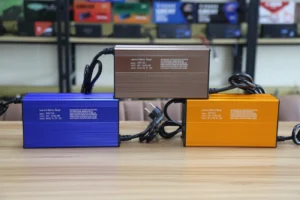
Choose charger input voltage from the actual AC supply and the exact operating range approved for the charger. A fixed 110V or 220V version can suit a defined supply market; a continuous wide-range version can cover multiple supply conditions when its specification permits them. Check frequency, available output at the lowest intended input, temperature, the AC cord and the regional plug. A wider AC input range does not approve the charger for a different battery.

AC input and battery output answer different questions
The input rating describes the power entering from the AC supply. The output specification describes what the charger delivers to its battery. A product described as a 48V battery charger may still require a particular AC input version. The battery voltage class does not identify the wall-supply voltage.
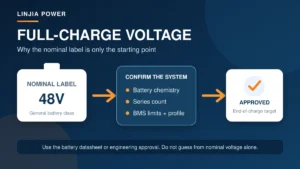
Keep two approval lines on the purchase specification: the AC supply and cord configuration, then the battery-side voltage, current, charging profile, connector and BMS requirements. Our full-charge voltage guide explains the battery-side decision. An AC input change should not silently change the approved charging settings.
Compare the input arrangement before comparing quotations
Ask what the supplier means by “110V/220V” or “wide input.” A sales description may refer to separate factory versions, two selectable operating bands, or one continuous range. Those are different configurations.
| Input arrangement | When to evaluate it | What must be written down |
|---|---|---|
| Fixed low-line version, often called 110V | A defined low-voltage AC supply market | The permitted minimum and maximum input, frequency and output conditions; do not infer them from “110V.” |
| Fixed high-line version, often called 220V | A defined higher-voltage AC supply market | The actual supported supply interval and output rating. A different plug does not convert this into a low-line version. |
| Selectable or separate low/high bands | A project with a controlled configuration process | Whether selection is automatic, factory configured or manual, and which intervals are approved. Two bands do not establish operation throughout the gap. |
| Continuous wide-range input | Multiple supply regions or a broader agreed operating interval | The continuous interval, frequency, output envelope, cooling conditions and exact model revision. |
TDK-Lambda’s AC-DC power-supply FAQ discusses input labeling and voltage selection. Treat ambiguous punctuation as a reason to ask for documentation. Users should not open a charger or change an internal selector to try to make an incompatible unit work.
Read the actual range, frequency and conditions
“Universal” and “wide range” are descriptions, not complete acceptance limits. For illustration, a specification of 100-240VAC states a particular interval; it does not authorize operation below 100VAC or above 240VAC. If a datasheet specifies a different operating interval from the rating label, obtain the manufacturer’s written explanation for that exact model.
Check the frequency separately. A marking that includes both 50Hz and 60Hz should not be assumed from a broad voltage range. Record the destination supply frequency, the permitted frequency range and any associated output conditions. TDK-Lambda’s FAQ explains why labels and operating specifications need to be read together; its examples do not extend a Linjia product’s rating.
A useful RFQ sentence is: “Please confirm continuous operation over our stated AC voltage and frequency interval, at the required DC output and ambient conditions, and identify any derating.” This asks for a defined operating envelope rather than a general compatibility assurance.
Will the charger provide the required output at low line?
For a given DC output, lowering AC voltage generally increases the required AC current. Efficiency and power factor also matter. TDK-Lambda’s input-filter selection explanation specifically warns against estimating input current from output watts and mains voltage alone.
Arithmetic illustration only: assume 300W DC output, 90% efficiency and a power factor of 0.95 at both operating points. Using IAC,RMS = PDC / (efficiency × VAC,RMS × power factor), the estimated input current is approximately 3.19A at 110VAC and 1.59A at 220VAC. These assumed values are not Linjia ratings, cable-sizing instructions or branch-circuit design values. Real efficiency and power factor change with operating conditions.
This is why “starts at the minimum input” and “delivers full rated charging power there” need separate answers. Some designs require reduced output at low line. Temperature and cooling can impose further limits. TDK-Lambda’s derating explanation describes these constraints for its own power supplies; the selected charger’s documentation must define the applicable limits.
Ask for the available charging current at the lowest intended input and highest intended ambient temperature together. Do not combine a favorable voltage result from one test with a favorable temperature result from another and assume the combined condition has passed.
Confirm the AC cord and supply conditions separately
A passive plug adapter changes the mechanical connection; it does not transform supply voltage. Approve the cord assembly’s voltage and current ratings, termination, required protective earth and destination plug configuration for the selected charger. A physically fitting plug does not establish electrical suitability.
The IEC 60884-1 publication summary identifies plugs and socket-outlets as rated accessories and notes the existence of different standardized systems. It does not certify a particular cord or establish all requirements for a destination. Obtain the applicable model and market documentation rather than treating an international reference as blanket approval.
For installations with voltage dips, long supply leads, generators or inverter-fed AC, provide the expected conditions before selection. Specify the voltage at the charger connection under load, frequency, interruptions and any special supply characteristics. A continuous input range alone does not establish immunity to short surges, repeated interruptions or an unsuitable waveform. Ask for agreed behavior and evidence for those conditions.
Turn the input requirement into a sample-acceptance record
The following is a proposed buyer acceptance framework, not a claim that every standard Linjia model has passed these tests. Qualified personnel should define the test methods, instruments and acceptance limits for the exact configuration.
| Review item | Evidence to request | Procurement decision |
|---|---|---|
| Minimum intended input | Startup and sustained output at the agreed load and ambient conditions | Confirm the required charging current is available or record the accepted reduction. |
| Upper intended input | Operation within approved output and temperature limits | Approve the actual upper operating condition, not just a nominal voltage. |
| Frequency and interruptions | Agreed frequency coverage and specified stop/restart behavior | Record expected recovery and any limitations relevant to the installation. |
| AC current and connection | Input-current data under stated conditions, separate startup/inrush information where needed, and approved cord details | Have the installation and cord selection evaluated using the correct data. |
| Production reference | Model and revision, input configuration, cord, label and approved sample record | Prevent a different input version from being substituted during later orders. |
Keep the input version under production control
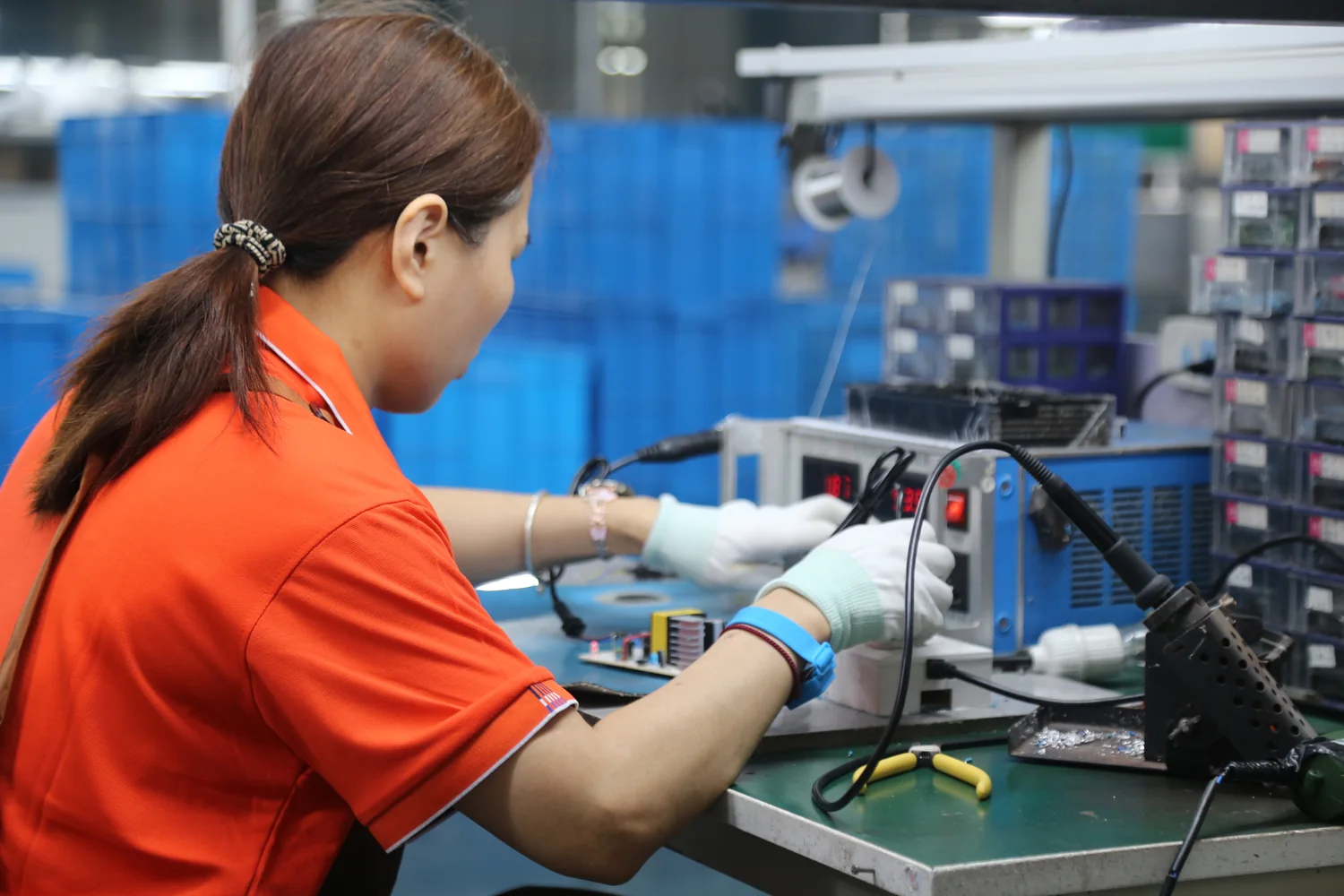
Linjia’s published development process reviews local AC input alongside battery and project requirements, then records the approved sample and key configuration before production. For an OEM request, use the custom battery charger development process to define the required input version together with the battery output and interface.
Our founder’s wide-voltage charger interview explains why broadening input coverage involves the input-stage design. The manufacturing implication is to control the electrical version as well as the plug and label. Matching the housing or changing a sticker does not establish equivalent electronics.
Linjia’s charger quality-control process includes model-specific electrical checks and final configuration verification. Confirm which checks belong to sample qualification and which belong to routine production. A burn-in record at one input condition does not by itself document the complete operating envelope.
What to send with an input-voltage RFQ
- Destination market, actual intended AC minimum/nominal/maximum, frequency, and available supply information.
- Whether one continuous input version or separate market-specific versions are required.
- Required DC output, battery chemistry, exact charging endpoint, permitted current and BMS requirements.
- Ambient temperature, ventilation, installation position, expected operating duration and special supply conditions.
- Plug and cord drawings or references, required ratings, protective-earth arrangement and market documents.
- Quantity, model identification, label requirements and the proposed sample-acceptance record.
Does a wide-input charger charge faster?
Not from its input range alone. Compare the approved DC charging current at the actual AC voltage and temperature. Battery limits and the charging profile still govern the charging process.
Can I assume a unit sold as 220V works on a 230V or 240V supply?
Check the specified operating interval for that exact version. A sales shorthand is insufficient, particularly when the intended supply can vary. Obtain written confirmation if the rating or documentation is unclear.
Can one wide-input model simplify distribution?
It can reduce the number of electrical input versions when the approved range covers all intended supplies. Keep country-specific cord, labeling and compliance requirements in the order matrix. One electrical version does not necessarily mean one finished SKU.
Request a charger input specification review
Send the AC supply interval and frequency, required charging output, battery and BMS data, plug requirements, operating environment and quantity. Include any low-line output requirement and the conditions you want documented during sample approval. Send Linjia your charger input and project specifications so the proposed configuration can be evaluated before an order is finalized.