
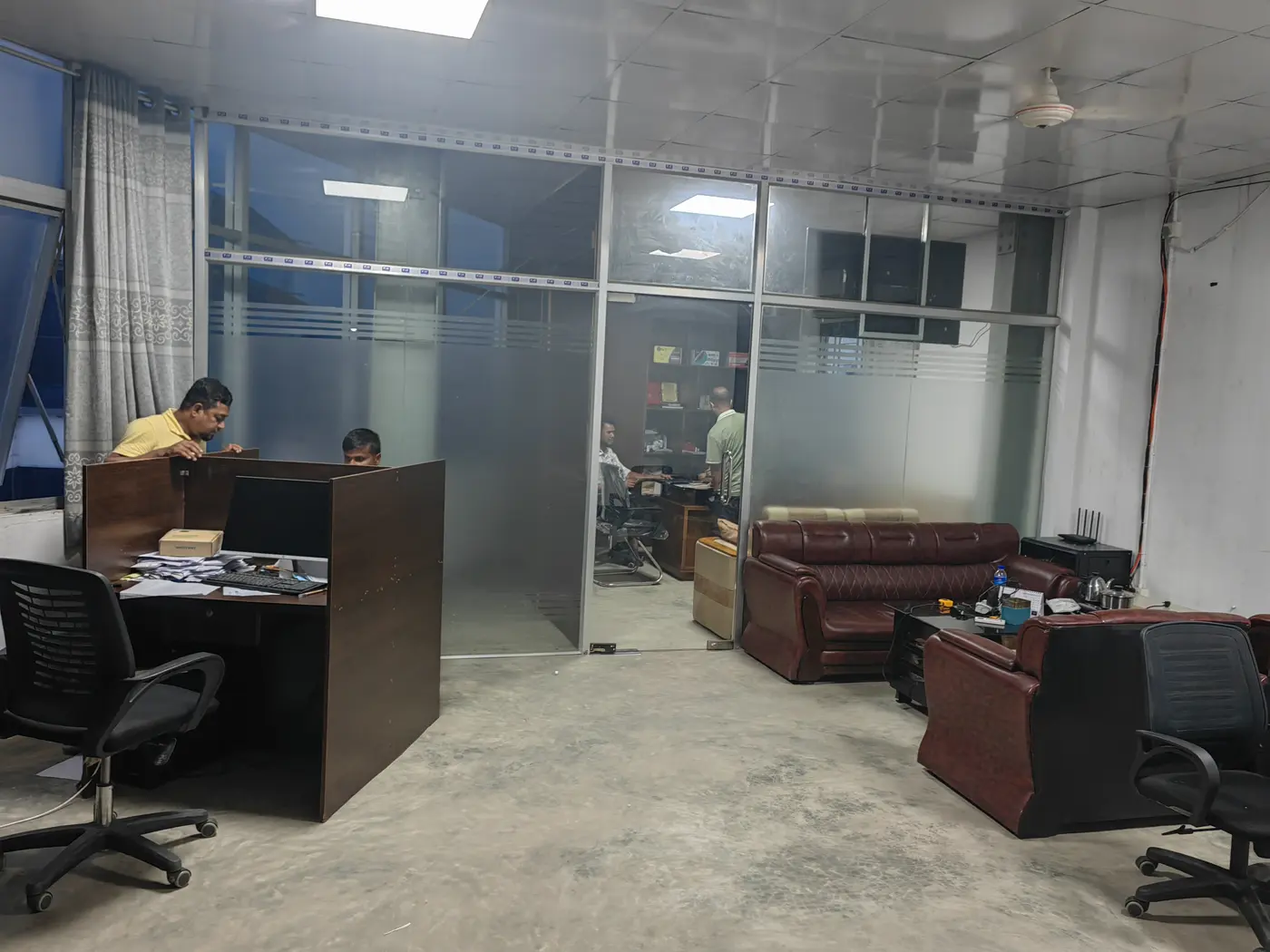
Linjia Power founder Sunny recently visited the company’s Bangladesh battery charger factory to review production operations with the local team and support the resolution of on-site issues. The visit continues a partnership that has developed from finished charger exports from China into SKD battery charger assembly, local production and after-sales service in Bangladesh.
1. A Bangladesh Factory Visit Built on a Long-Term Partnership
Sunny, founder of Anhui Linjia New Energy Technology Co., Ltd. (Linjia Power), recently visited the Bangladesh production base to learn about local charger production and operations, and to discuss practical issues with the cooperation team.
For Linjia, the visit was part of a relationship that has developed over several stages.
The partnership began with the purchase of finished battery chargers from China. Over time, it expanded to include a local assembly workshop, a sales team and after-sales service capabilities.
Today, Linjia’s manufacturing and technical resources in China work alongside the Bangladesh team’s assembly, sales and service resources to provide a supply arrangement that is closer to the needs of the local market.
This visit also gave both sides an opportunity to discuss production coordination, technical support and the long-term development of the business.
To understand how the partnership has continued to grow, it helps to look at how the two sides first established trust.
2. The Starting Point: More Than a Low Charger Purchase Price
Before working with Linjia, the Bangladesh partner had purchased products from other Chinese battery charger manufacturers.
According to Sunny’s account in the founder interview series, a high failure rate after those chargers entered the local market created difficulties for sales and after-sales service.
For electric vehicle dealers, vehicle manufacturers and charger importers, the purchase price of a charger is only one part of its overall cost.
If a product fails frequently in service, the importer may also have to handle returns, fault diagnosis, replacement stock and after-sales work, as well as the effect on customer confidence.
The Bangladesh partner therefore wanted to find a Chinese manufacturer with more stable product performance and the ability to provide ongoing technical support.
A friend introduced the partner to Sunny.
The two sides did not immediately invest in a local factory. They first began with finished chargers supplied by Linjia’s Chinese factory.
Following actual sales and use in the market, the partner found Linjia’s products more stable than the products previously purchased.
As the supply relationship matured, both sides began discussing how to achieve a better balance among product quality, import costs, shipping efficiency and local after-sales service.
This starting point reflects Linjia’s approach to long-term cooperation: earn customer recognition through actual product performance, then expand the scope of the partnership step by step.
For Sunny’s entrepreneurial background and Linjia’s entry into overseas markets, read Founder Interview 1: From Industry Beginnings to Global Expansion in Battery Charger Manufacturing.
3. From Price Competition to a Quality Focus: The Change in 2019
The development of the Bangladesh project was connected to a broader change in Linjia’s business direction.
In 2019, Sunny began to reconsider how the business should develop.
By then, Tianchang in Anhui, China, had an established charger manufacturing supply chain. However, parts of the repair aftermarket had long been shaped by intense price competition.
In that environment, even a large volume of orders did not necessarily leave a manufacturer with enough profit to continue investing in technical development, better materials and quality management.
Sunny decided to change the original business strategy, put product quality first and customer service second, and gradually shift the company’s focus toward vehicle OEM supply and overseas markets.
Overseas projects also taught Linjia that passing factory tests does not mean a product will suit the actual operating conditions of every country.
In an early project in India, the company encountered chargers that performed well in China but experienced a higher failure rate after entering the overseas market.
Later, in a cooperation project in Indonesia, Linjia used fault data from the partner’s after-sales warehouse to make targeted circuit and structural changes. The work addressed issues involving grid-voltage fluctuations, road vibration and the matching of key electronic components.
These experiences helped the company develop an approach that gives greater attention to the operating environment in the destination market.
For overseas OEM/ODM battery charger projects, product quality depends on more than the components selected. It also depends on circuit design, power margin, production processes, testing procedures and correct matching between the charger and the battery system.
These lessons also provided a technical foundation for the long-term Bangladesh partnership.
Read more about the technical experience and business thinking in Founder Interview 2: The Battery Charger Quality Path from the Repair Aftermarket to Global Markets.
4. Why Move from Finished Charger Imports to SKD Assembly?
As the Bangladesh business developed, the two sides began to reassess the original finished-product import model.
Under that arrangement, chargers were manufactured, assembled and tested in China before being shipped to Bangladesh as complete products.
This model has a relatively straightforward workflow and allows the Chinese manufacturer to manage production stages centrally.
As order volumes grew, however, the tariff structure, shipping space, local assembly conditions and after-sales needs became increasingly relevant to the overall supply cost.
In Sunny’s account of the project, finished chargers and semi-finished chargers were subject to different import duty treatment in Bangladesh. Complete chargers also occupied more shipping space than suitably separated and packed semi-finished products.
In the earlier founder interview, Sunny gave an example from the project’s container-loading calculations: approximately 15,000 finished chargers in one container, compared with approximately 30,000 chargers supplied in semi-finished form.
These figures describe experience with particular products and packaging conditions. They do not represent a fixed loading ratio for every charger model. They do, however, explain why semi-finished supply can be worth evaluating in an overseas project with sufficient volume.
After considering local import policies, shipping costs and market needs together, the partners gradually chose an SKD model. SKD stands for Semi-Knocked Down: key assemblies and components are supplied for further assembly in the destination market.
In this arrangement, the Chinese manufacturing operation provides the key electronic components and technical solution, while part of the later assembly work takes place in Bangladesh.
The aim is to make the supply model better suited to the local market while maintaining clear requirements for critical technology and product quality.
Linjia’s Bangladesh production base was completed and began production and shipment in 2024, providing a practical foundation for the next stages of local cooperation.
The tariff comparison above relates to the project experience described in the interview. For a new shipment, the applicable classification and current duty treatment should be confirmed using the official Bangladesh Customs import tariff resources and the project’s actual import arrangements.
Sunny discusses the choice among SKD, CKD, finished-product exports and overseas warehouses in Founder Interview 3: Wide Voltage Charger Technology and Overseas Localization.
5. How Chinese Manufacturing and Bangladesh Assembly Work Together
Establishing local assembly involves more than opening a workshop and assigning workers to install components.
For battery chargers, even when the main components have already been completed in China, the later assembly stages still need consistent product specifications, assembly procedures and testing requirements.
Linjia’s cooperation model combines the technical and manufacturing resources of its Chinese factory with the local operating capabilities of the Bangladesh team.
On the Chinese manufacturing side, Linjia is responsible for the key charging solution, core component manufacturing, and related equipment and technical support. Depending on project requirements, a modular product design can allow some later assembly stages to be carried out locally.
On the Bangladesh operating side, the local team handles assembly, sales and after-sales service, and develops the business according to local market needs.
For technical coordination, the Chinese technical team can provide on-site guidance and remote communication to help resolve issues involving production processes, material inspection, assembly and quality management.
This division of work allows both sides to contribute their strengths. The Chinese factory provides an established supply chain, technical development and manufacturing capabilities; the local partner brings knowledge of sales channels, customer needs and after-sales conditions.
Local assembly also places requirements on the production management of both parties.
For example, the charger’s output voltage and charging profile must match the battery chemistry. Charging current must take account of battery capacity and, for lithium battery systems, the BMS charging-current limit. The output connector, polarity, AC input voltage and plug configuration must also suit the destination market and application.
During volume production, material consistency, assembly quality, finished-product electrical performance and product traceability also matter.
Linjia’s battery charger quality control and reliability testing system in China includes incoming material inspection, PCB process checks, electrical performance testing, dielectric withstand and insulation testing, and full-load burn-in testing. This system provides a technical reference when defining the quality requirements for an overseas project. The specific checks should follow the local production stages and approved product specification.
For an overseas buyer, the location of final assembly is one part of the decision. A continuing requirement is that production follows clear technical standards and that quality responsibilities remain defined throughout the process.
6. Sunny’s Return Visit Brings Technical Support to the Production Site
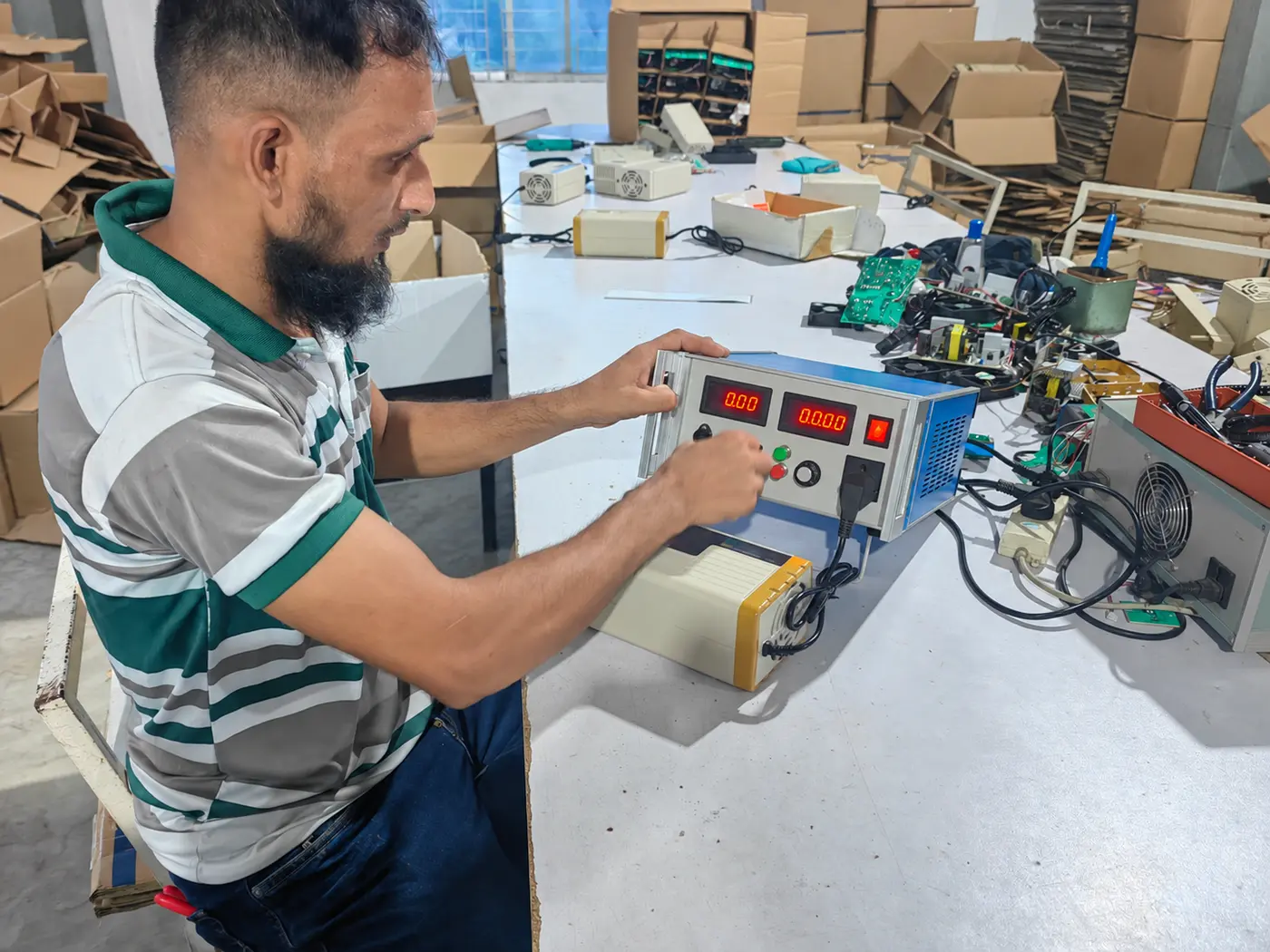
The recent visit is another practical example of Linjia’s ongoing involvement in its overseas partnerships.
Sunny visited the production site, reviewed operating conditions with the local team, and took part in discussions and work to address issues encountered in day-to-day operations.
For a battery charger manufacturer working with a local assembly operation, technical support needs to continue as the project develops.
Product specification, sample validation and equipment configuration are followed by staff training, production management, quality feedback and corrective action. Each stage can affect the long-term operation of the project.
As cooperation develops from finished-product purchasing into local assembly, close communication between the supplier and local partner becomes increasingly important.
The Chinese factory needs to understand how products perform after entering the local market. The local team also needs access to support when technical or process issues arise.
That continuing exchange is a central reason for Sunny’s on-site visit.
For Linjia, shipment is one stage in the partnership. Understanding the issues a partner encounters in the market and on the production floor is also part of a long-term supply relationship.
7. Choosing an Overseas Supply Model for Each Market
The Bangladesh project has also given Linjia a reference point when evaluating supply arrangements in other markets.
SKD is one of several options considered by the company.
Import policies, labour costs, supporting industries, order volumes and after-sales conditions differ from country to country, so the suitable cooperation model can also differ.
Linjia has used SKD assembly over the long term in Bangladesh. In Türkiye, cooperation moved from CKD, or Completely Knocked Down component assembly, to SKD. In Thailand, the arrangement combines finished-product exports from China with overseas warehousing and local sales and service.
These projects show why an overseas localization decision needs to consider more than a potential reduction in import duty. Local manufacturing costs, production efficiency, technical personnel, sales volume and operating risk also need to be assessed.
For some markets, direct imports of finished chargers may be the better fit.
For other markets with sufficient order volume and a capable local operation, SKD may offer a more flexible approach to shipping costs, duty treatment and local service.
For the company’s production and supply arrangements in Bangladesh, Türkiye and Thailand, see Linjia Power’s global manufacturing and supply network.
8. What Overseas B2B Buyers Can Learn from the Bangladesh Project
As electric two-wheelers, electric three-wheelers and other battery-powered equipment develop in different markets, the requirements that vehicle manufacturers, battery brands, importers and distributors place on charger suppliers are also changing.
Alongside charger models, purchase prices and lead times, buyers need to consider correct battery matching, consistent bulk supply, the handling of after-sales issues and the supplier’s ability to support a more flexible local supply arrangement.
The Bangladesh project illustrates a path from product supply toward a longer-term technical and market partnership.
For overseas companies planning to source OEM/ODM battery chargers, cooperation can begin with a clear product requirement and sample validation. The parties can then evaluate finished-product supply or semi-finished assembly according to order volume, import conditions and the capabilities of the local team.
A company developing its own charger brand also needs to confirm electrical parameters, connector configuration, housing, labels and packaging requirements. This helps reduce specification mismatches and avoidable after-sales difficulties after the product enters the market.
Linjia’s OEM/ODM battery charger development services cover battery-parameter analysis, charging-solution design, PCB and structural development, sample validation and preparation for volume production.
Buyers can also explore the company’s OEM/ODM battery charger project cases for examples of different voltage, current and supply configurations.
Whether local assembly is suitable still requires a project-specific assessment. An existing factory in a particular country is a starting point for discussion; the cooperation model must fit the requirements and capabilities of the new project.
9. From Anhui, China, to Bangladesh: The Partnership Continues
Linjia’s development since its change of direction around 2019, followed by its work in Indonesia, Bangladesh, Türkiye, Thailand and other overseas markets, has been a process of continuing adjustment.
Initially, the company focused on making chargers with more stable quality.
Overseas feedback then brought greater attention to the operating environment, charging parameters and reliability requirements of each market.
As cooperation developed further, tariff structures, logistics, local production and after-sales service became additional parts of the work.
The Bangladesh project is a specific example of that development.
From the initial import of finished chargers to SKD assembly and today’s continuing production coordination and technical support, the two sides have gradually built a relationship that extends across repeated orders and day-to-day operations.
Sunny’s recent visit to the Bangladesh production base reflects Linjia’s continued participation in the project.
For Linjia, international business involves working with partners in different markets to develop production, supply and service arrangements that can operate over the long term.
Vehicle manufacturers, battery brands, importers and distributors looking for a battery charger manufacturer, developing a private-label range or evaluating local assembly cooperation are welcome to discuss their actual technical and commercial requirements with Linjia.
Contact Linjia Power to discuss your OEM/ODM charger or overseas supply project.
About Linjia Power
Anhui Linjia New Energy Technology Co., Ltd. is a battery charger manufacturer based in Tianchang, Anhui, China. The company provides technical development, customized production and bulk supply of lead-acid and lithium battery chargers for overseas OEM/ODM customers.
With its Chinese manufacturing base at the centre of its operations, Linjia also works with production bases in Bangladesh and Türkiye and overseas warehousing resources in Thailand to support project-specific supply arrangements.
For more about Sunny’s entrepreneurial experience, charger quality management and international market practice, visit the Linjia founder interview series.