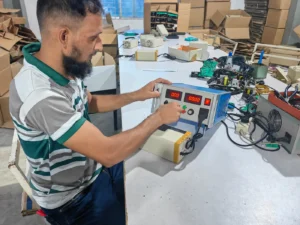
Interview Date: September 26, 2026
Interview Topic: Battery Charger Quality Strategy, Technical Expertise, and Overseas Market Practice
This interview focuses on Linjia’s business transformation since 2019. Drawing on real projects in India, Indonesia, Türkiye, Thailand, and other markets, Sunny explains why the company withdrew from low-price competition, how overseas after-sales data changed its understanding of power grids, road conditions, and operating environments, and how circuit design, component matching, production control, and cost boundaries together determine the reliability of a battery charger.

1. From the Repair Aftermarket to a Quality Focus
Ann: What prompted you to rethink Linjia’s development direction in 2019? Why did you ultimately decide to give product quality and service greater priority?
Sunny: Before 2019, we were like many local charger companies in Tianchang and mainly served China’s domestic repair aftermarket. Based on my observations of the industry at the time, the Tianchang manufacturing cluster accounted for a large share of charger sales in the national repair aftermarket and had also developed a relatively complete supply system. However, this market had long been driven by price competition: if your price was low, someone else had to go even lower. Order values and cash flow could be substantial, yet the company might still lack a reasonable profit. That made it difficult to sustain investment in research and development, quality control, and after-sales service.
After the local government strengthened industry management in 2019, I spent several months reconsidering which path the company should take. In the end, we decided to stop following low-price competition and put product quality first and service second. We later developed a phrase: “Quality Moves the World, Service Builds the Future.” For us, this was not a marketing slogan, but a change in business direction.
Ann: At that time, what development paths did you believe were available to charger companies? Why did you choose to make quality products that could retain a reasonable profit?
Sunny: At the time, I believed the industry would broadly follow three paths. The first was to make quality products that also generated a reasonable profit. By profit, I did not mean excessive profit, but enough for the factory to survive and continue improving its products. The second was to continue pursuing volume and scale, using low prices to win large numbers of orders while the company itself earned almost no profit. The third was to build scale first and then use the resulting financing conditions to invest capital in other industries, even if the charger business itself did not necessarily make money.
I wanted to build a factory that could survive over the long term, so it could not depend only on volume. At the time, I often used a simple example to explain this point. In a small-commodities market, a shirt may sell for RMB 15. The shop owner may be Mr. Zhang this year and Mr. Li next year. A shop with stable quality and an established brand, however, can continue opening new branches. Mass-market consumption ultimately returns to quality and value for money. To build a long-term business, its roots must be planted in quality.
Ann: After deciding to follow a quality-focused path, which companies did you study and use as benchmarks? What market position did Linjia want to establish between product quality and price?
Sunny: At the time, a group of charger companies outside Tianchang had already become relatively mature in supplying vehicle manufacturers. I used eight of them as benchmarks and required our product positioning, production processes, and supply system to reach their level, while working to perform even better in certain areas. I was also well aware that we still had a gap to close compared with the strongest company among them, but compared with the others, I believed our quality could match theirs.
I once called Linjia the “ninth company.” Our factory is located in Tianchang, so we can use the area’s complete supply chain and relatively low operating costs. At the same time, we select more reliable materials from the supply system and keep the company’s profit at a reasonable level. This creates a clear position: quality significantly above local low-price products, but a price below that of established companies supplying vehicle manufacturers. This middle ground is where we can survive.
2. Technical Changes Driven by Overseas Markets
Ann: What problems did you encounter when supplying the Indian market in 2019? How did you view the customer’s feedback at the time, and what new understanding of product quality did this experience give you?
Sunny: In 2019, we supplied the Indian market through a partner, shipping approximately 4,000 to 5,000 chargers per month. The customer made relatively high-end vehicles and had high quality requirements for components. We used a configuration that we considered very good and invested considerable effort, but the failure rate was still high after the products reached the local market. After the cooperation had continued for more than a year, the customer eventually stopped placing orders.
At first, I did not want to believe that the product was the problem. I came from a technical background, and we had not cut corners, so I subjectively believed that the product should not have had a problem. Because the products were already overseas, we could not see the actual operating conditions and even wondered whether the customer had other considerations. The facts later proved that the customer was right and that the problem did lie with us. Using genuine materials and passing factory tests do not necessarily mean that a product is suitable for the local environment.
Ann: When the Indonesian customer asked you to reduce returns and failures, how did you identify the causes and implement corrective action? What were the results after the improvements, and how were these lessons later applied in other markets?
Sunny: During the pandemic, we began supplying a customer in Indonesia. The customer asked us to reduce returns and failures further. Instead of changing materials immediately, we asked the customer’s after-sales department to record the symptoms and causes of each returned product, and then sent the data to our engineering and technical departments for analysis.
The analysis showed that damage caused by grid-voltage fluctuations accounted for approximately 40%, while damage caused by complex road conditions and transport vibration also accounted for approximately 40%. Both factors were outside the experience we had gained in China’s domestic environment. We adjusted the circuit and structure around these two categories of problems. After completing targeted corrective action in March 2021, the customer reported by September of that year that there were almost no returns. The subsequent failure rate fell to only a few units per thousand.
This improvement moved our technical capabilities forward significantly. Since then, we have continued collecting information about power grids, road conditions, and usage scenarios in different markets, and we prepare corresponding circuit designs for special environments. Our products are now sold in dozens of countries and regions. Last year, we visited Thailand to investigate the after-sales situation on site, and the recorded failure rate was approximately six per thousand. The data made the team very happy, but everyone also believed that it could be reduced further.
Ann: After resolving the Indonesian project’s problems, how did your assessment of the earlier India project change when you looked back on it? What happened when you later contacted the partner again?
Sunny: In 2022, I thought again about the India project and suddenly realized that the grid problems in the Indian market were similar to those in Indonesia. When the partner said that the product had a problem, he was right and I was wrong. I called him and told him clearly that we had found the cause, which was mainly related to the local grid voltage and its fluctuations.
He asked whether the problem had been solved, and I said that it had. However, the original Indian customer already had a new supplier, so we had lost the opportunity to work together again. He only said that he would contact me if opportunities arose in other markets. I have always remembered this experience. A failure cannot remain merely a loss. It must be brought back into the factory and turned into a new technical method, or the same problem will occur again.
Ann: After these overseas projects, why do you no longer quote a price immediately when a customer makes an inquiry? Which market and operating-environment details must be verified before you provide a quotation?
Sunny: Today, when a customer asks for a quotation, we do not quote immediately. The first step is to confirm the country or region where the product will ultimately be sold. We then verify the local grid voltage and fluctuation range, road conditions, air humidity, environmental differences between regions, and whether two or even three different voltages coexist in the market. We also confirm the power-plug type and assess whether the information provided by the customer may be incorrect.
Some customers mistake a 110 V environment for 220 V. If the product is configured for 220 V and sent there, it will fail as soon as it is powered on. In markets including the Philippines and Taiwan, customers have provided incorrect grid information, and we proactively alert them when we identify the error. We also encountered a project in which our chargers were exported to Algeria together with complete vehicles. Public information indicated that the local grid was relatively stable, but the failure rate was high after the products entered service. The problem improved only after we redesigned the product for harsher environmental conditions. This shows that online information may be outdated and that actual after-sales data must ultimately be considered.
Ann: During the transition from the repair aftermarket to export business, did you ever consider returning to the previous way of operating? What made you continue, and when did you begin to feel that the decision was right?
Sunny: Yes, and more than once. Export orders involve obvious uncertainty. During the peak season, all customers may place orders at the same time, and even 24-hour production may not be enough. During the off-season, there may be no orders at all. Generic products for China’s domestic repair aftermarket can be produced in advance and held in inventory, but products exported to different countries have different requirements and are difficult to stock in advance. Because of these pressures, I considered returning to the original repair aftermarket at least three times.
Each time I reviewed the product positioning, pricing, and supply system, I was still unwilling to return to low-price competition, so the only option was to keep moving forward. When export volume increased significantly in 2022, I felt strongly for the first time that the decision had been right. For five or six years after the transformation began in 2019, our overall order volume did not grow, because we were giving up low-price customers while looking for new customers willing to accept higher-quality products. By the end of 2024, the two customer groups had largely been replaced. In 2025 and 2026, business volume began increasing year by year.
3. The Technical Foundations of a High Quality Charger
Ann: When assessing the quality of a charger, which areas do you believe deserve the most attention? Which details cannot be seen from the appearance or specification sheet but can still affect reliability?
Sunny: The first is the circuit design. Different companies choose different operating principles. Some designs emphasize low cost, while others emphasize high quality. After discussion, research, and comparison, we selected a design with a good overall balance between performance and cost. Once the circuit design has been selected, the engineer’s design capability must also be considered. A charger is a high-frequency circuit, and PCB routing creates distributed capacitance and distributed inductance. These parasitic parameters change the original design conditions and can damage components if they are not handled properly.
The second is material selection. Components sold under the same name can differ completely in price and authenticity when they come from different manufacturers. We do not use defective materials or components with falsely stated ratings, nor do we blindly pursue the most expensive option. Instead, we choose suppliers with reliable scale and technical capability that understand charger applications. For example, an electrolytic capacitor’s voltage rating or capacitance can be increased, but it is more important to control its tolerance range properly and match it to the complete circuit.
The third is stage-by-stage quality control during manufacturing, and the fourth is final inspection after load aging. A product can remain stable only when the circuit design, components, production process, and inspection are all controlled. Good performance in any one area cannot replace the others.
Ann: Why do some chargers still fail easily in the market even when their materials are not inexpensive and they have passed factory testing and aging? What system-matching problems were revealed by the project you encountered in Türkiye?
Sunny: I was involved in a project in Türkiye. A local vehicle manufacturer had previously worked with another Chinese charger company. That supplier provided a complete design and material kit for assembly in Türkiye. The finished products passed factory testing and aging without problems, but the failure rate was high after they entered the market. I later analyzed the failures with the after-sales department, and the main problems were concentrated in the control IC and transformer.
After further study, we concluded that the problem was not that the materials were insufficiently expensive. First, the distributed capacitance and distributed inductance in the circuit layout affected the original parameters. Second, the high-frequency transformer for each model must be customized, and an unsuitable winding method can cause parameters such as leakage inductance to deviate. Third, the protection and fault-tolerance capability of the control-IC firmware was insufficient. Some materials in that product even cost more than ours. For example, we use a transformer costing approximately RMB 5, while the other supplier used one costing approximately RMB 8. Poor system matching still caused the product to fail.
A charger is a system. Expensive components do not automatically create a high-quality product if they are not properly coordinated with the circuit design, transformer parameters, and software protection.
Ann: When an Indonesian customer brought you a sample from another supplier, how did you compare the two products and explain the price difference? Why can two PCBs look similar while the final product quality is different?
Sunny: We had an Indonesian customer whose other supplier offered a lower price than ours but was consistently unable to make the product work well. After the customer provided a sample, I disassembled it and found that the other supplier’s PCB was basically the same as ours. It had been made by copying an existing circuit board, but components such as the transformer and electrolytic capacitor had been sourced from lower-cost suppliers. For example, our transformer cost approximately RMB 8, while theirs cost approximately RMB 5. Our electrolytic capacitor cost approximately RMB 2, while theirs cost approximately RMB 1.8. Saving money item by item naturally produced a lower quotation.
I placed the two products side by side, recorded a video, and explained three judgments to the customer. First, copying the PCB indicated that the other supplier had limited independent research and development capability. Second, based on the sources of the components, I suspected that its incoming-material inspection was incomplete. Third, I stated clearly at the time that this was only an inference, but its production quality control might also be insufficient. The customer ultimately continued working with us, and the cooperation has continued to the present.
Ann: Why must the MOSFETs, transformer, capacitors, and control IC be matched with one another? How does unreasonable internal power distribution affect charger temperature and service life?
Sunny: The key components in a charger include MOSFETs, high-voltage electrolytic capacitors, a high-frequency transformer, and a control IC. The goal is not to make each individual component as expensive as possible, but to match them correctly according to the circuit principles. Even if the transformer costs more on its own, the product may still fail if the other components and control parameters are poorly coordinated.
The power burden must also be distributed reasonably. For example, if the transformer and MOSFETs each carry an appropriate share of the power, the internal temperature will be lower. If more of the burden is shifted to the transformer to reduce MOSFET costs, the charger may still operate, but it will run hotter and its service life will also be affected. In my judgment, reasonable power matching affects not only the service life of the charger itself, but also the wear imposed on the battery during charging.
4. Quality Control During Manufacturing
Ann: From PCB assembly to final shipment, which critical inspections and tests must a charger undergo? Why must the parameters be checked again after load aging has been completed?
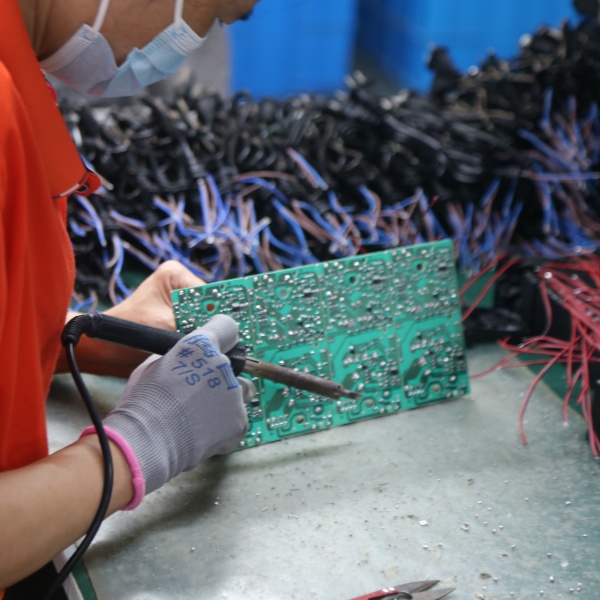
Sunny: The first step is inspection after PCB assembly to eliminate incorrect or missing components and problems such as cold or defective solder joints. The second step is parameter calibration, which checks whether the output charging current, charging voltage, and control voltage are within the technically permitted tolerance ranges.
The third step is load aging, which means continuously powering the charger under conditions that simulate actual use. High-voltage electrolytic capacitors have positive and negative terminals. If one is installed in reverse, the earlier stages of the production line may not detect it. After the product reaches the user and has been powered for a period, the safety vent may open and the charger may fail immediately. Aging can identify polarity errors in advance and can also continue to expose cold or defective solder joints, abnormal indicator lights, flickering, and other problems.
A pre-shipment inspection is still required after aging. Some resistors and other components have temperature coefficients, so their parameters may change after the charger heats up. The final inspection confirms that the critical parameters remain stable after the product has operated at high temperature. The product can leave the factory as qualified only when its parameters have not changed beyond the permitted range.
Ann: How do you distinguish between a product that passes factory inspection, a product that passes the customer’s incoming inspection after unpacking, and reliability in actual use? Why must quality control also consider transportation and continue collecting real after-sales feedback?
Sunny: Our goal is to contain nonconforming products inside the factory as much as possible, and the outgoing pass rate must exceed 99%. However, quality control does not end when a product leaves the factory. Ocean freight, overland transport, and loading and unloading can also cause damage, so the packaging and structure must be considered in advance. We want the pass rate when the customer receives and unpacks the goods to exceed 99%, and we continue working toward more than 99.5%.
The most valuable quality data comes from the market, not only from factory testing. The failure rate of approximately six per thousand in the Thai market was data we obtained through an on-site investigation. Only by bringing after-sales data back to the technical department can the factory know what to improve next.
Ann: You mentioned an experience in which adding approximately RMB 0.30 to the cost resolved a product-return problem. What problem did the product encounter, how was the cause eventually identified, and how did the circuit then remain stable in use for many years?
Sunny: In 2018, when the industry had just begun using automatic shut-off functions, many companies adopted the same or similar circuit designs, and we also used one of them. The product completed high-temperature and low-temperature testing, destructive testing, and destructive aging, and the laboratory determined that it could be released. However, after a small batch was placed in three cities, the return rate was very high.
The cause ultimately identified by the technical department was simply a mismatch in the operating characteristics of several small capacitors. Each product originally used six polyester film capacitors costing approximately RMB 0.018 each, and five of them needed to be replaced with CBB capacitors costing approximately RMB 0.08 each. The additional cost per charger was only about RMB 0.30. After the replacement, we released another small batch and the problem disappeared.
This circuit remained stable in use through 2025. We changed to a new circuit in 2026 not because the original design had failed, but because the original chip supplier stopped supplying the chip. We later learned that other companies using similar designs had gradually abandoned the circuit because of high return rates. We were able to continue using it because we spent the additional RMB 0.30 and adjusted the parameter matching to the appropriate level.
5. Cost Optimization and Safety Boundaries
Ann: Does making a high-quality charger mean that costs must keep increasing? How do you make tradeoffs among performance, service life, and cost based on actual usage requirements?
Sunny: No. We have continued optimizing cost and performance. Suppose a product can be made extremely well at a cost of RMB 30, while a cost of RMB 28 can still meet the actual usage requirements. The RMB 28 design may offer more appropriate value for money. A charger is a consumer product, so materials should not be added blindly without considering the actual life cycles of the complete vehicle and battery. If the vehicle has already been scrapped while the charger still far exceeds its required service life, the additional cost may have little practical value.
However, cost optimization depends on knowing clearly what can be reduced and what must never be reduced. Savings can be made in areas that do not affect safety or stability. For example, a 1.2 m power cable can be shortened to 1 m or 0.8 m when actual use permits. A charging current of 3 A can also be adjusted to 2.8 A or 2.6 A. These changes moderately extend the charging time and reduce the cost of power components, but they do not increase risk by weakening safety materials.
Ann: When reducing costs, which materials, technical requirements, and quality-control steps must Linjia never remove? Why do these bottom lines directly affect customer safety and after-sales costs?
Sunny: The first is the flame retardancy and toughness of the housing. If a better flame-retardant material is replaced with a material costing only half as much to reduce costs, the housing may ignite and create a fire risk. If the material lacks toughness, the housing can also be damaged easily when the product is dropped. Once a product has been shipped overseas, the customer usually cannot replace the housing and it is difficult to return the product to the factory, so the complete charger may have to be scrapped. We are unwilling to leave this risk with the customer.
The second is the thickness and flame retardancy of the PCB copper foil. For high-power products, the copper foil generally needs to be at least approximately 35 micrometers thick. For low-power products, it normally should not be less than approximately 28 micrometers. Otherwise, high current may cause the copper foil to lift or separate from the substrate. The flame retardancy of the PCB itself is equally important. We do not apply two different safety standards for two different price levels. These basic requirements must remain fixed.
When reducing costs, product safety and stability must always come first. Reasonable savings can be found through structural dimensions, cable length, rated current, and system efficiency, but costs must not be removed from flame-retardant materials, critical electrical parameters, or quality-control processes.