Charger mass production failures can occur when normal manufacturing variation or real operating conditions expose a weakness that the sample evaluation did not reveal. The problem may involve assembly, materials, the test setup, or the charger’s interaction with the battery and installation. A working sample cannot identify which cause applies. Compare failed and unaffected production units under the same recorded conditions, then verify both how the fault occurred and why the inspection process missed it.
For a vehicle manufacturer, battery brand or importer, the immediate question is practical: which units are affected, what evidence should the supplier collect, and what must change before supply resumes? This guide focuses on that investigation. For the earlier approval handover, see sample approval and mass-production consistency.
Define the Failure Before Replacing Components
“The bulk chargers do not work” combines several possible problems. A charger that never starts, one that stops after warming up, and one that charges a bench load but not a vehicle need different investigations. Record the observed behavior without turning it into a diagnosis.
Start with the model and order, available serial or batch identifiers, the number reported faulty, and the population from which those reports came. Keep returned failures, unaffected units from the same lot, and later production distinguishable. A return count alone is not a field failure rate if the quantity actually used and its operating time are unknown.
Hold the suspect stock while engineering defines the screening and disposition. Include related work in progress or shipments when the available traceability points to the same exposure. If the boundary cannot yet be established, record that uncertainty instead of assuming everything outside the first reported carton is unaffected.
Smoke, burning, damaged insulation or abnormal battery heating calls for stopping use and qualified investigation. Buyers should collect external observations and records; opening or energizing suspect mains-powered units belongs with qualified personnel.

Use the Failure Pattern to Choose the Next Check
The distribution of complaints often helps narrow an investigation. It does not prove a root cause. Use each pattern to decide which records and comparisons would distinguish competing explanations.
| Observed pattern | What to investigate | Evidence to compare |
|---|---|---|
| Failures cluster around one production period | A material lot, setup change, process interruption or rework route | Affected and unaffected units on either side of that period, with material and process records |
| A unit passes one station and fails another | Fixture contacts, connections, settings, method or measurement variation | The same identified units retested with the differences in setup recorded |
| Operation changes only after sustained charging | The actual load, thermal assembly and operating conditions | Time to the symptom, output behavior, ambient conditions and the assembled configuration |
| A bench load works but the intended battery does not | Battery condition, BMS behavior, charging-stage transitions or interface requirements | The actual battery specification and observed charger/BMS sequence against the bench method |
| The fault appears after transport or connection handling | Mechanical damage, wiring, cable restraint or connector contact problems | As-received photographs, packaging condition and qualified inspection before repair |
| Only one installation or destination reports problems | AC supply, placement, ventilation, battery variant or use conditions | Local conditions and configuration against an unaffected installation |
For example, a batch association can make a component lot worth investigating, but it does not establish that the component caused the failure. A test-fixture change at the same time may explain the association. Check the alternatives before accepting a convenient explanation.
Can the Production Test Station Actually Detect the Fault?
A unit can pass a test that never exercises the behavior now failing. Before asking for more testing, identify what the original station measured, under which conditions, and against which limits. A power indicator or a normal unloaded reading does not establish performance through a complete charging sequence.
NIST’s gauge R&R guidance treats repeatability, reproducibility, stability and bias as measurement-system questions. Applied to this investigation, a disagreement between stations should trigger a review of the measurement process as well as the charger.
- Repeat the observation: check whether one identified unit gives consistent results on the same station.
- Compare the setups: identify differences in fixtures, operators, leads, sensing points and settings.
- Review the records: examine equipment status, maintenance and setup changes around the affected period.
- Check detection: qualified staff should verify that the revised method distinguishes the relevant faulty condition from acceptable operation.
Record actual readings when needed for diagnosis, rather than retaining only a pass/fail result. Keep the method and configuration with those readings so a later comparison is meaningful.

Compare Failed and Unaffected Units Without Losing the Evidence
Preserve the as-received state before cleaning, opening, replacing parts or adjusting a setting. Label each unit and record what has already been done to it. A repaired unit may be useful for verification, but it no longer represents the original failure condition.
Where available, compare the retained sample, a failed production unit and an unaffected unit from the same lot. Treat the retained sample as another identified unit to examine, not as an unquestionable reference: it may have been modified or used differently since approval.
Separate a manufacturing difference from an operating-condition difference
First compare units under the same permitted input, load or battery, ambient conditions, placement and test sequence. Then investigate the reported field conditions within the product’s approved limits. If the production units differ under matched conditions, investigate the units and manufacturing process. If all behave similarly on the bench but differently in the installation, examine what the bench comparison omitted.
For a lithium system, include the battery chemistry, series configuration, charging limits and BMS events where available. A disconnect during charging is an observation; it does not by itself identify whether the charger, pack, BMS settings or connection is responsible.
Find the first process stage where behavior changes
If evidence suggests a manufacturing origin, compare the relevant stage records: PCBA or semi-finished testing, enclosure assembly, final electrical testing and subsequent handling. Depending on the construction, qualified inspection may examine soldered joints, cable routing, insulation placement, thermal contact or fan connections. These are investigation candidates, not a claim that a particular fault exists.
A unit that changes behavior after enclosure assembly points the investigation toward that transition. A unit already abnormal at the semi-finished stage calls for earlier evidence. This is more useful than replacing the same failed component repeatedly without explaining what damaged it.
Answer Two Questions: Why Did It Happen, and Why Was It Missed?
A useful corrective report explains both the fault’s origin and the inspection escape. ASQ’s 8D approach calls for verified causes, containment and validation of corrective action. It also asks why the problem was not detected. The following charger example illustrates that distinction; it is not a customer case.
| Question | Illustrative finding | What the correction must address |
|---|---|---|
| Why did the fault occur? | A cable joint becomes intermittent when stressed in its assembled position. | The verified joint-making and cable-restraint cause, with suitable workmanship checks. |
| Why was it missed? | The production fixture held the cable in a position that concealed the symptom. | A detection method shown to reveal the relevant condition, without damaging acceptable units. |
“Operator error” leaves too much unexplained. Ask which instruction, tool, material presentation or inspection condition allowed the deviation, and what evidence shows the proposed change prevents it. Likewise, “component replaced” describes a repair; it does not demonstrate a root cause.
Verify the Correction on Normal Production
A successful repair is one result. To support restarting supply, the corrective action should also be demonstrated through the normal materials, assembly route and applicable production checks. An engineer-adjusted replacement sample does not establish that the line now controls the problem.
- Preserve the comparison: retain the original observations, identified units and relevant test conditions.
- Verify the mechanism: engineering should explain how the evidence supports the cause and how the change removes it.
- Verify detection: show that the inspection change can identify the relevant defect or failing behavior.
- Review production evidence: choose coverage that represents the affected process, material lots or stations, rather than only convenient units.
- Define closure: record disposition of suspect stock, ownership of remaining actions and follow-up for recurrence.
There is no universal verification quantity or run duration for every fault. Agree the plan around the failure mechanism, severity, traceability and affected population. Full-load burn-in can help screen abnormal operation under its specified conditions; it cannot compensate for a test method that omits the failing condition.
What Makes a Manufacturer Review Useful?
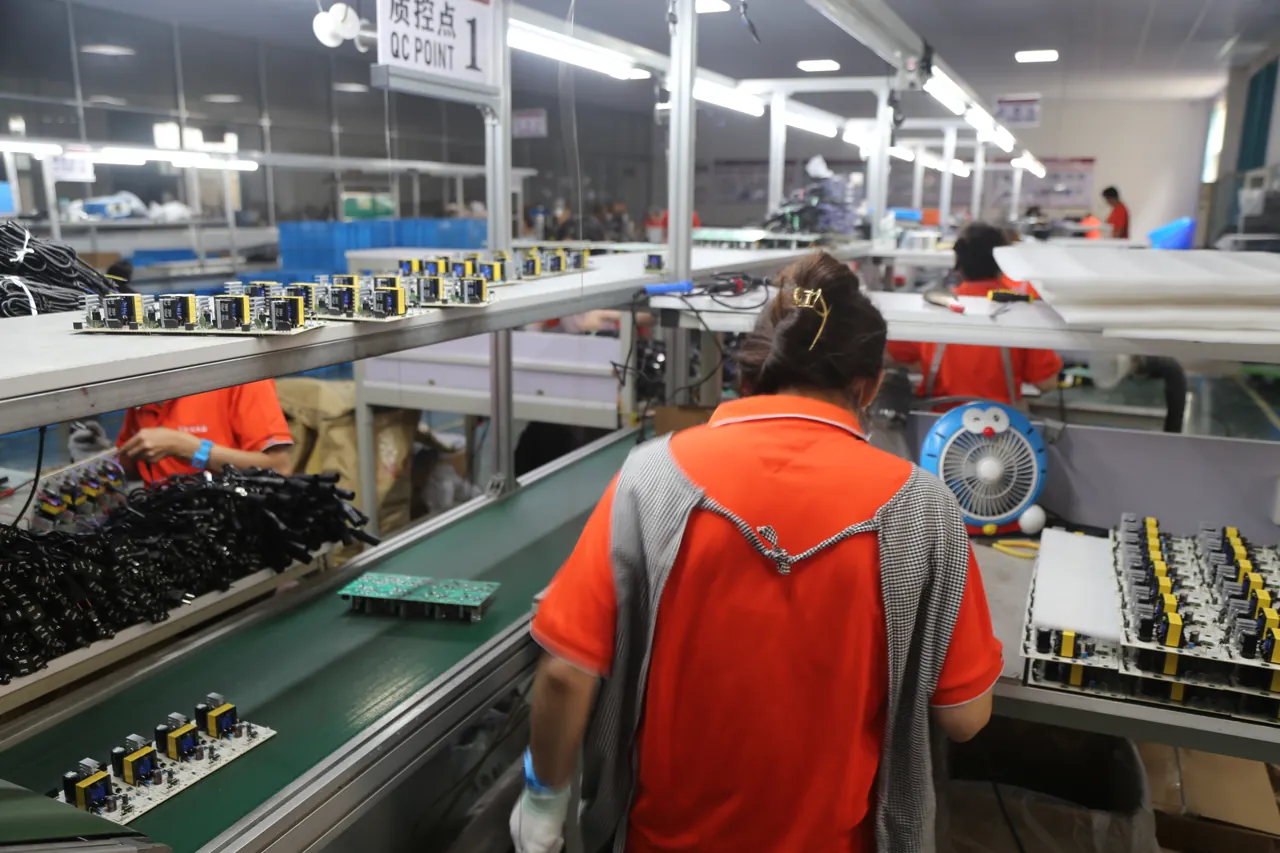
Linjia’s documented production route includes incoming material checks, PCBA and semi-finished checks, finished electrical testing, withstand-voltage and insulation checks, full-load burn-in and final order verification. Its quality-control and reliability-testing overview also describes model, batch and order information supporting corrective review.
The practical manufacturing judgment is to connect a complaint to the stage that could have created the fault and the stage that should have detected it. Adding another final inspection may help containment, but it leaves the production cause unresolved unless the investigation addresses that cause directly.
When evaluating a battery charger manufacturer for OEM and ODM supply, ask for the applicable manufacturing flow and issue-review process. Request evidence for your model and reported symptom rather than a generic promise that every charger is tested.
Buyer Checklist for a Bulk-Order Failure Review
- Charger model, order, available batch identifiers and affected quantities.
- Exact symptom, first occurrence, operating time before failure and any indicator sequence.
- Battery specification, BMS information where applicable, connector and installation details.
- Actual AC input, charging location, ambient conditions and use pattern.
- As-received photos or video, with repairs and adjustments clearly identified.
- Failed and unaffected units preserved separately for an agreed comparison.
- A containment boundary, verified cause, detection review and corrective verification plan.
Frequently Asked Questions
What if a returned charger shows “no fault found”?
Record the test conditions and what was actually exercised. Compare them with the reported battery, placement, charging duration and connection sequence. Keep the result as “not reproduced under these conditions” until the discrepancy is understood; a bench pass alone does not invalidate the report.
Can buyers use replacement chargers while the investigation continues?
Replacement supply needs an agreed disposition. The responsible engineering and quality teams should establish whether replacements share the suspect exposure, what screening applies and how their identities remain traceable. Shipping an unverified unit from the same population can repeat the original problem.
What should an importer collect when unit-level records are limited?
Preserve the available order, carton, shipment and label information, and separate reported failures by installation and delivery period. Ask the factory what production records can be linked to those identifiers. Where linkage remains incomplete, reflect that limitation in the containment and verification plan.
Discuss Your Charger Production Requirements
For a Linjia OEM/ODM project review, send the model or sample reference, battery and BMS requirements, symptom, batch information, connector details, operating conditions and available photos or test data. For a new supply project, include the application, destination market and estimated quantity. Contact Linjia with your charger project details so the discussion can focus on the evidence and manufacturing requirements relevant to your configuration.