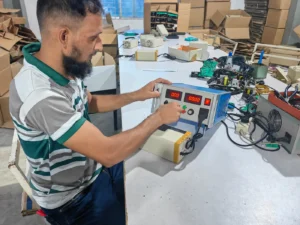
Interview Date: September 23, 2026
Interview Topic: Industry Development, Entrepreneurship, Product Evolution, and Global Expansion in the Battery Charger Sector
This interview covers Sunny’s industry experience and entrepreneurial journey, Linjia’s product evolution, and the company’s expansion into overseas markets. Drawing on his early experience supplying vehicle manufacturers, lessons from an India project, quality improvements for an Indonesian customer, and Linjia’s expansion in Bangladesh, Türkiye, and Thailand, Sunny reviews how the company gradually established a quality-focused path, how chargers evolved from two-stage to multi-stage charging, and how technical research and development, material selection, production validation, and customer reputation drove business growth. He also shares plans and ideas for the lithium battery business and smart chargers.
1. Industry Beginnings and Early Career
Ann: Let’s begin with the early years of the industry. How did you enter the electric two-wheeler charger industry? From your work at Fumei to starting your own business, which experiences and industry changes later led you toward vehicle OEM supply and overseas markets?
Sunny: As I understand it, China’s electric two-wheeler charger industry began to develop around 1998. At the time, a national initiative was launched to research and develop new-energy two-wheelers, with Professor Ma Guilong of Tsinghua University leading the development of electric two-wheelers. The early chargers were produced by Xipuer in Nanjing, Jiangsu. By around 2002 and 2003, electronics factories in Wuxi had also begun producing this type of product.
In 2001, I joined Tianchang Fumei Electronics Co., Ltd. In 2004, we introduced an electric two-wheeler charger project to Tianchang, Anhui, for production. At that time, we were still making the first generation of electric two-wheeler chargers. I was responsible for organizing technical research and development, production management, and subsequent market support. Tianchang, Anhui, later developed into an important charger manufacturing base.
At that stage, a mature repair and replacement aftermarket had not yet formed. Products were supplied mainly to vehicle manufacturers, so Fumei worked to the quality requirements of vehicle OEM supply. By 2006 and 2007, China’s electric two-wheeler manufacturing was concentrated mainly in Tianjin, Zhejiang, and Wuxi, Jiangsu. The main charger brands supplying vehicle manufacturers included Xipuer, Jianghe, and Fumei. Fumei was highly influential in the industry at the time, and its production capacity, quality, and pricing were all among the leaders in the Tianchang manufacturing cluster.
During the 2008 financial crisis, the vehicle market was affected, while the repair aftermarket had already begun to take shape. Fumei therefore entered the repair aftermarket and continued developing in that market until 2016. In 2016, I decided to start my own business and began organizing charger production independently.
The industry underwent an important change in 2019. The government began strengthening regulation and requiring chargers to comply with the relevant standards, and the concept of a “new national standard” gradually became clearer. For a company to develop over the long term, I believed that its products had to meet national requirements and be qualified, and that the company also had to operate in a standardized manner and pay taxes in accordance with the law. From 2019 onward, we began focusing on developing vehicle-manufacturer customers and overseas markets. Our export business grew rapidly during the pandemic from 2020 to 2022.
2. Lessons from the India Project and Quality Improvements for U-WINFLY in Indonesia
Ann: What lessons did the initial India project teach you? Later, when supplying U-WINFLY in Indonesia, how did you use local after-sales feedback to identify problems step by step and improve product stability?
Sunny: In 2019, a vehicle manufacturer in Wuxi approached us to supply chargers for export to India. The product performed very well in China, but the failure rate was high after it reached India, and we ultimately lost that market. At the time, we did not know exactly what was causing the problem. This experience made us realize that stable performance in China does not guarantee the same stability in countries with different power grids and road conditions.
During the pandemic, overseas customers could not travel to China easily and could only look for suppliers online, by telephone, or through relationships with existing customers. This led us to begin supplying U-WINFLY, which was one of Indonesia’s larger electric two-wheeler brands and was known at the time for relatively good quality.
At the beginning of the cooperation, our product failure rate was still relatively high. Around 2021, the buyer asked whether we could improve the quality further. We asked the Indonesian after-sales warehouse to record each category of failure, and we then modified the circuit and structure in a targeted way based on the failure data. After these adjustments, the product failure rate fell from at least 10% to approximately 1%.
The after-sales data showed that some failures were caused by poor local road conditions and prolonged vehicle vibration, which loosened or dislodged soldered components. Another group of failures involved damaged power transistors. As explained during the interview, each category accounted for a substantial share of the failures. We reinforced the areas prone to detachment and reconfigured the power components.
In the circuit design, we leave greater margin for critical components, an approach commonly described as “using a large horse to pull a small cart.” We also account for fluctuations in the local grid voltage and surge or inrush transients. A surge can be understood as the momentary impact that occurs when a 220 V supply is first connected, similar to the initial rush of water when a tap is opened. Following these adjustments, the failure rate fell significantly and product stability improved substantially.
At the peak of the cooperation, we supplied almost all of the chargers used by U-WINFLY. Including products that entered Indonesia through other channels, we estimated that about six out of every ten chargers in the local market were made by us, meaning that our share reached approximately 60% at one point.
3. The Uzbekistan Order and Overseas Expansion
Ann: How did the customer in Uzbekistan originally find you, and why did the customer insist on using the original product housing? As overseas orders increased, how did Linjia gradually expand into different countries and establish overseas factories and after-sales warehouses?
Sunny: In 2018, our chargers were exported to Uzbekistan together with complete vehicles. We were not actively developing export business at the time, and the products even used Chinese-language packaging, so we did not know that they had reached an overseas market.
During the pandemic in 2020, a customer in Uzbekistan could not find the same charger. The customer searched online for the “Yuxuan” brand printed on the packaging and eventually contacted our staff. Only after speaking with the customer did we learn that the original batch had been exported together with complete vehicles. The customer’s first request was for an order of several thousand units.
By then, we had already upgraded the product and changed the housing, but the customer insisted on the old housing because local users recognized the original product and its appearance. Fortunately, the old mold was still available, so we were able to continue production. This showed that once quality has earned market recognition, end-user word of mouth can lead customers back to the manufacturer even when the manufacturer has not actively promoted the product.
After 2023, the overseas business grew further, and at one point we supplied nearly 100 vehicle manufacturers. Our customers in Uzbekistan included local vehicle dealers and wholesalers, as well as customers purchasing through Chinese vehicle manufacturers or trading companies.
Our overseas expansion broadly included the following:
- A market visit to Thailand in 2023.
- The establishment of a branch factory in Bangladesh in 2024 and the start of cooperation with Lion, a major Thai company.
- A market visit to Türkiye in December 2024. A local company had previously worked with another Chinese charger factory, but because of a high failure rate, it wanted to find a more stable solution.
- The start of formal volume shipments from the Türkiye factory in June 2025.
- The establishment of a transit and after-sales warehouse in Thailand in 2025. The failure rate recorded by the Thai partner’s after-sales warehouse was approximately 6.7 per thousand.
- Annual charger sales in the Bangladesh market have reached approximately 200,000 units. In August 2026, the Bangladesh branch factory began selling the lithium battery products that we manufacture.
Other export partnerships have included the following:
- In 2025, we partnered with a complete-vehicle export company in Huizhou, Guangdong, to supply products for the North American market. Monthly sales exceeded 20,000 units.
- We have worked with vehicle manufacturers in Xingtai, Hebei, Wuxi Forever, and Tianjin Fushida, among others, with our products exported to markets such as Brazil together with complete vehicles.
- We have supplied products for export to Mexico through relevant purchasing parties. Our OEM supply relationship with SUNRA Electric Vehicle was established through its distributor or purchasing party.
- We have supplied the Zhiqu Weilai and Zewo brands in Wuxi for export to Vietnam.
- We have worked with a trading company in Hefei, Anhui, to supply the local Myanmar brand GREAT.
- We have exported to Russia through relevant companies in Tianjin and have gradually entered markets including Algeria, Kazakhstan, and the Philippines.
Our products have now been exported to nearly 50 countries. By the end of 2024, the company had essentially stopped actively developing the repair aftermarket in mainland China. Around 2025, approximately 90% of our production capacity was used for exports, while mainland domestic business accounted for about 10%.
4. Charger Evolution from Two Stage to Multi Stage Charging
Ann: From the earliest two-stage charging to three-stage and multi-stage charging, and then to functions such as automatic shut-off and pulse charging, how have chargers been upgraded over the years? What practical usage problem was each upgrade mainly intended to solve?
Sunny: The first generation used two-stage charging. It later developed into three-stage charging, followed by automatic shut-off and multi-stage charging around 2019. Pulse charging, timers, and charge-level displays have since been added.
Two-stage charging mainly consists of constant-current and constant-voltage stages. When the battery’s state of charge is low, it is first charged with a relatively high constant current, much like filling a basin with a strong stream of water. When the battery is nearly full, maintaining that strong flow would be like allowing the water to splash out, so the charger switches to the constant-voltage stage and the current gradually decreases.
Three-stage charging adds trickle charging after the constant-current and constant-voltage stages. Lead-acid batteries self-discharge, so their charge gradually decreases even when they are not being used. Trickle charging supplies a small current of several hundred milliamperes to compensate for the battery’s own loss of charge. When the parameters are matched correctly, leaving the charger connected for a long time will not damage the battery through continuous high current.
We later developed a multi-stage solution. Many users begin charging immediately after a ride, but the battery temperature is still relatively high when the vehicle has just stopped. If high-current charging begins immediately, the battery heats up further and its service life may be affected. Our solution uses only a small current during the first 15 minutes, mainly to indicate that power has been connected. After the battery temperature has fallen, the charger enters constant-current charging, followed by constant-voltage charging and then trickle charging. In practice, this creates a four-stage process.
If the user forgets to disconnect the power supply for an extended period, the charger can also cut off its output automatically after trickle charging ends. This automatic shut-off improves safety.
The pulse function causes the charging current to operate intermittently during charging: it charges for a period, pauses, and then continues. This avoids keeping the battery at a high state of charge under continuous current for a long time and can help extend its service life. However, the current products use a simulated or approximate pulse method, which still differs from a complete pulse signal in the strict sense.
I began taking responsibility for charger development in 2004. Based on my experience, the first electric two-wheeler charger in the Tianchang manufacturing cluster in Anhui was initiated at Fumei and developed with me as the project leader. At the time, it used only two-stage charging and was very expensive. The industry subsequently continued reducing costs while increasing power, functionality, and safety, gradually evolving into the products available today.
5. Compliance Capabilities and Company Development Direction
Ann: As the industry’s safety and compliance requirements have increased, what preparations has Linjia made in product development and factory construction? Beyond chargers, how are you planning the lithium battery business and the company’s subsequent development?
Sunny: Chargers were often regarded in the past as low-value consumable products, so the thinking applied to televisions and other household appliances could not simply be copied. As national standards and China Compulsory Certification requirements, also known as CCC or 3C requirements, have increased, the industry has had to reassess circuit design, safety, and manufacturing standards.
We have independent development capabilities, and in 2025 we developed products capable of meeting CCC or 3C certification requirements. Using the corresponding compliant circuit design as a foundation, we can also proceed with applications for CE, UL, KC, and other certifications required in different markets.
In terms of company development, Shengneng Electronics Co., Ltd. was established in 2013, Linjia was established in 2020, the factory building was purchased in 2024, and the company moved into Linjia’s new factory in 2025. The factory passed ISO 9000 quality management system certification in 2025.
The lithium battery business began with collaborative research and development with an affiliated company in 2019, and we began planning overseas sales at the end of 2025. In August 2026, the first full container of lithium batteries was shipped to Bangladesh, marking the formal launch of this business. We plan to continue developing related products such as energy storage cabinets and inverters along the path of “chargers plus lithium batteries.”
When we talk about chargers, we do not mean only lead-acid battery chargers; we also mean lithium battery chargers. In 2018, we supplied lithium battery chargers for a project associated with Zhongbei Runliang New Energy Vehicles, and peak monthly shipments reached approximately 17,000 units. Because the chargers carried the “Yuxuan” brand and a 400 service hotline, some end-market sales outlets later contacted us directly to purchase additional units.
6. Own Brands OEM and Customer Reputation
Ann: For export orders, how do you decide whether to use your own brand, generic packaging, or the customer’s OEM branding? Looking back on these partnerships, how have product quality and your reputation in the industry helped you gain new customers?
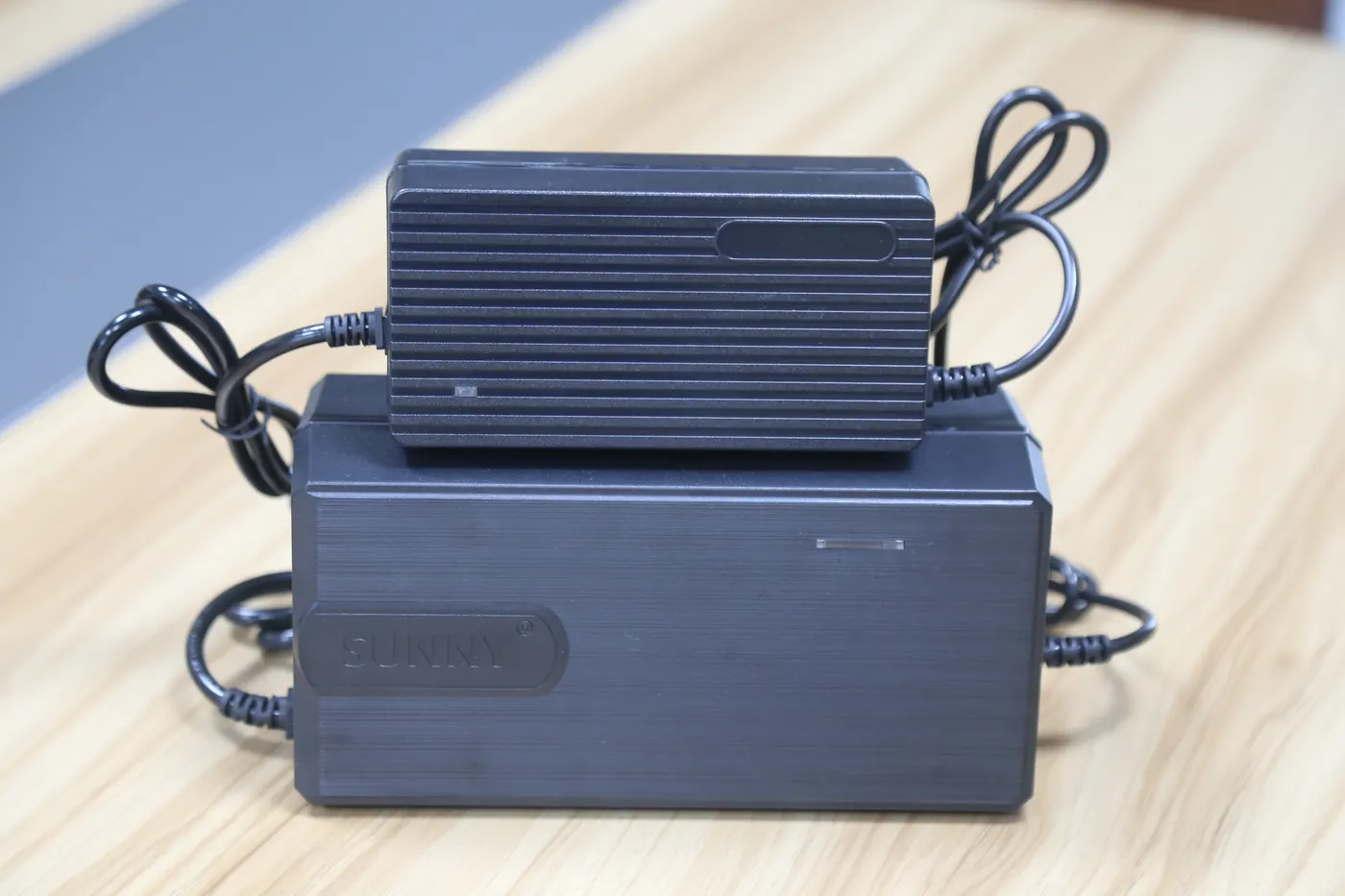
Sunny: There is no single rule. Some products use our own branded packaging, such as SUNNY or Yuxuan, while others use generic unbranded packaging. Many customers with larger order volumes use their own brands and packaging, which is OEM production. Overseas markets are relatively fragmented, and when the volume in each market is limited, insisting on a single in-house brand may not provide a suitable return on the investment.
Word of mouth and sample traceability can sometimes be more effective than active promotion. In 2023, a large Indonesian trading company called Pacific was preparing to enter the electric two-wheeler market. It had previously sold children’s vehicles, bicycles, toys, and other products. After entering the electric two-wheeler market, its main competitor was U-WINFLY. To learn from its competitor’s supply chain, Pacific purchased a U-WINFLY sample in the Indonesian market and brought the charger we had manufactured back to China. The company ultimately found us and began working with us, and the cooperation continues today.
Professor Ma Guilong once served as an honorary adviser to Fumei. He also visited the company to explain the history of electric two-wheeler development and toured the workshop to provide guidance.
By 2006 and 2007, Fumei had already established influence in vehicle OEM supply, and the industry’s main brands included Xipuer, Jianghe, and Fumei. In Tianjin, we supplied many second-tier and third-tier vehicle brands. We also supplied a large number of vehicle manufacturers in Zhejiang, including brands such as Qianlimao and Dabaisha at the time.
Before 2008, wholesalers serving the repair aftermarket would usually approach Fumei first when they came to Tianchang to source products. At the time, however, we focused on vehicle OEM supply and did not serve the low-price repair aftermarket. Only after the financial crisis did we begin entering repair channels in order to expand the market. Because we had already established a reputation for quality, major wholesalers from different provinces welcomed our entry into the repair aftermarket and were willing to accept prices RMB 2 or RMB 3 higher than those of our competitors. After that, many of the leading wholesalers in provinces across China began placing orders with us, and production volume increased rapidly.
In 2013 and 2014, we also worked with another company to establish a branch factory in Tianjin. The cooperation did not last long, and the two parties later separated. Around 2015, I returned to the local area and continued developing the business independently.
7. Market Positioning and Cost Logic
Ann: Many charger factories in Tianchang mainly serve the repair aftermarket. Why did you choose the route of vehicle OEM supply and exports? Where do you want Linjia’s quality and pricing to sit in the market, and how do you balance materials, quality, and cost?
Sunny: After we began developing export business in 2019, we clearly set our product direction: reduce the failure rate as much as possible. Competition in China’s domestic repair aftermarket often focuses on making the cost as low as possible and the appearance as attractive as possible. The repair aftermarket and the vehicle OEM and export markets therefore followed two different paths.
At one point, the Tianchang manufacturing cluster accounted for approximately 70% of China’s charger market, but most companies in Tianchang mainly served the repair aftermarket. Relatively few supplied vehicle manufacturers directly.
At the time, there were approximately eight well-known companies outside Tianchang that focused on vehicle OEM supply, including Xipuer, Jianghe, Mingkun, Juyuan, Jiangke, Chuanqi, Chongqing Lihua, and Teneng. I positioned my own company as the “ninth”: our product quality would match those eight companies, while our prices would sit between their brands and ordinary products made for Tianchang’s repair aftermarket.
Our costs are higher than those of many comparable products from Tianchang. However, Tianchang has a mature industrial chain and supporting supplier base, so we can still keep the overall cost within a reasonable range. The essence of this positioning is not to offer the lowest price, but to use higher-grade materials and deliver better quality at a competitive price within a mature supply-chain environment.
8. Certification Capabilities and the Smart Charger Concept
Ann: When customers in different countries have certification requirements, how do you combine order conditions, technical changes, and costs to plan the certification work? Looking further ahead, what would the smart charger you envision be like, and what problems could it solve for users?
Sunny: The main considerations are market demand and cost. Most customers in Southeast Asia do not require UL. Europe generally requires CE, and we already have the relevant CE capability. UL is mainly intended for the US market. Our current North American orders are mostly exported together with complete vehicles, so we may not need to obtain the certification independently for the time being.
If we develop US customers directly, we can obtain UL certification, but a single certification costs approximately RMB 50,000 to RMB 60,000. As long as the customer is willing to bear the cost and commit to stable orders, we can support the project technically. When the process is fast, certification takes approximately one month.
Similarly, in Tianjin we had contact with a customer that required KC certification and had demand for approximately 4,000 vehicles per month. Once the order is confirmed, certification can be completed for the product. The scope of certification must be confirmed separately for different products or product series.
To meet stricter certification requirements, a circuit generally needs EMC filtering to resist electromagnetic interference and power-factor-correction circuitry. Lithium battery products may also require communication protocols. Adding these designs increases costs significantly. For example, a product that originally cost approximately RMB 20 may cost RMB 40 or more after the relevant functions are added.
In the future, we could consider developing a smart charger. The device would automatically identify whether the connected battery is lead-acid or lithium, and it would identify the lithium battery type, voltage, current, and remaining charge. The user could view the status on a mobile phone. Using a 48 V 3 A lithium battery as an example, the system would identify the charging voltage, automatically calibrate the output, and gradually reduce the current after the state of charge approaches 95%, similar to the charging management used in electric vehicles.
A smart product could also add lighting, a clock, or other practical functions, upgrading it from a single low-value charger into a durable household appliance. The housing could use aluminum alloy to improve water resistance, vibration resistance, and impact resistance, while software and communications could provide additional protection functions. The product would then no longer compete only at low price points of a little over RMB 10 or RMB 20, but would instead be sold at a higher cost and with greater value.
If the product could be promoted through an existing industry mini-program and a network of repair shops, the potential market would be large. Suppose the platform had more than 200,000 stores and one-tenth of them sold the product. That would create approximately 20,000 sales outlets. If each outlet sold only one unit per month, monthly sales could still reach 20,000 units. Compared with low-price products for the repair aftermarket, this type of product would offer both higher profit and greater long-term value.
During the interview, the founder also discussed product concepts that combine charging with other household functions. However, if the goal were to create a true large mobile “power bank,” capacity and size would become constraints. A 48 V 12 Ah battery stores approximately 576 Wh, or nearly 0.6 kWh, so the mobile device would be relatively large.
9. Four Factors That Determine Charger Quality
Ann: When assessing the quality of a charger, which parts of the process deserve the most attention? Are there details that cannot be seen from the appearance or specification sheet but can still affect reliability, safety, and after-sales costs?
Sunny: These factors can be summarized in four areas.
The first is the circuit concept and layout design. A sound circuit schematic must come first, followed by well-designed PCB routing. A charger is a high-frequency circuit, and distributed capacitance and distributed inductance exist between its traces. These parasitic parameters are difficult to calculate completely in theory. If the routing is poorly designed, interference may still damage the circuit even when the individual components have high specifications. Some components used by the previous factory working with the Turkish customer were even larger than ours and appeared to use better materials, but the circuit configuration was unreasonable and many failures still occurred in practice. The circuit design and PCB routing are therefore the first factors determining the return rate and failure rate.
The second is raw materials. Engineers specify the required ratings for each capacitor, transformer, and power device. If purchasing substitutes smaller, thinner, or under-specified components to save money, material has been removed from the design. Even when the outside dimensions are identical, performance can differ completely between brands and internal materials, and some components carry overstated ratings. Major customers ask about the suppliers of key components during procurement because the source of the materials directly affects reliability.
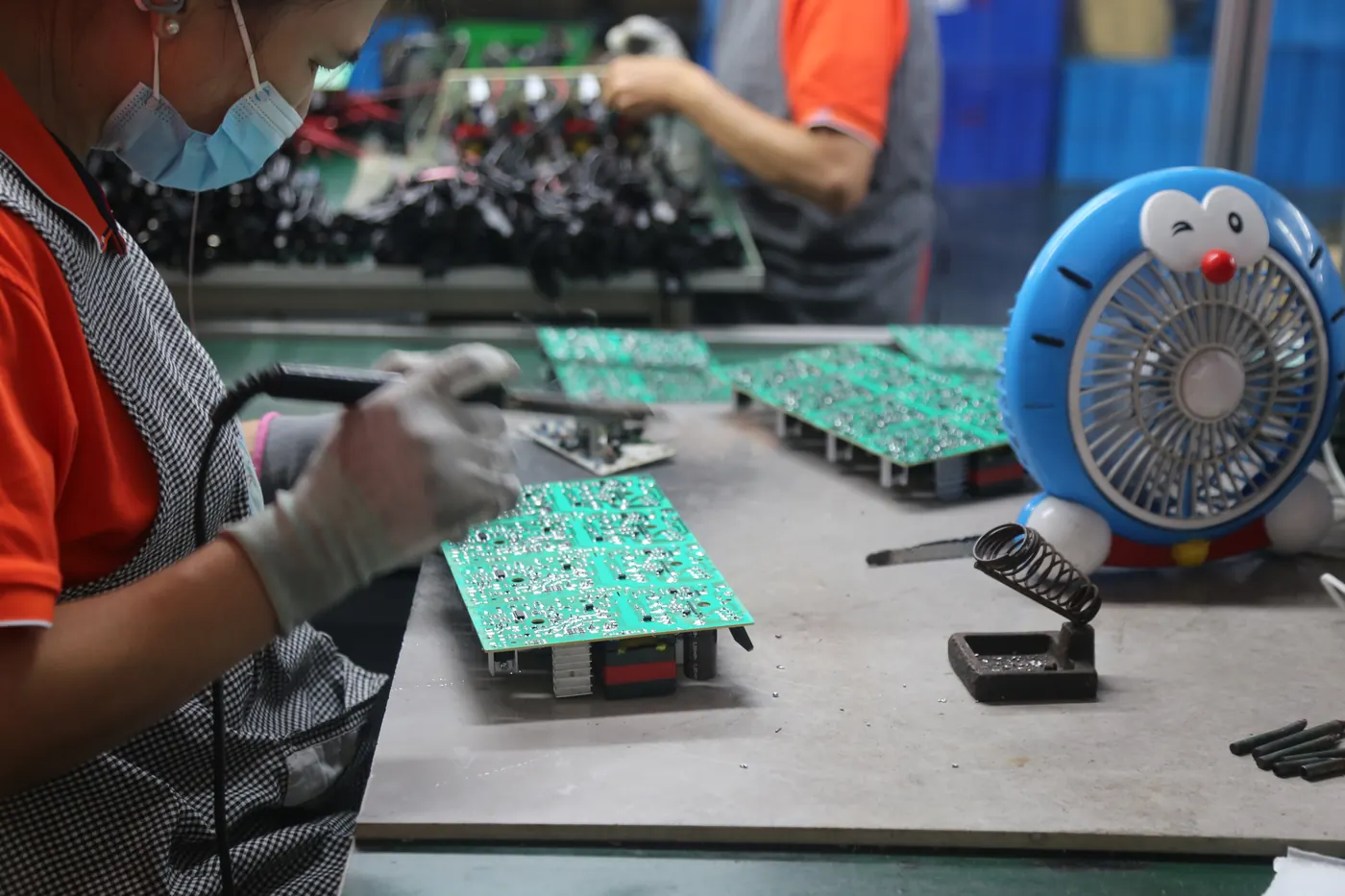
The third is production process control. After materials enter the factory, soldering, assembly, polarity verification, and testing must all be controlled. Cottage-industry production may check only whether the product powers on normally, making it easy to miss cold solder joints, defective solder joints, or capacitors installed with reversed polarity. Some capacitors installed with reversed polarity may still work immediately after power is applied, but they may rupture after five minutes of operation and can even force open the plastic housing. A defective solder joint may also remain hidden during a short test and appear only after prolonged heating and aging. Aging tests are therefore an important step for keeping potential problems in the factory instead of allowing them to reach the market.
The fourth is control of after-sales returns. China’s domestic repair aftermarket has a high rate of incorrect returns. A user may request a replacement because the charger feels hot, even though power devices naturally experience a certain temperature rise during operation. Out of 100 products returned to the factory, perhaps 50 are actually functioning properly. Once a product has been returned, the wires and housing may already have affected its suitability for resale even if the circuit board is normal, so the factory still has to inspect and process it again. Vehicle manufacturers generally test the unit on site before confirming whether it has genuinely failed, so incorrect returns are relatively less common. The sales channel’s ability to diagnose a product correctly also affects the final cost.
Flame-retardant materials are also very important. If a capacitor develops a fault, its safety vent may open and release sparks. If the plastic housing is not flame-retardant, the housing may ignite and then set fire to a seat cushion or clothing, causing a fire. With a flame-retardant housing and flame-retardant PCB, the flame is contained inside the enclosure and gradually extinguishes. Ordinary housing material costs a little over RMB 4,000 per metric ton, while the flame-retardant material used by Linjia costs a little over RMB 6,000 per metric ton. The additional cost per product may appear small, but these choices, which users cannot see, have a direct bearing on safety.
10. How the U-WINFLY Orders Grew and Why Material Choices Matter
Ann: How did the cooperation with U-WINFLY expand step by step from the initial trial order? Based on this project and other development experience, why do you insist on spending more on certain critical components rather than lowering material standards?
Sunny: U-WINFLY was initially supplied by other manufacturers and later asked us to produce a trial batch of more than 1,000 units. During the pandemic, production in the original supply chain was restricted, and the customer suddenly needed urgent replenishment. The customer asked how many days we would need to make 3,000 units. I said we could complete them in one day. The cooperation expanded from that point, and later we each handled half of the orders for a period.
As order volume increased, the return problem became more apparent. During our discussions, the buyer realized that I understood the technology and asked whether I could truly improve the product. I said that I could, but that the cost would have to increase. The buyer agreed. Because I had spent many years supplying vehicle manufacturers while at Fumei, I knew that OEM-grade quality requirements differed from those of low-price repair-market products, and I also knew which areas needed to be corrected.
I asked the Indonesian after-sales team to provide specific failure data and then modified the design and materials in a targeted way. For example, the transformer used both all-copper wire and a Grade-A magnetic core, meaning that both the wire and the core were selected at a higher grade. The supplier felt that using both at the same time was wasteful and suggested lowering at least one of the two. In the end, I asked the supplier to manufacture it according to my requirements. In practice, failures virtually disappeared after we made the product this way.
This approach is not always readily accepted by other companies in the Tianchang manufacturing cluster, because many companies respond first by trying to reduce costs, while our starting point is to protect quality.
We had a similar experience when developing our first-generation automatic shut-off product in 2018. The microcontroller circuit supplied by the design company was relatively complex and used a small capacitor costing approximately RMB 0.018 each. Around 50 companies initially used the design, but because the return rate was high, almost no one except us continued using it in the end. After studying the circuit, our technical department found that replacing this capacitor with a better-performing model costing approximately RMB 0.075 and making the replacement at five or six critical positions increased the total cost by about RMB 0.30 but made the circuit much more stable. We continued using this design until the relevant chip was discontinued.
This shows that when we make product decisions, we prioritize quality instead of first trying to remove a few tenths of a yuan from the cost.
11. Custom Components Development Validation and Mass Production
Ann: Which parts of a charger need to be customized to your own design, and which parts can use standard components? What tests and validation must a new design pass between the first sample and formal mass production?
Sunny: Not every component needs to be customized. The most important customized elements are the circuit-board design and the transformer. Each factory uses different circuit principles, PCB routing, and firmware. The internal winding method of the transformer also differs, and we give the transformer factory our own winding requirements for production.
Capacitors are generally not custom-tooled specifically for us. Instead, we select different materials and grades based on performance requirements. Multilayer capacitors, ceramic capacitors, CBB film capacitors, and electrolytic capacitors, for example, have different functions and performance. The improvement mentioned earlier did not involve “customizing a capacitor.” It involved replacing an underperforming type with one that was more suitable and of higher quality.
Many devices, including power MOSFETs, are standard parts. For example, one model uses a 5160 MOSFET. A competitor making a similar charger for a 48 V 12 Ah battery can purchase the same standard model. The main differences between companies are found in the circuit-board design, PCB routing, transformer, firmware, and housing structure.
Our own firmware is written into the chip. The chip supplier can pre-program the firmware to our requirements, or the factory can use its own equipment to program the chips in volume. Today, the chips are generally programmed by the supplier before delivery.
After a new design is completed, we first make and assemble samples and then conduct high-temperature and low-temperature tests. The samples are powered for more than 72 hours in the laboratory’s low-temperature chamber and heating oven to observe whether the PCB yellows or chars and whether any component overheats or fails. After the design passes laboratory validation, we conduct a pilot production run of 500 to 1,000 units for continued market validation. Only after we receive feedback and confirm that there are no problems do we move into formal mass production.
None of the six new products launched during the previous year experienced a design failure, because this process was followed strictly.
12. Personal and Company Timelines and Closing Summary
Ann: Finally, could you take us through your own career and the company’s development in chronological order? Looking back, how did the two main threads of Linjia’s product upgrades and market choices take shape step by step?
Sunny: My personal experience can be summarized as a timeline: I was born in 1970, graduated from technical secondary school in 1994, went to work in Changzhou in 1995, went to work in Shanghai in 1998, joined Fumei in 2001, began taking responsibility for charger projects in 2004, and returned to start my own business independently in 2016.
The company’s development timeline is as follows: Shengneng was established in 2013, Linjia was established in 2020, the factory building was purchased in 2024, and the company moved into Linjia’s new factory in 2025. The dates for establishing overseas factories, offices, and warehouses can be added later.
Product development can also be summarized as a single line: from two-stage charging to three-stage charging, multi-stage charging, automatic shut-off, pulse charging, timers, and charge-level displays, and then toward products with communications and intelligent identification. The market followed two paths. We chose the quality path required for vehicle OEM supply and exports, while the repair aftermarket focused more on low-price and appearance-based competition.